
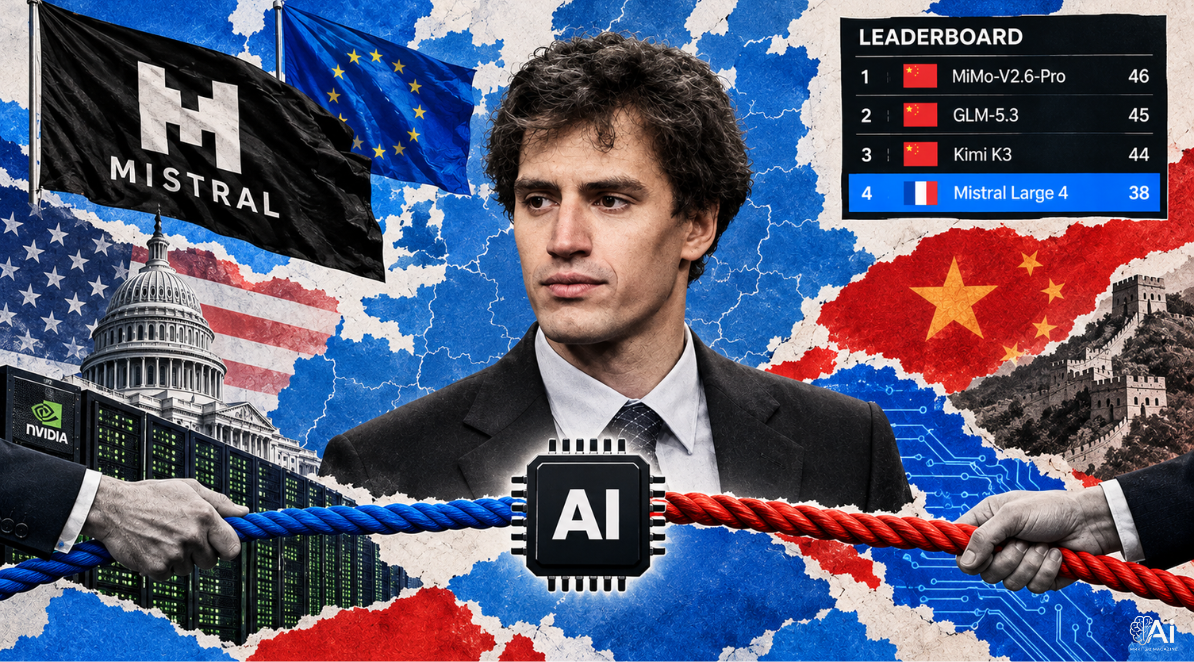
Most of the world’s frontier AI models are built in the United States or China. Arthur Mensch, co-founder and CEO of Mistral AI, argues Europe should not simply accept that.
On October 15 he published an essay warning that ceding frontier models to the United States and China would lock Europe “into a regime of economic dependence unprecedented in the history of civilizations.” He shared the same text on X and LinkedIn. The piece follows Anthropic’s June decision to cut off foreign access to its Fable 5 and Mythos 5 models after a US government order.
What Does Europe’s Existing Dependence Look Like?
Europe already ran this experiment with cloud and software. It built the applications and left the platforms to American companies. Twenty years later, European businesses pay more than €260 billion a year to those providers, Mensch wrote. Europe became, in his words, “the continent that consumes what others build.”
AI is different because the models themselves have owners. Those owners set the price, decide which uses are allowed, and can withdraw a version. Reports indicate a European sovereign AI push could cost €115 billion over ten years. Mensch’s counter is that the alternative is licences that eventually run into the trillions.
Why Does He Say Open Models Do Not Solve It?
Open weights let a company download a model and run it on its own servers. They do not give it any say over the next version, the licence terms, or whether the model continues to be released at all. “Dependence on others, even on their openness, is still dependence,” he wrote.
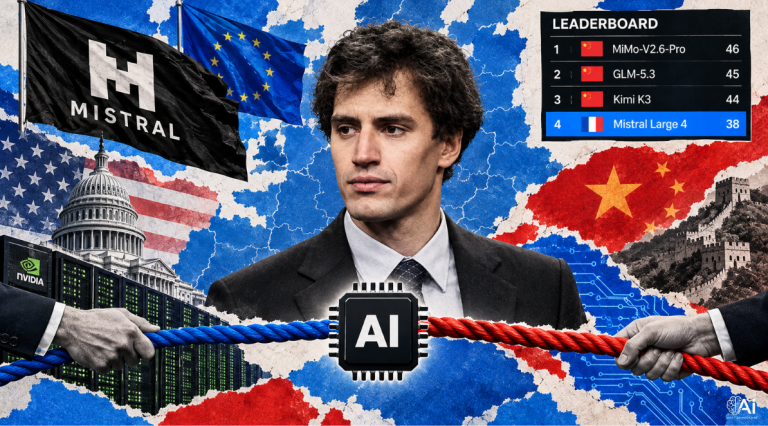
The people who train the strongest models have little reason to hand over the advantage. Mistral plans to increase its own compute capacity sixfold over the next year. With Large 4, the company has said it has significantly narrowed the gap with the best models in the world, using far less compute than its competitors.
Where Does Large 4 Sit on Independent Tests?
Artificial Analysis scores Mistral Large 4 at 38 on its Intelligence Index. That is the highest mark for any model built outside the United States and China. It is still behind seven Chinese open-weight models. Xiaomi’s MiMo-V2.6-Pro leads at 46.
Ecosia dropped Mistral this month and moved to open models, some of them Chinese. CEO Christian Kroll cited quality that lagged, servers that could not handle the load, costs that fell by roughly half, and questions about sovereignty given Mistral’s non-European investors. Mistral released Large 4 as a paid preview on October 6 and has said the weights will be public by the end of the month.
What the Latest Round Does Not Disclose
Mistral raised €3 billion on September 8 in a Series D led by Samsung Electronics. The post-money valuation sits above €21 billion. The company called it the largest equity round by a European technology firm.
Earlier reporting indicated the three founders held roughly 39 percent of the capital and more than half the votes through dual-class shares. Filings we examined previously show that SP preference shares carry ten votes each, concentrating control relative to economic ownership. The Series D announcement does not update those figures. Post-round percentages, current board composition, and the exact voting power retained by the founders are not public. ASML held about 11 percent at the end of 2025. The new round diluted every existing holder. The size of that dilution is not disclosed.
Where Policy Stands
Ursula von der Leyen said in her State of the European Union speech that “we do not need to be the ones who develop the frontier technology to be the ones who draw the greatest value from it.” On September 4, Jim Hagemann Snabe, the Commission’s special envoy for industrial AI, advised commissioners to prioritise adoption. Eurostat had reported that only one in five European businesses used AI at the end of last year.
European Commission tech chief Henna Virkkunen has said the bloc has not given up on frontier AI and is accelerating development of its own systems. The Commission hosts an Apply AI summit on November 17 focused on adoption in strategic industries.
In the UK, AI minister Kanishka Narayan said in September that Britain does not currently have the regulatory or energy position to build superintelligence: “it is illegal to do so.”
What To Watch Next
Three questions will decide whether Mensch’s warning lands or whether Europe settles into the role of tenant.
- Will Mistral’s founders still hold majority voting control after the Series D dilution, or has the dual-class structure finally been diluted away?
- When Large 4’s weights are released later this month, will they close the gap on the Chinese open models that currently sit ahead of it, or simply confirm the distance?
- At the Apply AI summit on November 17, will the Commission treat frontier capability as a live priority or treat adoption of foreign models as the finished strategy?
Author: Grace Sharp
See Also:
Is Mistral Large 4 the Best Open Model Outside China?