
The bill for CoreWeave’s AI build-out keeps climbing faster than almost anyone expected even six months ago. The company ended September with $46.9 billion of debt on its balance sheet, up from $35.1 billion at the end of June, and $66.2 billion once $19.3 billion of lease liabilities are included. On the November 10 earnings call, chief executive Michael Intrator said the company would stop selling unsecured bonds while they yield as much as they do now.
At a glance
CoreWeave’s debt
AI cloud company listed on Nasdaq as CRWV. Figures at September 30, 2026
- Who can claim
- $41.6bn is recourse to CoreWeave itself; $5.3bn sits in separate financing companies
- Main kinds
- Loans secured on GPUs and customer contracts, equipment financing, about $10bn of high-yield bonds and about $10.8bn of convertible notes
- Average cost
- 7.9%, down 2.5 points in a year
- Cash
- $4.1bn unrestricted; $6.4bn including restricted cash
- Ratings
- Moody’s Ba3, Fitch BB- and S&P B+, all below investment grade
- Next
- Interest of $1.05bn to $1.15bn guided for the fourth quarter
How Much Debt Does CoreWeave Have?
The figure that sits on the balance sheet is $46.9 billion. That is 3.3 times the $14.0 billion recorded a year earlier, according to the figures CoreWeave published on November 10. At the end of 2024 the total stood at $7.9 billion.
Leases add another $19.3 billion, mostly for data centres the company rents. Of the debt itself, $41.6 billion is recourse, so lenders can claim on CoreWeave if a payment is missed. The remaining $5.3 billion sits in separate financing companies whose lenders can take only the chips and contracts they paid for.
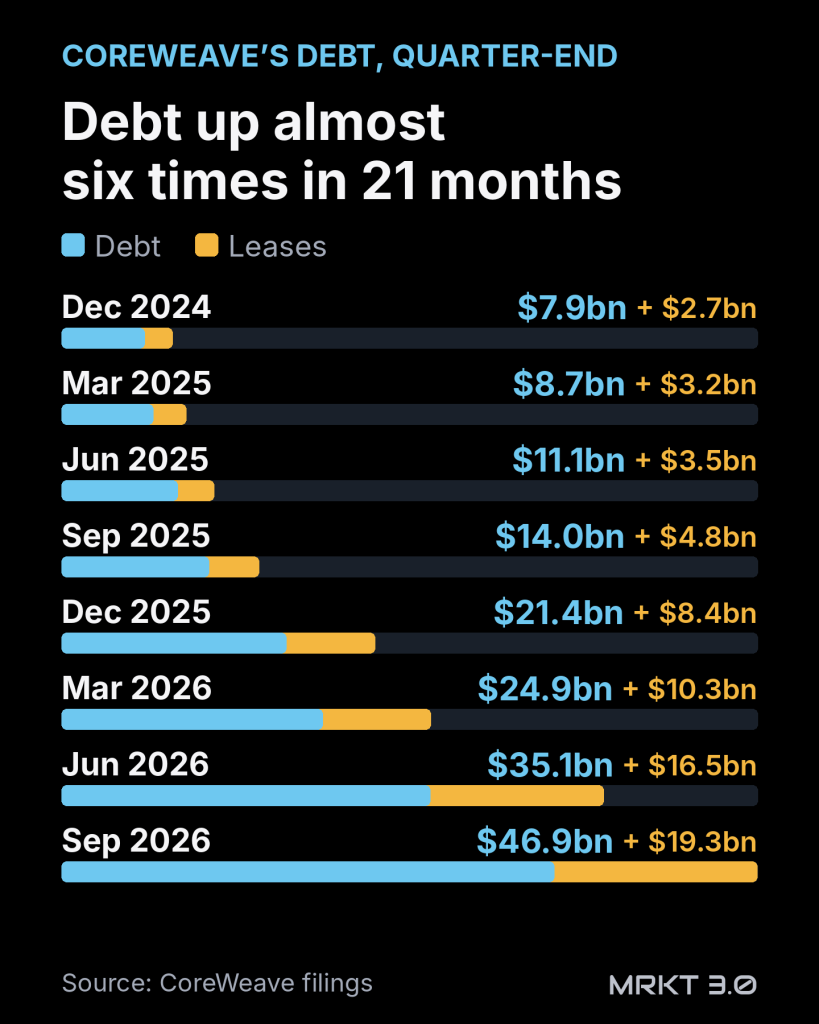
The pace has not slowed. In the third quarter alone the company raised $10.3 billion of new debt and repaid $2.3 billion, while capital spending reached $14.5 billion by its own measure. It expects $37 billion to $39 billion of capital spending in 2026. If it builds only for contracts already signed, 2027 will need about as much again.
Who Does CoreWeave Owe?
The largest single slice is loans from banks and private lenders secured on its NVIDIA chips, and most of the rest is bonds and convertible notes. Its latest full breakdown is the one listed in its June quarterly report. We have added the deals it announced in the third quarter.
| Kind of debt | Owed | Rate | Due |
|---|---|---|---|
| Chip-backed loans (DDTLs) | $13.6bn, plus a $2.6bn facility in August | About 7% to 15% | 2028 to 2032 |
| Bonds, unsecured | $10.0bn, including €2bn | 8.5% to 9.75% | 2030 to 2032 |
| Convertible notes | $6.6bn, plus $4.2bn in September | 1.75% to 2.875% | 2031 to 2033 |
| Equipment financing | $5.1bn | About 9% to 11% | 2026 to 2030 |
| Revolving credit | $1.2bn drawn in August | Floating | 2029 |
| Other, mainly Magnetar | $0.2bn | About 12% | 2029 |
| Total at June 30 | $35.6bn |
The delayed-draw term loans, or DDTLs, are the core of the model. Each is tied to customer contracts, and “the cash flow from those contracts pays interest and repays the principal over the contract term,” Intrator said. In August the company closed a $2.6 billion facility for shorter contracts at 5.5 points above SOFR.
The bonds rank behind those secured loans. In September CoreWeave also sold about $4.2 billion of convertible notes at 2.875%, which turn into shares at about $97.85. That is about twice the November 10 closing price of $48.73.
How Much Interest Does CoreWeave Pay?
The third-quarter bill was $846 million, up from $310 million a year earlier, and the company expects $1.05 billion to $1.15 billion in the fourth quarter. Interest has taken 22% to 27% of revenue in every quarter since the start of 2025. Debt grew faster than sales, but falling borrowing costs made up the difference.
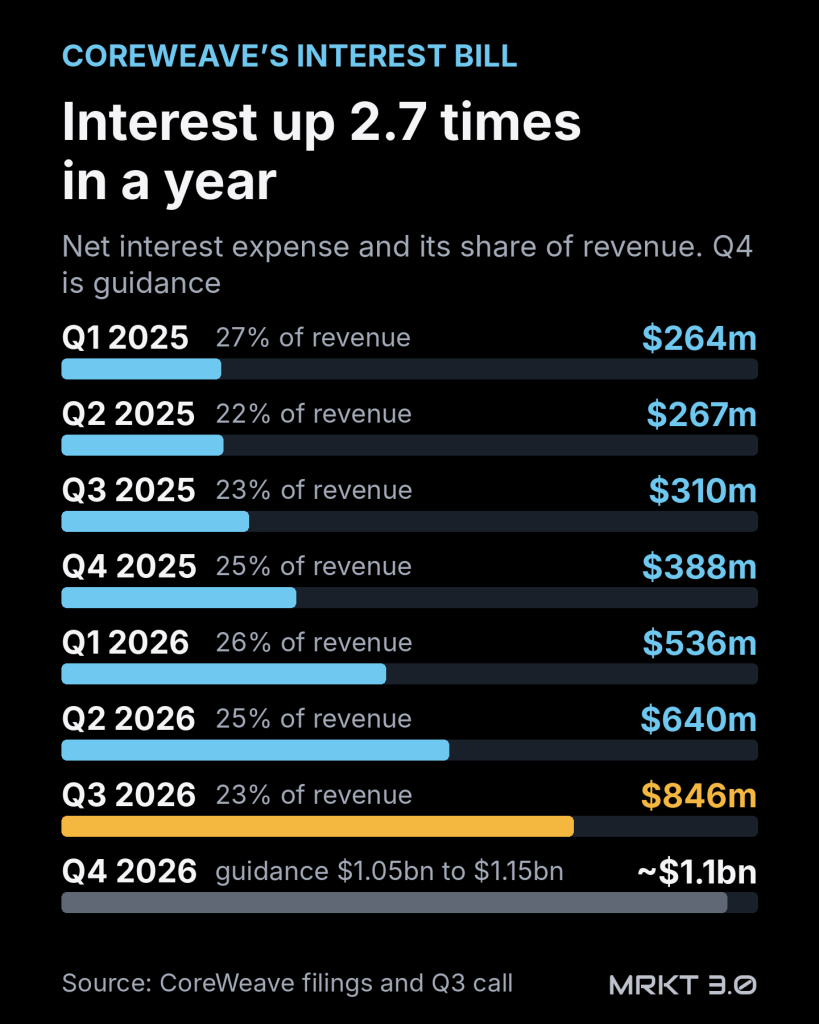
The interest bill is larger than the operating profit. Adjusted operating income was $379 million in the quarter, less than half the interest, and the net loss widened to $709 million from $110 million. Chief financial officer Nitin Agrawal stressed the trend instead, saying “adjusted operating income at $379 million nearly tripled from the second quarter, while interest expense rose about a third.”
Borrowing has become cheaper on average. The weighted average cost of the debt was 7.9% at the end of September, Intrator said. That is 2.5 points lower than a year earlier.
Why Are CoreWeave’s Bond Yields So High?
Bond buyers now want far more to hold the unsecured debt than when it was sold. The 9.625% notes due 2032, issued in June, yielded more than 16% by November 6. They now trade far below their face value.
Insurance against a default has got dearer too. CoreWeave’s credit default swaps were above 1,000 basis points on October 15, against 288 for Oracle. Reuters put the implied odds of a default within five years at nearly 63%, up from about 30% a year earlier.
The high yield leaves the coupons on existing bonds unchanged but sets the price of any new ones. The company itself is rated below investment grade, as it has been since Moody’s gave it a Ba3 rating in May 2025. Fitch rates it BB- and S&P rates it B+.
How Will CoreWeave Pay Back Its Debt?
Most of the money will come from customer contracts and more chip-backed loans. “Looking ahead, we will not use the unsecured debt market to fund our business at current yields. Nor do we need to,” Intrator said on the November 10 call.
Agrawal said the next DDTL would launch within weeks, with an investment-grade rating and a yield of 7% to 7.5%. He counts those loans, cash from operations and about $9 billion of customer prepayments and deposits due in the next three months. With all of that, he expects “to raise less than $5 billion in incremental parent-level capital through 2027.” That assumes it builds only for contracts it has already signed.
Shareholders may still pay part of the bill. CoreWeave has set up a programme to sell up to 35 million new shares on the market. By our calculation, they were worth about $1.7 billion at the November 10 close.
The shares rose more than 10% before the market opened on November 11, a day after CoreWeave raised its 2026 revenue forecast to $13 billion to $13.3 billion.
When Is CoreWeave’s Debt Due?
$4.4 billion of principal falls due in the second half of 2026 and $6.2 billion in 2027, according to the June 30 schedule, the latest one filed. Those payments are instalments on the chip-backed loans and equipment financing. No bond or convertible note is due before 2030.
| Period | Principal due |
|---|---|
| July to December 2026 | $4.4 billion |
| 2027 | $6.2 billion |
| 2028 | $4.4 billion |
| 2029 | $2.4 billion |
| 2030 | $3.2 billion |
| 2031 and later | $14.9 billion |
| Total at June 30 | $35.6 billion |
At September 30, $10.6 billion of the debt was classed as current, more than twice its $4.1 billion of unrestricted cash. Agrawal expects contracted cash flow from existing customers “to be sufficient to service and repay the debt.”
How Does CoreWeave’s Debt Compare With Its Rivals?
CoreWeave is by far the biggest borrower among the neoclouds, the companies that rent out NVIDIA chips. Nebius had $8.55 billion of debt at the end of June and reports its third quarter on November 12. CoreWeave also has the most power running, more than 1.7GW at September 30, and tops our neocloud ranking.
Oracle borrows far more, with $125.3 billion of senior unsecured borrowings at the end of August. It sold $10bn of new bonds on November 2 at coupons of 7% to 8.65%, about half what CoreWeave’s 2032 notes yield in the market.
Is CoreWeave Going Bankrupt?
The latest results show a business still growing fast. Revenue grew 168% to $3.66 billion in the third quarter, and its $132.5 billion backlog of signed contracts is almost three times its debt.
The risks are delivery and refinancing. Revenue depends on bringing data centres online on time, and its largest customer accounted for 36% of revenue in the second quarter. Intrator said he does not see “material risks to our 2027 deliveries.”
Sentiment can turn fast. Elon Musk warned in October that more than 200 neoclouds face “guppy-level death and consolidation.” For CoreWeave, the bond yields are the gauge to watch.
Author: Akos Szima
See Also:
Who Is Michael Intrator? The CoreWeave CEO Who Has Sold $975m of Its Stock
Did Elon Musk Just Call the End of the AI Debt Boom?
Neocloud IPO Tracker: Who Has Filed, Who Pulled Out, Who Is Next
How We Checked This:
We took debt, lease, interest and revenue figures from CoreWeave’s 10-K, its 10-Qs and its third-quarter results, and the quotes from the call transcript. Debt is the carrying value on the balance sheet; principal is a little higher, $35.6bn against $35.1bn at June 30, because of unamortised fees. Fourth-quarter 2025 interest is the full year minus the first nine months. The instrument and maturity tables use June 30, the latest full breakdown, plus deals announced since; rates are effective rates for loans and coupons for bonds and convertibles. Bond yields and default-swap levels come from the market data cited, and the share-sale value is our calculation. Download the data, with sources (CSV).
Change log: November 11, 2026, first published.
Frequently Asked Questions:
CoreWeave had $46.9 billion of debt on September 30, 2026, up from $35.1 billion on June 30. $41.6 billion of it is recourse to the company and $5.3 billion is non-recourse. Including $19.3 billion of lease liabilities, the total is $66.2 billion.
No. Moody’s, Fitch and S&P rate the company below investment grade, at Ba3, BB- and B+. Some of its chip-backed loan facilities carry investment-grade ratings, and it expects the next one to as well.
Its net interest expense was $846 million in the third quarter of 2026 and $2.02 billion in the first nine months. It expects $1.05 billion to $1.15 billion in the fourth quarter.
This article is based on SEC filings, the November 10 earnings call and published market data, and is not investment advice. MRKT 3.0 has no commercial relationship with CoreWeave.