
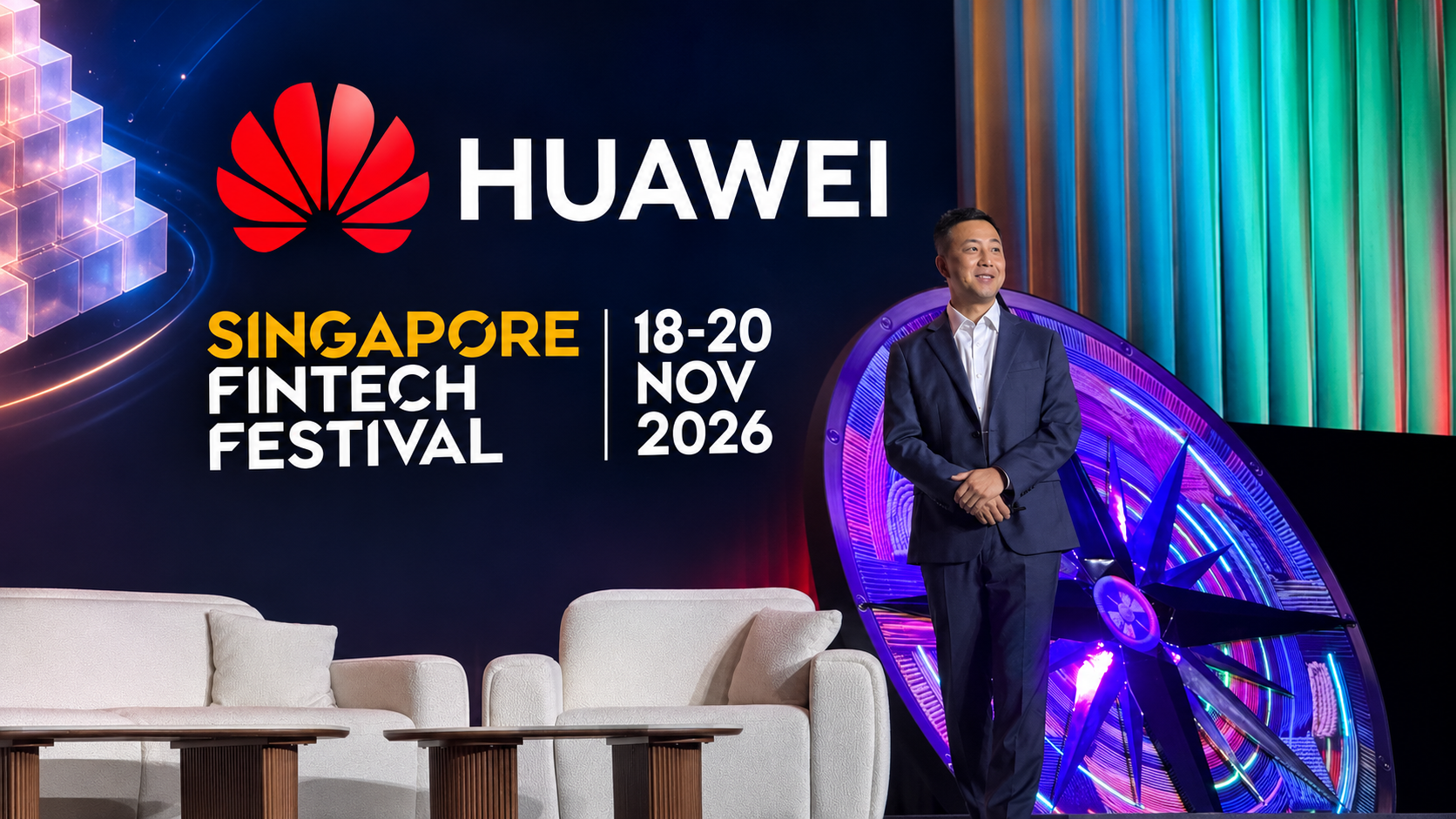
Banks keep announcing AI projects while their day-to-day work stays largely unchanged. At the Singapore FinTech Festival 2026, Jason Cao, CEO of Huawei‘s Digital Finance unit, asked whether institutions were building lasting capabilities or simply collecting isolated experiments. In his keynote, Owning Your Intelligence: From AI Adoption to AI at Scale, on November 19, he argued that enterprise AI demands a change in infrastructure, engineering, security and control.
Cao told the audience that banks had made real progress with AI pilots, but few had managed to embed AI across the whole organisation. “Are we aiming to build a pilots museum, or do we really want to change the bank?” he asked.
The Challenges of Scaling Enterprise AI
At the start of Cao’s keynote, he identified three recurring challenges banks face when implementing enterprise AI: scalability, security and sustainability. Some institutions, he said, had also added sovereignty to the mix.
Scalability asks whether AI can move beyond individual teams and become part of wider operations. Security concerns whether AI-driven decisions and actions can be trusted, traced and audited. Sustainability covers the rising cost of running systems as token consumption grows. Cao described banks whose technology budgets were already under pressure from expanded AI use.
Sovereignty is another point to consider. Institutions must decide how much control they retain over their data, models, computing infrastructure and the systems through which AI operates. In Europe, this issue is attracting increasing attention. In November 2026, the European Central Bank’s Financial Stability Review identified third-party dependencies, data confidentiality and model reliability among the principal risks of AI adoption in finance. It also highlighted the concentration of cloud and generative AI services among a small number of providers.
The analysis reinforces the question Cao raised: how can institutions expand AI use without becoming excessively dependent on the companies supplying it?
China’s Approach to AI Commercialisation
Cao pointed to China as a market that has moved beyond just experimenting with enterprise AI. He attributed the progress to a strong commercialisation culture, widespread use of open-source models and an emphasis on engineering.
Describing the accessibility of open-source AI in China, Cao compared it to an everyday utility. “In China… open-source AI is like tap water. It means everybody can use it.”
In March 2026, China’s National Data Administration reported that daily AI token consumption had exceeded 140 trillion, compared with approximately 100 billion in early 2024. That is growth of more than 1,000 times in just over two years. OpenRouter’s rankings on November 18, 2026 showed eight of the platform’s ten most-used models by token volume were developed by Chinese companies, including models from DeepSeek, Tencent, Z.ai, StepFun, Xiaomi and MiniMax. The figures reflect significant adoption on that platform, though they do not represent the entire global market.
Cao argued that open models have lowered barriers to adoption, while engineering capabilities let organisations make better use of limited computing resources. He described AI in China as becoming widely accessible, with the emphasis on getting models into practical use rather than treating them as experimental technology.
What Are Chinese Banks Doing Differently?
Cao identified four developments in Chinese banking: modernising legacy infrastructure, adopting hybrid AI environments, building enterprise-level AI architecture and integrating AI into core business operations.
He pointed to China Merchants Bank as an example, saying its daily token consumption had exceeded 80 billion by September.
Cao explained that Chinese banks moving towards cloud-based microservices were better positioned to integrate AI across their operations. He also advocated hybrid infrastructure, combining public cloud services with on-premises deployment where security and data control matter.
When Customers Have Their Own AI Agents
Customers are beginning to use their own AI systems to compare products and carry out tasks. Cao posed a challenge: “If a customer’s AI tells them that another bank has a better product… what should we do?”
Historically, banks competed through products, branch networks and digital experiences. The next stage, he suggested, may depend on how effectively institutions recognise customer intentions and respond to requests made through external AI agents.
Banks will also need to consider how they interact with customers’ AI systems and provide access to relevant, customer-authorised information through secure channels.
Building Intelligence Rather Than Simply Consuming It
Cao described a bank run through two super agents, one serving customers and one serving employees. Each would coordinate smaller agents handling specific tasks, drawing on the bank’s own data, knowledge and staff expertise.
To build that, he outlined three areas for investment: agent factories, token factories, and data and knowledge factories. These were presented as ways to standardise the development, deployment and management of AI across an enterprise. He also emphasised open architecture, standardised engineering and treating data and knowledge as shared assets across the organisation.
The wider objective is to make data, knowledge and engineering capabilities reusable across departments, so institutions can scale AI without repeatedly building individual solutions from scratch.
For financial institutions, this suggests a more demanding way to measure progress. The number of AI pilots, models or tokens consumed says relatively little about whether a bank has transformed its operations or improved its competitive position.
Cao’s warning was that many banks are mistaking activity for capability. As he put it: “We think we are using AI, but we are not building and owning the intelligence.”
Author: Grace Sharp