


Xlinks wants to build a 1,500MW AI computing campus in North Devon, but has yet to submit a planning application. In Northumberland, QTS has begun enabling works on another major development, while five of the ten projects examined are in Scotland, where a parliamentary vote has added uncertainty to planning decisions.
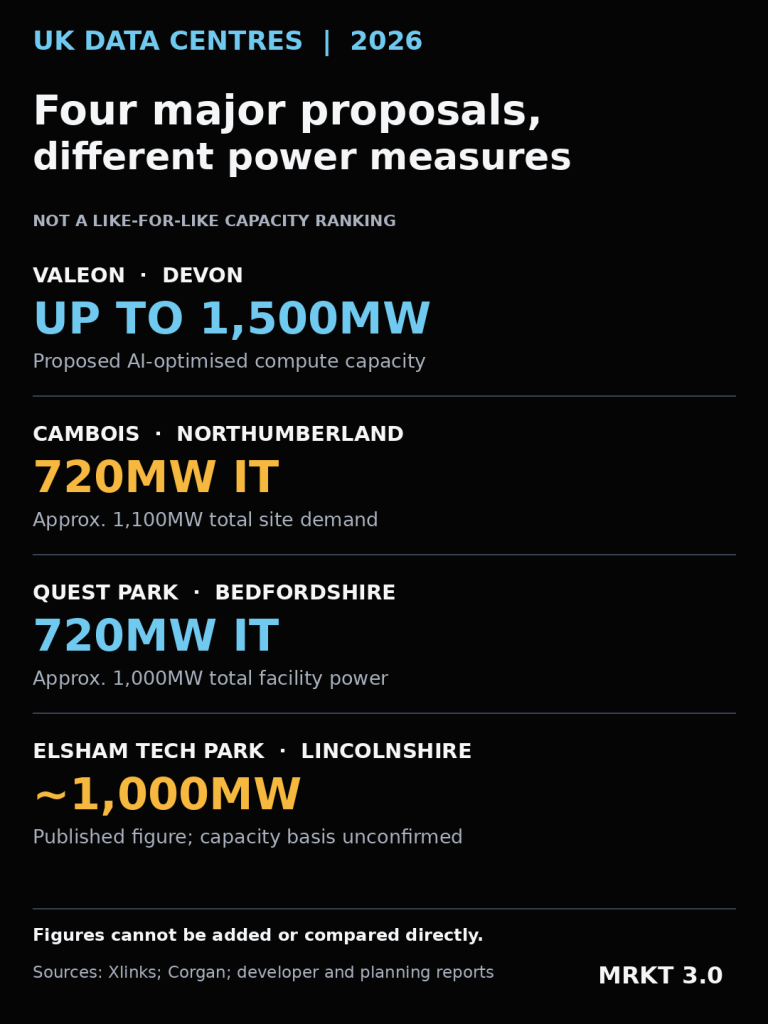
These are among the largest proposed data centre developments in the UK, although their published capacity figures are not always directly comparable. Some developers report power available to servers, while others disclose total electricity demand or grid connections.
We examined ten major proposals, looking at their reported capacity, investment plans and progress towards construction.
| Project | Published capacity | Capacity type | Status |
|---|---|---|---|
| Valeon, Devon (Xlinks) | Up to 1,500MW | Proposed AI compute capacity | Consultation |
| Cambois, Northumberland (QTS) | 720MW IT; 1,100MW total | IT and site power | Enabling works |
| Elsham Tech Park, Lincolnshire | About 1,000MW | Proposed IT capacity | Conditional planning approval |
| Quest Park, Bedfordshire | 720MW IT; 1,000MW total | IT and facility power | National planning process |
| Cottam, Nottinghamshire | 1,000MW | Proposed campus capacity | Early-stage plans |
| Chapelcross, Dumfries and Galloway | Up to 1,000MW | Proposed campus capacity | Application submitted |
| Blackdog, Aberdeenshire | 600MW | Published figure; basis unresolved | Announced / pre-application |
| Cato, Fife | 600MW | Proposed power capacity | Application submitted |
| Ravenscraig, Motherwell | 550MW | Proposed grid capacity | Planning |
| Rufus, East Ayrshire | 540MW | Maximum electrical demand | Pre-application |
Projects Reporting 1GW or More
Six of the developments examined have published capacity figures of at least 1,000MW, although the figures refer to different measurements. Valeon reports proposed AI computing capacity, while other developers disclose total facility power or indicative campus demand.
Valeon, Alverdiscott: Up to 1,500MW
Xlinks, the company behind the Morocco-to-UK power cable project that lost government support, now wants to develop up to 1.5GW of AI computing capacity near Great Torrington in Devon.
The proposed Valeon campus would include a 1.8GW battery storage facility. Xlinks estimates the investment at between £12.2 billion and £13.8 billion.
The company has extended its public consultation and plans to submit a planning application to Torridge District Council in 2027.
QTS, Cambois: 720MW IT, 1,100MW Total Power
QTS, owned by funds managed by Blackstone, plans ten data centre buildings on the former Blyth power station site in Northumberland.
Each building would provide approximately 72MW of IT capacity, giving the campus 720MW of planned computing capacity. Total electricity demand is estimated at around 1,100MW.
Enabling works began in October 2025, making Cambois one of the most advanced developments examined. The £10 billion project could be completed in phases through to 2035.
The site is also within the North East AI Growth Zone, part of the government’s effort to encourage AI infrastructure investment outside London.
Elsham Tech Park, North Lincolnshire: About 1,000MW
North Lincolnshire Council‘s planning committee resolved to approve the proposed Elsham Tech Park in March 2026, subject to outstanding planning requirements. The development would occupy approximately 176 hectares of farmland near Elsham Wolds and contain up to 15 data halls.
The project is linked to Greystoke Land, whose directors are also associated with the nearby Humber Tech Park development.
The proposed campus would provide up to 1,000MW of IT capacity, according to the developer’s planning material, making it one of the largest proposed computing facilities in Britain.
Quest Park, Bedfordshire: 720MW IT, 1,000MW Total Power
Questpit proposes four data centre buildings at Stewartby, on a former quarry site in Bedfordshire.
The project would provide approximately 720MW of IT capacity, with total electricity demand of around 1,000MW. It also includes plans for an on-site gas-fired power plant, with investment estimated at £9.3 billion.
In June, ministers moved the development into the nationally significant infrastructure planning process. That puts the final decision at national rather than local level, but the project still requires development consent.
Cottam, Nottinghamshire: 1,000MW
The former Cottam coal power station could become a major data centre campus, potentially supplied by small modular nuclear reactors.
EDF UK, Holtec International and Tritax Management announced plans for a 1GW development in September 2025.
The partners have signed a memorandum of understanding, but the project remains at an early stage. Neither the data centre nor the proposed nuclear generation has reached construction.
Chapelcross, Dumfries and Galloway: Up to 1,000MW
CX Tech, formerly CX Power, plans a data centre campus at Chapelcross, the former nuclear power station near Annan.
In September 2026, the developer submitted an application for planning permission in principle for eight buildings, with potential capacity of up to 1GW.
The estimated investment is £16.5 billion.
The proposal has attracted considerable local opposition, with concerns about electricity demand, environmental effects and the scale of development. Its progress also depends on Scotland’s evolving approach to hyperscale data centre planning.
Projects Reporting 500MW to 999MW
Four other proposals have published capacity figures between 500MW and 999MW. These developments are at different stages of planning, and their figures also include a mixture of proposed facility demand and grid capacity.
Blackdog, Aberdeenshire: 600MW
Ashfield Land and TechRE plan a campus on a former Ministry of Defence firing range north of Aberdeen.
The developers have outlined an initial 600MW development, with renewable energy infrastructure forming part of the wider proposal.
The site previously received planning permission in principle for mixed-use development, including business and industrial uses. However, planning consent for the proposed data centre itself has not been independently established. The published 600MW figure has not been established as a measure of IT capacity.
Cato, Fife: 600MW
ILI Group submitted plans for a £5 billion AI data centre near Auchtertool in June 2026.
The proposed 600MW campus is part of the company’s wider Stoics programme, covering three major Scottish data centre developments.
ILI Group intends to combine computing infrastructure with renewable energy resources. Cato remains subject to planning approval.
Ravenscraig, Motherwell: 550MW
Apatura wants to redevelop part of the former Ravenscraig steelworks into an AI data centre campus.
The company has identified 550MW of proposed grid connections, expected to become available by 2030.
That figure describes electricity connection capacity, not necessarily the power available to computing equipment. The development remains in planning, with its future timetable dependent on consent and infrastructure delivery.
Rufus, East Ayrshire: 540MW
ILI Group’s proposed Rufus campus is located at Hurlford in East Ayrshire.
It forms part of the company’s Stoics data centre programme, alongside Cato and Aurelius.
The project has a published maximum electrical demand of approximately 540MW but remains at the pre-application stage. Its final configuration and construction timetable have yet to be confirmed.
Which Other Major UK Data Centre Projects Are Planned?
Several other developments have reported capacity figures approaching 500MW, including Drumshangie in North Lanarkshire, Horsey Level in Somerset, Tilbury in Essex and Stellium’s Cobalt Park in North Tyneside.
In London, Digital Reef proposes a large campus at East Havering, with a published IT capacity figure of up to 490MW.
Teesworks in Redcar also has outline permission for a substantial data centre development, although no directly comparable megawatt figure has been established.
These projects illustrate why a definitive national ranking remains difficult. Developers publish different measurements, and some major schemes have not disclosed enough information to support a reliable comparison.
What Is the Largest Operational Data Centre in the UK?
Vantage Data Centers’ CWL1 campus in Newport, South Wales, is among the country’s largest established data centre campuses.
Data Centre Tracker lists the campus at approximately 148MW, although that figure should not be interpreted as independently verified live IT load.
Other large operational facilities include VIRTUS campuses near Heathrow, at Slough and Stockley Park.
CWL1 sits within the South Wales AI Growth Zone. In August, Nebius committed to capacity in the region.
Britain’s existing data centre industry remains heavily concentrated around London, part of Europe’s FLAP-D network of major data centre markets.
Why Are So Few of Britain’s Biggest Data Centres Being Built?
Electricity access remains one of the main obstacles facing proposed developments. In written evidence to Parliament, the National Energy System Operator (NESO) reported approximately 72.8GW of data centre connection requests across Great Britain’s transmission and distribution networks, including nearly 59GW at transmission level.
Its 2025 forecast, by comparison, anticipated approximately 5.2GW of connected data centre capacity by 2030.
These figures measure different things. A grid connection request is not an operating data centre, and some projects in the queue may never be developed. Nevertheless, the size of the queue illustrates the difficulty developers face in securing electricity for major new campuses.
The consequences are already visible. OpenAI reportedly paused its Stargate UK plans in April amid concerns over energy costs and regulation. Microsoft also withdrew from Nscale’s proposed Loughton site after the expected grid connection date moved into the 2030s.
The government’s data centre covenant proposes giving faster access to projects that meet requirements relating to employment, local investment and resource use.
But electricity is not the only obstacle. Large developments also need planning permission, financing, suitable sites and customers willing to commit to the capacity being proposed.
How Could Scotland’s Planning Rules Affect These Projects?
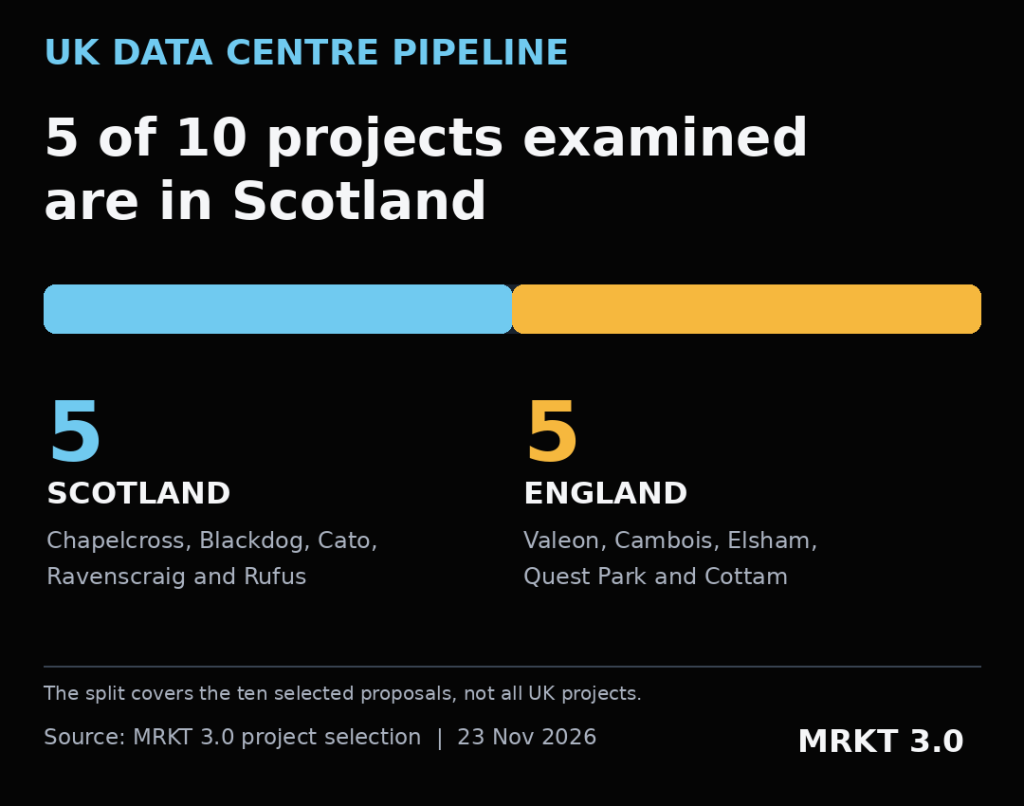
Five of the ten developments examined are in Scotland, where new environmental requirements have added uncertainty to the planning process.
On September 16, the Scottish Parliament supported a motion calling for stronger environmental assessment and national guidance before decisions on hyperscale data centres proceed.
The vote did not itself impose a legally binding blanket moratorium. However, the Scottish Government has introduced additional environmental assessment requirements for large developments and committed to producing national planning guidance.
That creates uncertainty for proposed campuses including Chapelcross, Blackdog, Cato, Ravenscraig and Rufus, although their planning circumstances differ.
England has taken another route for some major proposals. The government has brought Quest Park into the national planning system, as it has Wapseys Wood in Buckinghamshire.
Local opposition is also affecting the debate. MRKT 3.0 has previously examined campaigns against UK data centre development, including concerns about land use, electricity demand, water and environmental impacts.
The next important tests for Britain’s proposed campuses will be planning decisions, confirmed grid connection dates and evidence of financing and customer commitments. Those developments will provide a clearer picture of how much of the announced pipeline is likely to be built.
Author: Akos Szima
See Also:
Largest Data Centres in the World: The Gigawatt Club (2026)
What Country in Europe Has the Most Data Centres?
The Biggest Data Centre Operators in the Nordics, Ranked (2026)
How We Checked This:
This article compares ten major UK data centre proposals identified through publicly available developer announcements, planning material, government records and industry research. The capacities reported are not all directly comparable. IT capacity refers to the electricity used by computing equipment, while facility demand includes other power requirements, such as cooling. Grid connection figures refer to requested or allocated electricity supply, which may differ from the eventual operating load. We have therefore not calculated a combined capacity total or presented these projects as a definitive national ranking.
Published planning statuses and development details reflect information available up to November 23, 2026.
Frequently Asked Questions:
Xlinks’ proposed Valeon campus in North Devon has one of the largest published capacity figures, at up to 1,500MW of AI computing capacity. The project remains at the consultation stage.
QTS has begun enabling works at its Cambois development in Northumberland. Other major projects, including Elsham Tech Park and Quest Park, are at different stages of the planning and approval process.
NESO identified approximately 72.8GW of data centre grid connection requests in data gathered in 2025. That is not a measure of confirmed development or operational computing capacity, and many proposals may not proceed.