
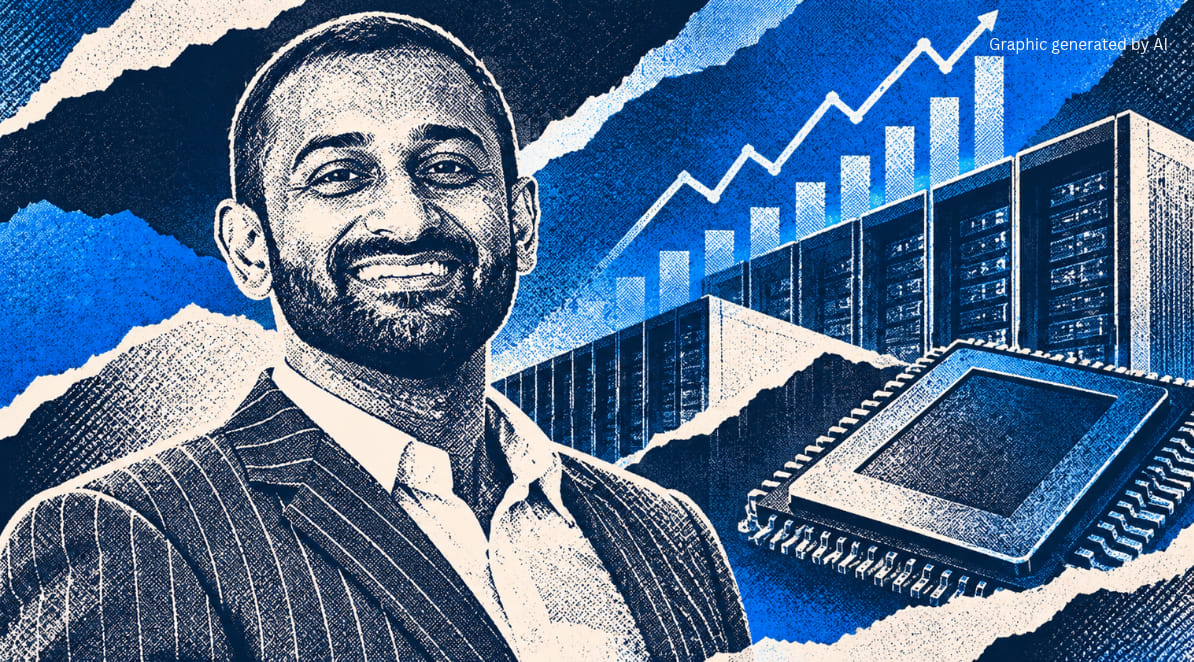
At NVIDIA‘s GTC conference in March 2026, Jensen Huang admitted that he had understated the efficiency gains of his company’s technology. The person who had challenged his figures was Dylan Patel, the founder of semiconductor research firm SemiAnalysis.
Six years after starting the business on his own, Patel counts some of the world’s largest technology companies among his customers. His research is used by chip manufacturers, cloud providers and investors, and SemiAnalysis expects to generate approximately $100 million in revenue this year.
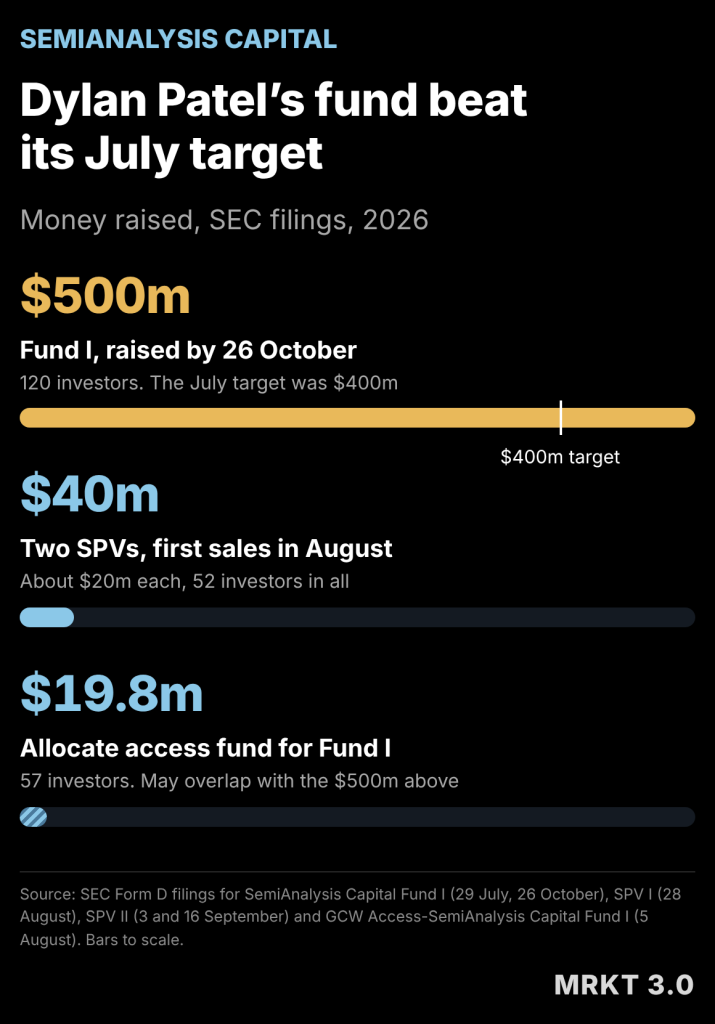
Patel is increasingly investing in the industry he covers. Regulatory filings from October show that his venture fund has raised $500 million from 120 investors, while some of the companies he backs also appear in SemiAnalysis’s technical assessments.
| Dylan Patel | At a Glance |
|---|---|
| Role | Founder and CEO of SemiAnalysis |
| Founded | SemiAnalysis in 2020 |
| Venture fund | SemiAnalysis Capital Fund I |
| Capital raised | $500 million from 120 investors |
| Reported investments | Approximately 20 start-ups, including Thinking Machines Lab, Prime Intellect and Enfabrica |
| Board appointments | Positron, since September 2026 |
| Known for | InferenceX benchmarks and ClusterMAX cloud ratings |
Who Is Dylan Patel?
Patel’s interest in semiconductors began in online hardware communities. According to a September 2026 profile, he began participating in online discussions under a pseudonym at the age of 12, later becoming active on Reddit under the username dylan522p.
He founded SemiAnalysis in 2020, turning his knowledge of semiconductor technology and supply chains into a subscription-based research business. The pandemic, which exposed the world’s dependence on semiconductor manufacturing, provided a growing audience for his work.
Patel bootstrapped the firm without outside investment. What started as a solo venture now covers everything from semiconductor manufacturing and supply chains to data centres and the AI models that run on them.
By October 2026, SemiAnalysis had grown to 115 people, Patel said during a conference discussion.
What Is SemiAnalysis?
SemiAnalysis sells research, proprietary data and cost models to chip manufacturers, cloud providers, AI laboratories and investors. Its newsletter, available through free and paid subscriptions, is only one part of the business.
The company expects approximately $100 million in revenue in 2026, according to reports. In September, it also acquired Citrini Research, a research firm covering investment themes and technological developments.
Many of the companies SemiAnalysis writes about also pay for its research. Most of the world’s ten largest companies are among its top 15 customers.
Two of its best-known research products are InferenceX and ClusterMAX. InferenceX measures the performance of AI inference hardware and software, while ClusterMAX assesses cloud providers on their technical and operational capabilities.
For companies deciding which chips to purchase or where to run their AI workloads, these assessments offer an independent point of comparison with manufacturers’ own performance claims.
Why Did Jensen Huang Quote Dylan Patel?
At NVIDIA’s GTC conference in March 2026, Huang said Patel had accused him of sandbagging, or understating the performance improvements of NVIDIA’s technology. Huang had presented a 35-fold efficiency improvement, while SemiAnalysis had reported a 50-fold improvement.
“And he’s not wrong,” Huang added.
The benchmark behind the comparison was InferenceX, which SemiAnalysis launched in October 2025 under its original name, InferenceMAX. The open-source project runs nightly tests to track how changes in hardware and software affect inference performance. Both NVIDIA and AMD contribute hardware and engineering resources.
The firm has also published less favourable assessments of the companies it benchmarks. Days after GTC, Patel published a bearish assessment of NVIDIA’s upcoming Rubin chip.
Earlier, a December 2024 training benchmark found that AMD’s MI300X fell short of the advantages its specifications suggested it should have over NVIDIA’s competing hardware.
What Has Dylan Patel Said About Jensen Huang’s Return to NVIDIA?
Huang’s reinstatement as NVIDIA’s chief executive this month followed warnings from Patel about what the semiconductor industry could look like without him.
When Huang resigned on November 12, SemiAnalysis argued that “Nvidia doesn’t function without Jensen”.
Speaking on the TBPN podcast, Patel suggested that Google and AMD could gain market share in Huang’s absence, pointing to the increasingly competitive performance of rival AI chips.
“We run benchmarks on them on open source models every night. They’re just as good as Nvidia,” he said of Google’s TPU chips.
Three days later, responding to reports that Huang was considering a comeback, Patel wrote on X:
NVIDIA announced Huang’s reinstatement as president, chief executive and board director on November 23.
Although Patel appeared to welcome the prospect of Huang’s return, it remains unclear whether the reinstatement has changed his assessment of the competitive threats facing NVIDIA.
What Is SemiAnalysis Capital?
Patel has expanded his commercial interests beyond research through SemiAnalysis Capital, a venture fund investing in the technology industry.
The fund first filed with the US Securities and Exchange Commission (SEC) in July 2026, with an initial fundraising target of $400 million. An amended filing on October 26 shows that SemiAnalysis Capital Fund I had raised $500 million from 120 investors. Patel manages the fund’s general partner.
One of its publicly announced investments is Positron, a US developer of AI inference chips competing in a market dominated by NVIDIA.
In September, SemiAnalysis Capital co-led Positron’s $375 million Series C, the first tranche of a financing announced at up to $875 million and a $5 billion valuation. Patel also joined the company’s board.
The investment gives Patel a financial interest in the development of alternative inference hardware, an area SemiAnalysis has covered extensively through its research.
Does Dylan Patel Invest in Companies SemiAnalysis Rates?
Patel holds stakes in approximately 20 start-ups, including Thinking Machines Lab and semiconductor networking company Enfabrica.
Some of his investments are in companies that SemiAnalysis assesses directly.
Fluidstack provides one of the clearest examples. In November 2025, SemiAnalysis’s ClusterMAX 2.0 cloud ratings described the British-founded neocloud as “the only cloud to debut in our Gold tier.” In September 2026, Forbes estimated that an investment vehicle associated with Patel and SemiAnalysis president Doug O’Laughlin could hold approximately $140 million worth of Fluidstack shares.
The estimate concerns the vehicle’s potential holding rather than Patel’s personal ownership. The public portions of the ClusterMAX reports do not disclose the holding, and MRKT 3.0 could not establish when the vehicle acquired its shares.
Fluidstack subsequently moved from Gold to the Unavailable category in September’s ClusterMAX 3.0. SemiAnalysis attributed the change to Fluidstack’s decision to move away from managed clusters towards large-scale TPU deployments. The new classification reflected a change in Fluidstack’s business rather than a conventional performance downgrade.
Patel has pointed to Prime Intellect, another company he backs, as evidence that his investments receive no preferential treatment. The company received a Bronze rating, according to The Information. Its co-founder, Vincent Weisser, also told the publication that Patel acts independently of his financial interests.
ClusterMAX 2.0 nevertheless described Prime Intellect as “our favourite non-neocloud startup that happens to be a neocloud too.”
How Does SemiAnalysis Handle Conflicts of Interest?
SemiAnalysis has established compliance rules governing its research activities and staff investments.
Its published compliance policy requires pre-approval for staff trades and restricts trading in hundreds of semiconductor and AI securities. Its institutional research is also subject to supervisory review.
The company states that it does not provide investment recommendations or securities ratings. Its ClusterMAX assessments evaluate cloud services rather than the investment merits of the companies providing them.
The publicly available policy does not, however, specify how the firm manages potential conflicts arising from private investments in companies it covers.
Patel argues that SemiAnalysis’s willingness to publish unfavourable research about its own customers demonstrates its independence.
“Hyperscalers are my biggest customers,” he said in September. “And yet we’ll post negatively about Meta, or we’ll post negatively about Google.”
Others in the industry have questioned the company’s business model. Jon Stevens, chief executive of AMD-focused cloud provider Hot Aisle, argued in December 2025 that publishing research while selling paid advice to the companies being assessed creates “an inescapable conflict of interest.”
Stevens’s own company had received criticism in ClusterMAX 2.0 the previous month.
Why Is SemiAnalysis in a Legal Dispute With a Former Employee?
The firm’s handling of confidential information has also come under scrutiny following a legal dispute with a former employee.
The former employee alleges that Patel pressured him to incorporate sensitive Fluidstack information into research reports. Patel disputes the allegations, and both sides have brought legal claims, according to Forbes.
In an April 4 statement on X, Patel said SemiAnalysis had dismissed the employee in January and initiated legal proceedings on March 27 over alleged breach of contract and misuse of trade secrets. “SemiAnalysis unequivocally denies these claims, and we will defend against them vigorously,” he wrote.
Some customers subsequently contacted SemiAnalysis with questions about how their confidential information was handled. The firm also planned an external review of its data practices, according to reports.
The allegations remain disputed. Forbes reported in September that both cases had been referred to arbitration.
What Does SemiAnalysis Say About Europe’s Neoclouds?
European cloud providers are becoming more prominent in SemiAnalysis’s research as they compete for AI infrastructure customers.
In September’s ClusterMAX 3.0 assessment, Amsterdam-based Nebius joined CoreWeave in the highest Platinum tier. The report also noted that Nebius now commands premium prices.
French cloud provider Scaleway was classified as unavailable for testing, while Mistral AI, Nscale and Sesterce were listed as not yet tested.
For European providers, inclusion in assessments such as ClusterMAX offers an opportunity to demonstrate their capabilities to prospective customers alongside larger, established competitors.
The differences between these companies are particularly relevant as Europe’s neocloud market expands and providers compete for international AI workloads.
What Does Dylan Patel Think About AI Spending?
Patel believes the largest cloud providers need to continue investing in AI infrastructure, even as the expenditure puts pressure on their profits.
In a February 2026 interview, he discussed projected annual infrastructure spending of approximately $200 billion at Amazon and $180 billion at Google.
“So the market doesn’t like it, but it’s clearly obvious that it’s needed,” he said.
SemiAnalysis is itself becoming a substantial consumer of AI services. In a November 11 post on X, Patel said 45% of the firm’s AI spending was going towards persistent agents, which continue working on tasks in the background.
He said Anthropic’s Claude Tags and OpenAI’s Slack agent had fallen short of the firm’s requirements, leaving Perplexity Computer as its main tool for this purpose.
With the acquisition of Citrini Research and the launch of SemiAnalysis Capital, Patel’s business now extends well beyond the semiconductor newsletter he started in 2020. How SemiAnalysis maintains the trust of its research customers as its investment activities expand will be worth watching.
Author: Akos Szima
See Also:
Who Is Leopold Aschenbrenner? The Ex-OpenAI Researcher Whose AI Fund Lost 67% in July
Who Is Michael Intrator? The CoreWeave CEO Who Has Sold $975m of Its Stock
Who Is Josh Payne? The Former Coal Miner Behind Nscale’s $30bn IPO Bid
How We Checked This
The fund figures come from SemiAnalysis Capital’s SEC Form D filings dated July 29 and October 26, 2026. Cloud assessments come from the publicly available portions of ClusterMAX 2.0 and 3.0. NVIDIA’s leadership changes are documented in the company’s regulatory filings and public announcements.
Other sources include SemiAnalysis’s compliance policy, Positron’s financing announcement, Citrini Research’s acquisition announcement, interviews, Patel’s public statements and reporting by Forbes, The Information and Substrate.
The value of the Fluidstack holding is a Forbes estimate rather than a confirmed disclosure of Patel’s personal ownership.
Frequently Asked Questions:
Dylan Patel is the founder and chief executive of SemiAnalysis, a research firm covering semiconductors, data centres and AI infrastructure. He also manages the general partner of SemiAnalysis Capital Fund I.
Patel founded SemiAnalysis in 2020 as an independent research business. It has since expanded into proprietary data, semiconductor benchmarking, cloud assessments and consultancy.
SemiAnalysis Capital Fund I had raised $500 million from 120 investors by October 26, 2026, according to an amended SEC Form D filing.
This article is based on regulatory filings, company announcements, published research, interviews and press coverage. It is not investment advice.