

Denmark has been in the news frequently so far in 2026. Whilst Greenland is certainly important, it’s the way that Denmark has become a serious AI centre of Europe that interests us today.
In December 2025 the EU’s Eurostat published its findings about the usage of artificial intelligence in the EU. The average for the European Union for people aged 16 – 74 is 32.7%. Denmark stands out, with generative AI tools being used by 48.4% of people. It is definitely worth learning from what the Danes are doing.
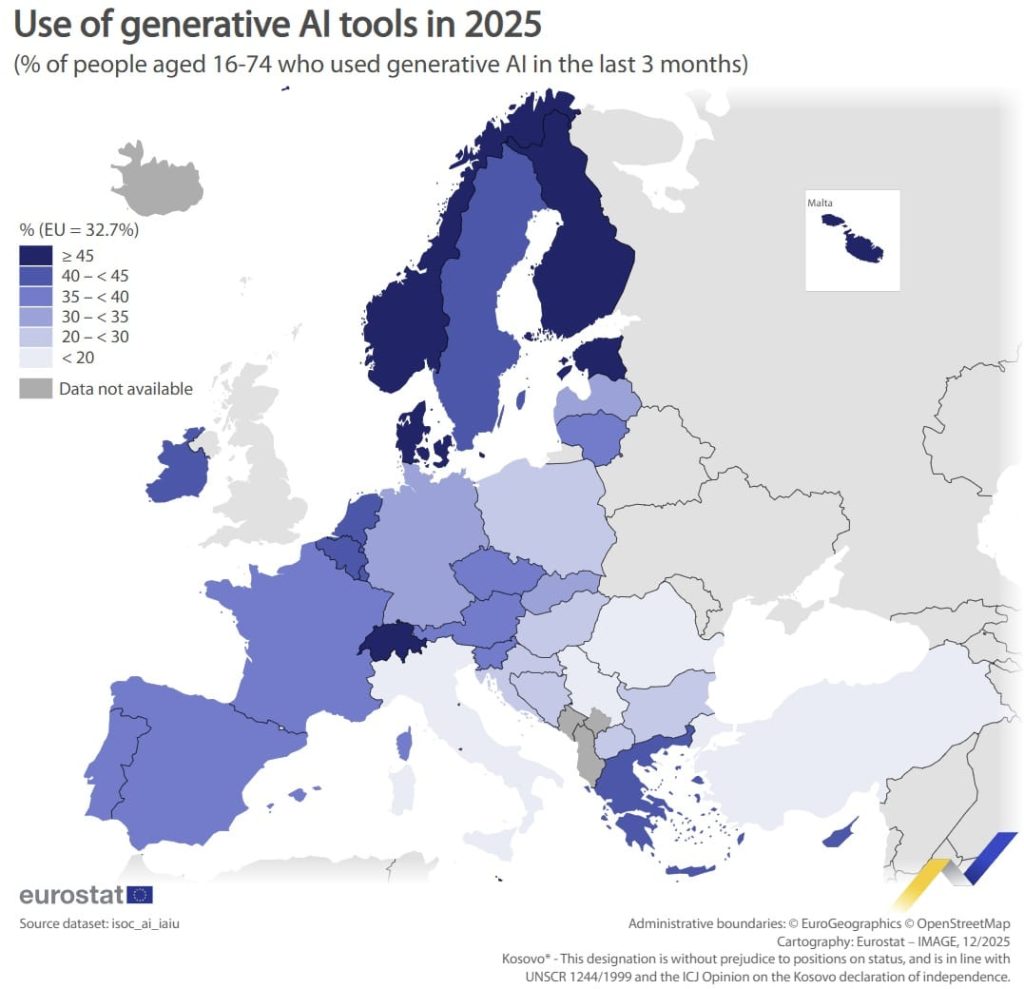
It’s not just Danish people who have embraced AI. Denmark has led the percentage of enterprises using AI technologies chart in both 2024 and 2025. Where the EU average for enterprises using at least one AI technology was approximately 20 percent in 2025. 42.03% of Danish enterprises use AI, the highest share among EU nations.
How has the Scandinavian nation achieved this level of AI adoption? Why are Danish people embracing AI tools?
The History of Digital Denmark
It is a trait amongst Scandinavian nations to go green. In Denmark’s case this meant an aggressive approach to going paperless and getting digital IDs. According to the UN e-Government Development Index rankings Denmark held a solid 2nd place globally during the 2000s. Today the country ranks first in the world.
This is no accident. More than 90 percent of the adult population use Denmark’s ‘Digital Post’ when communicating with public authorities. Every year more than 30,000 public and private organisations send hundreds of millions of documents through platforms like e-Boks, instead of sending letters on paper.
This move in part led to Denmark closing its national postal service in December 2025. The paperless commitment shown by Denmark has evolved into broader digital strategies.
The digitaldenmark portal (also called Digital Hub Denmark) is a fountain of knowledge about the history of Digital Denmark. It shows a timeline of milestones the government has reached in its drive to be more digital. They include 2001 when digital signatures were first introduced between businesses and government authorities. In 2004 a mandatory easyaccount tied to personal bank accounts made payments easier. In 2007 Digital IDs were introduced, and in 2011 digital post was introduced.
One of the reasons that Danes are embracing technology, especially in the public sector technology, is because of the level of trust amongst Danish people. 72% of Danes say they trust each other, one of the highest levels of trust in the world.
“In Denmark, the public sector plays a very important role in all citizens’ lives and we have a great deal of openness and a lot of interaction with the public sector,” Rikke Hougaard Zeberg, Director of the Agency for Digitisation in Denmark said, adding:
“That’s why we also have a high degree of trust in the public sector and that trust is one of the fundamental things when it comes to digitisation and the digital services that the public authorities present to the citizens.”
Denmark’s Rise as Europe’s AI Hotspot
According to online reports, international tech companies recognize Denmark as an AI hotspot. The European Commission chose Denmark to lead the work of setting common European requirements for the use of AI in the future.
The four focus areas of Denmark’s national strategy for AI include:
- A responsible foundation for artificial intelligence
- More and better data
- Strong competences and new knowledge
- Increased investment
In March 2019, the Danish Government published it’s ‘National Strategy for Artificial Intelligence’. The vision was for Denmark to be a front-runner in responsible development and use of artificial intelligence.
It set out how:
- Denmark should have a common ethical and human centred basis for artificial intelligence
- Danish researchers should research and develop artificial intelligence
- Danish businesses should achieve growth through developing and using artificial intelligence
- The public sector should use artificial intelligence to offer world-class services
Priority areas included healthcare, energy and utilities, agriculture, and transport.
In March 2022 the Danish Pioneer Centre for AI was opened. Professor Serge Belongie was appointed to run the project. By opening the centre, Denmark hopes it can build AI which people can trust, and that Danes can play a role in developing participatory AI governance so that AI can serve everyone.
The centre is funded by foundations like Novo Nordisk Fonden, Carlsberg Foundation, VILLUM FONDEN, Lundbeckfonden, and the Danish National Research Foundation (with support from the Ministry of Higher Education and Science). It collaborates with leading universities in Aarhus, Aalborg, and Copenhagen.
Denmark’s AI Startups
One of the most promising Danish startups is Veo, which uses AI-powered cameras to automatically record and analyze sports matches, generating highlights without human operators. It secured $80M in Series C funding and is expanding globally.
Another leading AI startup is Corti which builds healthcare AI. The company’s R&D focus on creating tools that augment rather than replace human expertise, allowing doctors and nurses to focus more on patient care and less on paperwork. It has already won impressive market share in the U.S., Germany, and the UK.
Founded in 2018, Abzu unlocks discoveries in data, revealing insights that fuel innovation. Its proprietary explainable AI, the QLattice® is the cornerstone of its approach. The company has been awarded the “Cool Vendor” by Gartner for explainable AI.
These are just some of the startups Denmark has to offer today. More are being created every day.
Denmark vs Big Tech
Denmark’s media landscape is going through challenges. All this while Google’s Alphabet and others rake in record profits. In a show of solidarity, Denmark’s media has made its last stand against the tech giants.
Denmark’s leading publishers have formed a common front. They are demanding a higher price for using their content.
Pernille Tranberg, director of the think tank Data Ethics told Politico in January 2026 that “we were very happy with the U.S. We know the language; we watch all the U.S. movies. Even before Trump that was changing.”
Karen Ronde, Ceo of the Danish Press Collective Management Organization (DPCMO) told Politico that “the interest here is not just about fair remuneration. At the end of the day, it’s about democracy. It’s about a free press.”
The DPCMO has taken OpenAI to court for using the content of Denmark’s media outlets.
Powering the Future: Denmark’s Supercomputers
To support the drive to be an AI leader Denmark’s pharmaceutical leader, Novo Nordisk, has taken steps to gain access to supercomputers. In October 2024 the King of Denmark together with the CEO of Nvidia, Jensen Huang, “plugged in” the Gefion machine. A supercomputer which uses 65 kilometers of cable and weighs 30 tons.
The supercomputer is owned by the Novo Nordisk Foundation and the Danish state. It is intended for researchers across Denmark’s pharmaceuticals and biotechnology, green transition and quantum computing sectors.
In July 2025 the Danish government and the Novo Nordisk Foundation invested $93 million in a Microsoft-powered quantum computer. Magne, the name of the computer, will be made available to companies and researchers to develop products and should be completing its first tasks by early 2027.
Wherever you look, the Danes are pushing their digital ambitions forward. From AI to quantum computing, the Scandinavian country continues to lead. Additionally, the country’s AI policies have formed a key part of how the EU AI Act has taken shape.
Challenges abound for the small country, but the trust shown by Danes towards their government and public institutions puts them in a better position than many countries.
Author: Andy Samu
See Also:
Will the EU’s AI Act Cripple Europe’s Innovation Edge?