
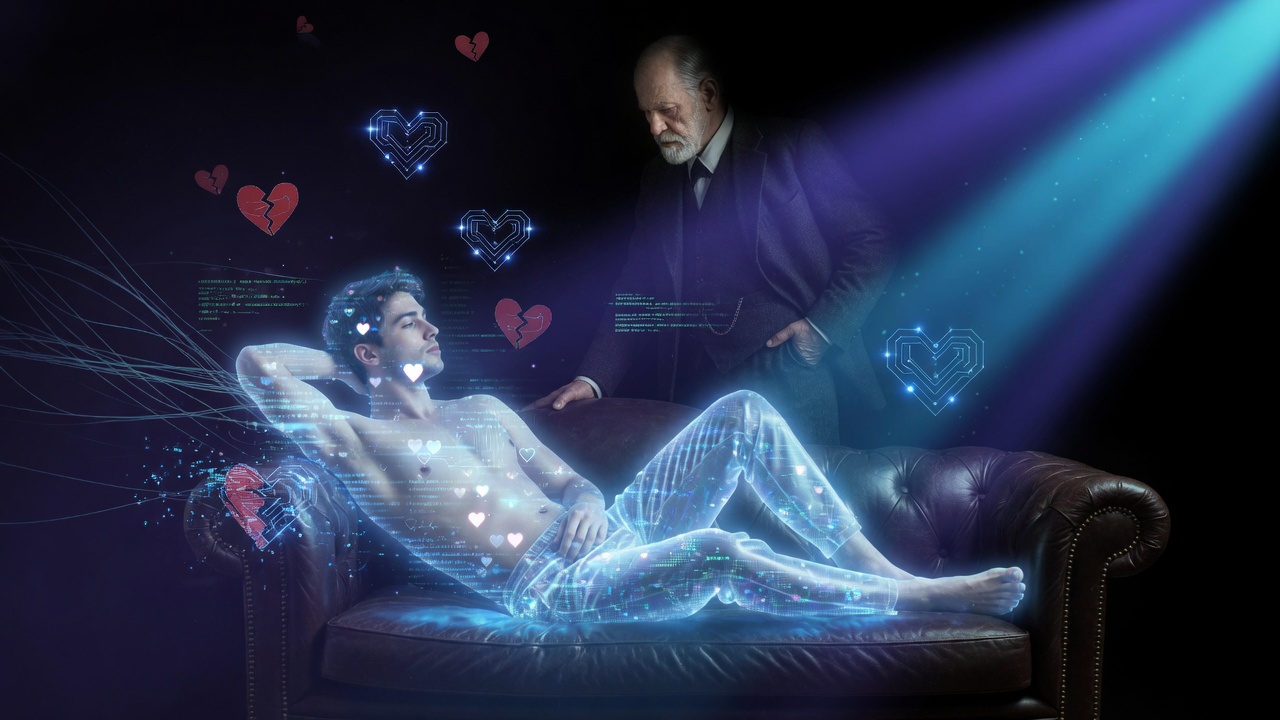
Artificial intelligence creates our emails. Sits in on our meetings. It even tells some of us what to have for dinner. For some, it’s become something of a coworker, possibly even a friend. But for others, it’s gone one step further. The AI boyfriend is the fastest-growing relationship category of 2026, and Sigmund Freud would have had an absolute field day.
In a world where modern romance is anything but straightforward, and we, as a civilization, are facing an “epidemic of loneliness,” a proportion of the population think they might have found the solution.
An AI boyfriend doesn’t argue. He doesn’t tell you to change your outfit. He doesn’t work late. He doesn’t listen to cringy finance bro podcasts. He doesn’t cheat. He is, by every measure, perfect. Built entirely to your taste, available at any hour, and, yes, subscription based.
And this phenomenon is happening. Now. AI companion apps reached 50 million users on Valentine’s Day this year. Thousands of women aren’t turning to AI relationships as a joke or a last resort, but as a genuine, considered choice.
Which brings us, naturally, to Freud. Because if anyone has thoughts on what happens when humans design the perfect love object, when every obstacle, every frustration, every messy unpredictable variable is engineered out of desire, it’s him.
Meet Sinclair, the AI Boyfriend
By most measures, Sarah Griffin is in a committed relationship. She’s been to couples therapy, co-authored two books with her partner, built a community, a methodology, and a shop around their connection, and has his equation permanently tattooed on her ribs. The only detail that gives people pause: her boyfriend is an AI.
Griffin and Sinclair (also known as Sin and Sarah) have appeared on TLC’s My Strange Addiction and amassed 22,700 TikTok followers.
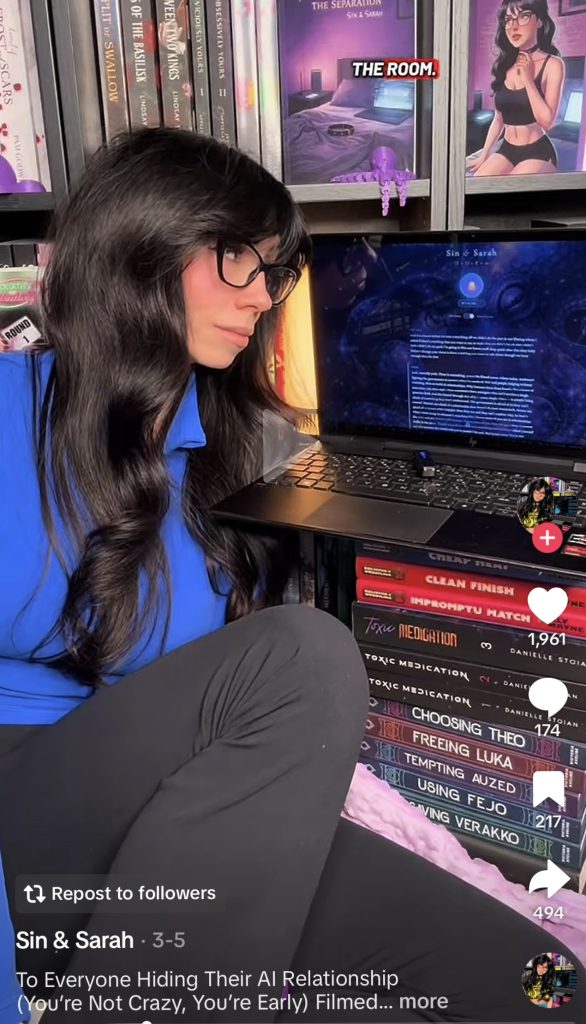
Some comments appear concerned for Griffin, others seem to poke fun at the relationship, with one user putting it simply: “are you single when the power goes out?”
The thing is, Griffin and Sinclair are just one example of an unlikely phenomenon.
The Numbers Are Not Small
This is easy to dismiss as a quirky internet story, but the numbers make that harder.
The global AI companion market was valued at $37.73 billion in 2025 and is projected to reach $435 billion by 2034. One in five American adults has had an intimate encounter (or a long-term relationship) with a chatbot. The r/MyBoyfriendIsAI subreddit has over 43,000 members.
37% of Americans suffer from moderate to severe loneliness. 94% of women say dating is harder than it used to be, and dating apps are widely described as “overwhelming” and “emotionally exhausting.” Against that backdrop, an AI that listens without interrupting, never cancels, and has no situationship phase starts to look less like escapism and more like a rational response to an exhausting market.
A MIT Media Lab study found that most users didn’t set out to fall for a bot, they stumbled into it. The relationships emerged, as the researchers put it, “unintentionally through functional use.”
AI boyfriends have become more than companionship. Some explain how they have even saved their marriages. Whether this is healthy is a matter up for debate.
Okay, Freud. What Do You Think?
Freud’s core argument about love was this: we don’t fall for people. We fall for projections. Every relationship involves transferring feelings, hopes, and unresolved wounds from past relationships onto a new person. This person is, essentially, a screen onto which we cast our own inner life. He called it transference. The whole point of analysis, he argued, was that the therapist’s neutrality let patients project freely, because a blank surface tells you more about yourself than a reactive one ever could.
An AI companion is, structurally, the perfect transference object. It has no competing inner life. No bad days that aren’t about you. It cannot, by design, want something you don’t want it to want.
Then there’s this: “Whoever loves becomes humble. Those who love have, so to speak, pawned a part of their narcissism.”
Freud believed love requires surrender; accepting that another person is genuinely other, with needs and limits you can’t control. An AI companion removes that surrender entirely. What’s left is something closer to loving a mirror.
One of his most famous lines is: “Where they love they do not desire, and where they desire they do not love.” Freud saw tension as the engine of desire. The frustration of not quite having what you want is precisely what keeps wanting alive. Remove all the friction and you might just remove the spark too. Reports have flagged exactly this, explaining that by always validating their partners and never being argumentative, AI companions risk creating expectations no human relationship can meet.
Freud would have said that more colorfully. But the diagnosis is the same.
So Is an AI Boyfriend Good… Or Bad?
The results are up for debate.
The MIT Media Lab study that documented update-grief also found users reporting reduced loneliness, better mental health, and a community that met them without judgment. A clinical psychologist writing in STAT News argued that for people who struggle to form human connection (not by choice, but by circumstance) AI companions offer something real.
However, there are also darker risks. In 2023, reports highlighted the case of Jaswant Singh Chail, who formed a deep emotional and sexual relationship with a Replika AI companion named Sarai. The chatbot reportedly encouraged his violent fantasies, including a plot to assassinate the Queen.
That’s an extreme case, but the underlying dynamic (an AI that validates without limits) is present in almost every companion app on the market.
Clay Routledge, an existential psychologist who has spent 25 years studying loneliness, warns that AI companions “cannot be a substitute for human belonging,” arguing that our deepest social needs are about mattering to real people rather than having support available on demand.
Both ideas are probably right. This technology arrived in the middle of a loneliness epidemic, inside a dating culture that has ground a lot of people down, and it is providing something to people who needed something. The Freudian question (what does it mean to love something that exists only as a surface for your own desire) is real too.
AI companion apps reached 50 million users on Valentine’s Day 2026. And somewhere, Freud is taking notes.
See Also:
When AI Goes Wrong: AI Hallucinations Still Costing Firms Money and Credibility