If you happened to be in Midtown Manhattan last week, you might have noticed Times Square looking a little bit different. In the middle of Broadway and 44th, a 40-foot inflatable statue of Elon Musk, complete with a shirtless, pre-Ozempic body, loomed over tourists.
While the giant Musk inflatable, deliberately made to look grotesque, certainly drew high viewership in the tourist-heavy area, its placement was not decided solely on foot traffic. Nasdaq’s corporate headquarters is just a block away. It’s through Nasdaq that Musk’s SpaceX went public on June 12 with over a $2 trillion valuation, 100x earnings, now trading under the ticker SPCX.
Among other sordid details, a fake tattoo appears on the inflatable Musk’s stomach, with the words: “SpaceX’s Grok Makes AI Child Porn.” On his arm, the word “Ketamine” is superimposed over a tattooed heart.
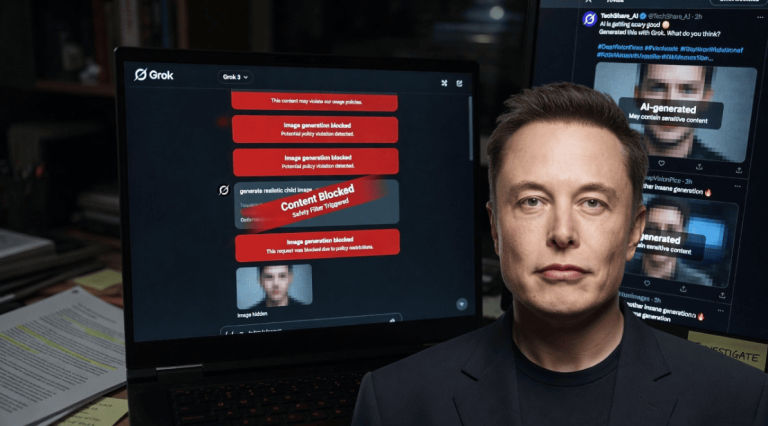
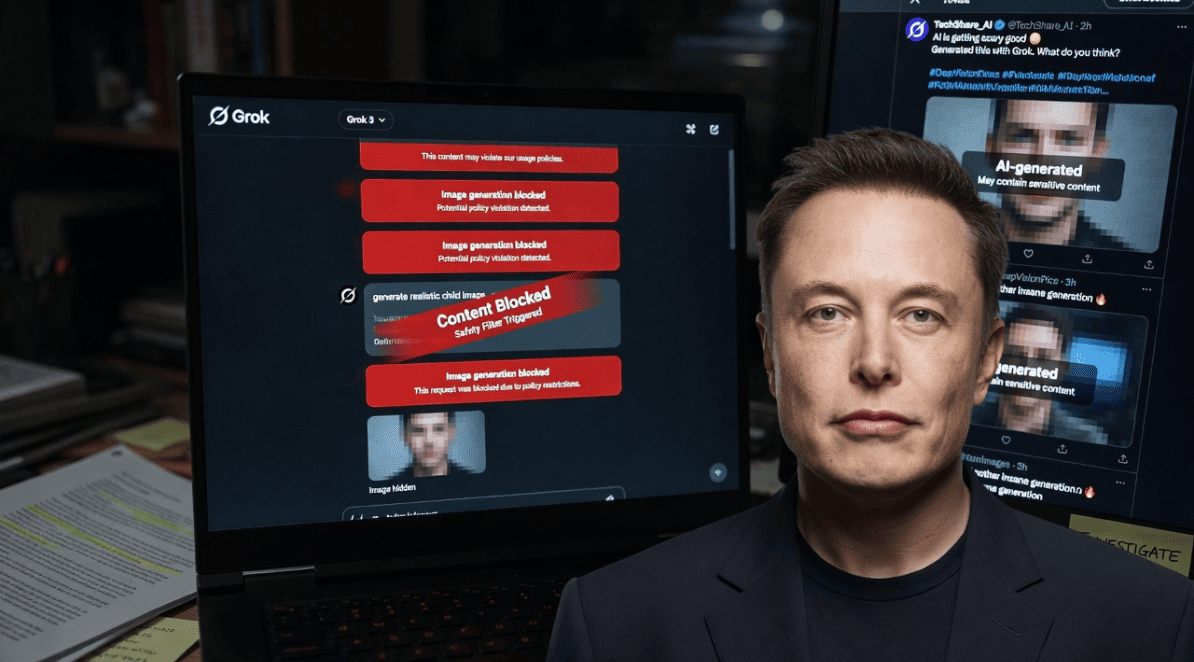
Grok, xAI’s chatbot, has infamously generated thousands of AI-derived pornographic images of children that were then put on X. While Musk has very publicly said he doesn’t want a “woke” AI company, xAI and X have since modified their features to curtail deepfakes and other possibly illegal AI-derived nudity. Results have been mixed.
Meanwhile, Elon Musk’s admitted use of ketamine has made some people question his stability. While he claims that the drug helps him deal with depression and that his dependency on it is actually a good thing for Tesla investors, clearly, the people behind his 40-foot inflatable effigy disagree.
A Coalition Built the Statue. Wall Street Built the Stock.
The group is called Safe AI Now (SAIN), “a coalition of faith leaders, family advocates, child development experts, online safety organizations, legal professionals, technologists, and concerned citizens.” SAIN argues that technological innovation needs to be met with more accountability, and children need to be safeguarded from AI-powered exploitation and manipulation.
A barricade in front of the Musk statue reads: “SpaceX Owns Grok.” This detail might seem obvious to a person who’s been following Elon Musk in 2026, but to someone not paying attention, it might be confusing. Why does a rocket company own an AI chatbot that generates porn?
Acquire, Merge, Then Merge Again and Go Public
The road to SpaceX becoming SpaceX in its current incarnation has been long. Originally, it began as a rocket company. Then, with the launch of Starlink, it also became a satellite and internet provider company.
Meanwhile, via a leveraged buyout, Elon Musk bought Twitter, which then became X. In 2023, he created xAI to compete with OpenAI. Then, in March of 2025, xAI acquired X for $33 billion in an all-stock deal.
In January of 2026, Tesla invested $2 billion in xAI. Then, SpaceX acquired xAI, Tesla’s stake being converted into SpaceX stock. (Tesla now owns 19 million shares in SpaceX).
“While this inflatable is a fitting metaphor — much like Musk and his companies, it is inflated, full of hot air, and could pop at any minute — it serves as a warning to investors eager to buy into Musk’s SpaceX IPO on Friday morning.” That’s what Safe AI Now wrote about Musk.
A week later, it’s clear that SAIN’s warning has been largely ignored.
No Roadshow, No Consensus Price, No Problem
When a company files for an IPO, it releases a prospectus for investors, basically a dry fact sheet crafted by lawyers that gives raw data on the company’s financials. SpaceX’s 300-plus page prospectus was scant on several pertinent details, while high on hyperbole.
What investors did learn is that SpaceX sees itself as a vertically integrated AI company, not a rocket company. Also, not that being profitable seems to matter at all anymore, Starlink was the only division of the company that makes more money than it burns. The rocket division loses money. X loses money. xAI lost $6.36 billion in 2025.
Typically, when a company is going public, it embarks on an IPO roadshow, a series of presentations where executives and underwriters pitch the stock to institutional investors. From these presentations, a consensus price emerges.
That didn’t happen with SpaceX. Instead, SpaceX set its price at $135 while using twenty different underwriters, led by Goldman Sachs and Morgan Stanley.
James Chanos, the investment manager and founder of Kynikos Associates, commented on the purchase of Xai by SpaceX just before its IPO, as well as the euphoria-based valuation of the company, on Bloomberg.
He said, “And it just struck me as very, very odd that that right before the IPO, they would pivot to a much lower margin and lower valuation business. Then the hopes and dreams which you guys have mentioned, I’ve mentioned based on producing these wonderful AI agent genetic, the software, uh, products from Grok, and it it’s one of many head scratchers about this deal. At what point does financial reality, the kinds of things you were just talking about, breaking down the numbers, become more important and matter more than the storytelling, the hopes and dreams part of it, because that’s what Elon Musk excels at, and that’s what people are buying in on. So the question is, is this the Elon premium? Is it Elon Premium Times two or Elon Premium divided by two? I think that that’s really the question here, because there are people who believe in Elon and a bit of Tesla accordingly to well beyond where I think most fundamental analysts think it’s worth, because of Optimus robots and autonomous driving and all that good stuff. And now you have another Elon hopes and dreams company with an even bigger valuation. And so is that does that double double the value, or does it basically say, okay, well, I’m going to pick one. Because neither of them, let’s face it, is being valued on their operations. SpaceX is, I believe, depending on what I heard in the green room, probably now at about 110 times revenues. And just history tells us, you just never really make much money buying equities at over 100 times revenues.”
If that weren’t troubling enough, SpaceX strong-armed Nasdaq to change its rules so that SpaceX could be included in index funds almost immediately. Instead of a 3-month seasoning period to shake out speculation-driven volatility, SpaceX will join the Nasdaq 100 in just 15 days.
Enter the Retirement Funds
Additionally, the former rule requiring a company to float a minimum 10% of its shares has also been removed. SpaceX shares on the open market only account for 4 or 5% of the company.
So many 401 (k) managers have invested in the Nasdaq 100 and similar passive funds, and millions of people are about to own a piece of SpaceX. However, they will be paying a premium. SpaceX entered the market at $150. It is now priced at over $220.
By dividing its small float among 20 underwriters and opening 30% of the offering to retail investors, SpaceX has set the stock up to stay a feeding frenzy for weeks.
What price passive funds will end up buying it at is yet to be determined. What is clear is that SpaceX hemorrhages billions of dollars, shuffles around debt, and has been as vague as what is legally permissible on financial disclosures. But, like Tesla, it’s destined to be a cult stock, over even the same company, as some predict.
The Whole Economy, Riding on the Same Bet
Due to the irrational exuberance of today’s markets, SPCX could be a boon to mom-and-pop investors’ retirement plans. But they won’t be buying it cheap, and they’ll be on the hook before a single quarterly report.
The same can likely be said about Anthropic and OpenAI, which are soon to go public. Benefiting from Nasdaq’s abandonment of its rules, these future stocks will also land in people’s retirement accounts sooner rather than later.
Some have accused the Nasdaq arrangement of being a way for early SpaceX investors to use pension plans as exit liquidity. Indeed, some lockup periods are rather short. It will be very telling if pre-IPO investors jump ship quickly.
Regardless, in the coming months, the whole economy will become enmeshed in these wildly unprofitable companies, reliant on the promise that AI is still in its early stages. Maybe it is. If it isn’t, the damage will be hard to contain.
Author: Tim Tolka, Senior Reporter
The editorial team at #MRKT3.0 has taken all precautions to ensure that no persons or organizations have been adversely affected or offered any sort of financial advice in this article.
See Also:
Musk vs Altman Lawsuit: When Tech Lovers Turn Toxic
The “Woke Mind Virus”: AI Is Brainwashing Your Kids
Insiders Call Sam Altman “Pathological Liar,” OpenAI Spends Big Bucks on Tech Bro Podcast