China is rewriting the rules of artificial intelligence with an ambitious industrial-first strategy that puts rapid real-world adoption and physical applications ahead of closed-door model development. While American labs compete fiercely on large language model leaderboards, China is taking AI out of the cloud and into the physical world.
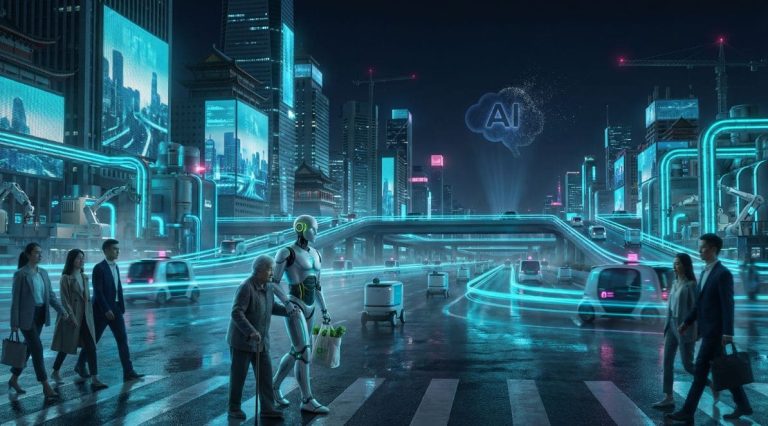
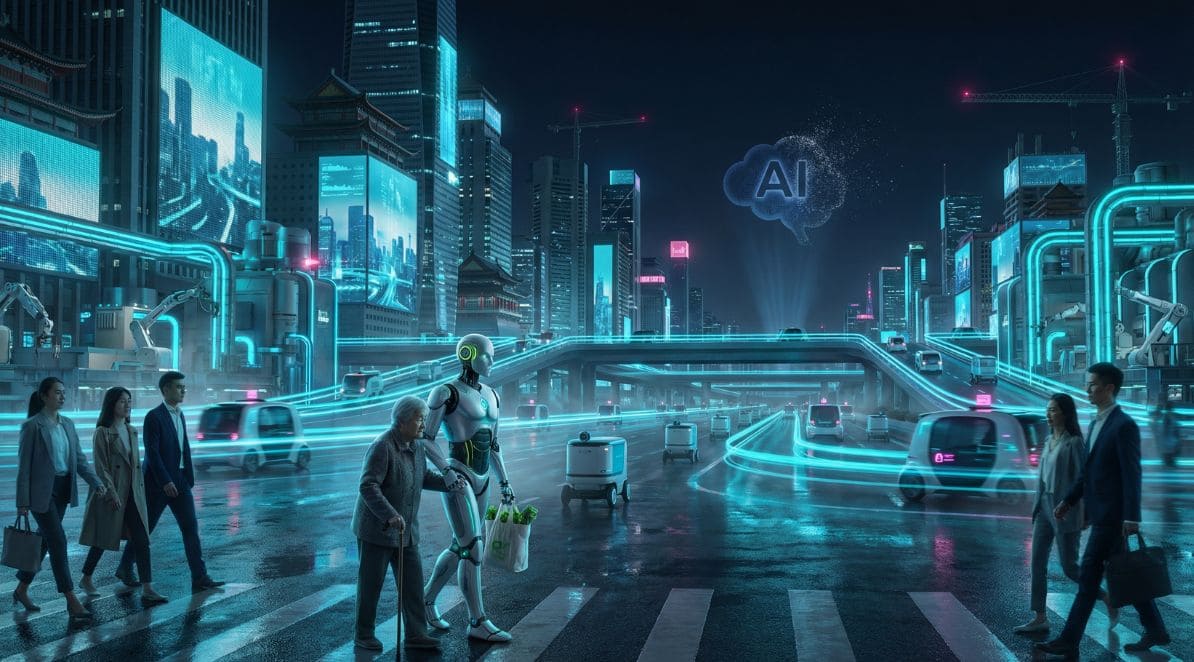
Picture bustling city streets navigated by fleets of self-driving robotaxis and nimble delivery robots weaving through crowds. Envision humanoid machines becoming everyday household fixtures, much like smartphones today, quietly managing chores, assisting the elderly with daily needs, and taking on hazardous or monotonous jobs that humans prefer to avoid.
China is currently leading the charge toward this new reality.
For decades, robotics progress remained painfully slow as machines were limited to performing repetitive tasks in highly structured, controlled settings. That barrier has now been broken by the rise of generative AI. Modern robots are gaining the ability to interpret their surroundings in real time, learn from minimal examples, and successfully operate in ever-changing environments.
How China’s Open-Source Playbook Is Outpacing Silicon Valley
In February 2026, hundreds of millions of Chinese households watched in awe as humanoid robots from four different companies took center stage at the Spring Festival Gala in Beijing, China’s most-watched television event.
The robots danced, performed comedy skits, executed flawless parkour, and demonstrated martial arts with impressive precision.
This was a public declaration of China’s accelerating lead in physical AI, or what many now call embodied intelligence.
At the heart of China’s progress is its unusually open AI ecosystem.
While open-source AI development is not unique to China, it has long been practiced by Western organisations. This includes companies like Meta (with its Llama series), Mistral AI, and the broader Hugging Face community. However, it is relatively unusual for China, a country traditionally associated with strong state control and more cautious attitudes toward intellectual property and data sharing.
Yet, Chinese developers have begun routinely releasing model weights and source code, dramatically lowering barriers to entry and sparking widespread experimentation.
China’s Secret Weapon: More Data, Faster Deployment
According to a report by the U.S-China Economic and Security Review Commission, China’s growing dominance in open-source AI is creating a self-reinforcing competitive advantage. Driven by lower costs, Chinese large language models from companies such as Alibaba, Moonshot, and MiniMax now dominate global usage rankings on platforms like Hugging Face and OpenRouter.
Beijing’s fast-paced deployment of AI across manufacturing, factories, logistics, and robotics is generating vast amounts of real-world data that continuously improves its models. The report warns that the rapid proliferation of open models could create alternative pathways to AI leadership. This could potentially threaten the dominant position of American firms such as OpenAI and Anthropic.
This approach has allowed China to narrow the performance gap with top U.S. and European models despite U.S. export controls on advanced chips.
China has made impressive progress in AI in recent years. Despite facing strict U.S. restrictions on advanced chips, the country’s core AI industry reached an estimated value of 160 to 170 billion dollars in 2025. It now hosts more than 6,000 AI-related companies and leads the world in generative AI patents, registering six times as many as the United States.
A major breakthrough came in early 2025 when the startup DeepSeek released its R1 model.
This system delivered performance close to ChatGPT while using far fewer computing resources. The launch sparked a wave of investment and helped create six major AI startups, often called China’s “AI Tigers”.
Why Xi Jinping Is Betting China’s Future on AI
At the core of President Xi Jinping’s economic and strategic vision is the policy of “technological self-reliance”. This idea aims to reduce China’s dependence on foreign technology in critical sectors.
The policy was launched after the US began imposing export controls on advanced semiconductors between 2018 and 2022. The policy seeks to secure China’s long-term economic competitiveness and national security by developing indigenous capabilities in key frontier technologies.
The strategy focuses heavily on AI, semiconductors, quantum computing, biotechnology, new energy, and advanced manufacturing. This has translated into massive state investment, the mobilisation of national resources, and the creation of dedicated funding programs such as “Made in China 2025”.
China Is Teaching Its Next Generation to Speak AI
China is also rapidly emerging as a global leader in embracing AI as a legitimate educational tool. While many Western institutions continue to struggle with plagiarism concerns, Chinese authorities have taken a proactive approach by embedding AI literacy into every level of the curriculum.
National ministry plans and Beijing’s guidelines now require AI skills to be integrated across all syllabuses, with universities running powerful local models like DeepSeek on campus servers.
The AI+ Blueprint: How China Plans to Rewire Its Entire Economy
The government’s AI+ Initiative seeks to integrate AI into 90 per cent of the economy by 2030.
Generous tax incentives support research and development, with semiconductor projects eligible for deductions as high as 200%.
Rather than focusing solely on abstract artificial general intelligence, Chinese companies and policymakers emphasise practical applications that solve real industrial problems. This application-first mindset, supported by close cooperation between government, local authorities, and private firms, is speeding up the adoption of AI across society.
However, progress has not been entirely smooth. In 2025, Huawei’s previous flagship AI chip, the Ascend 910C, gained limited traction among major private tech firms despite government encouragement to adopt domestic semiconductors. Many companies were reluctant to switch due to its lower performance compared to Nvidia chips and poor compatibility with widely used software ecosystems.
A key development reinforcing this push is Huawei’s new 950PR AI chip. This performed well in customer testing and is expected to see strong orders from ByteDance, Alibaba, and other giants due to better compatibility with CUDA (Nvidia’s parallel computing platform) and improved inference capabilities.
By focusing on integrating AI into factories, education, and homes at scale, China hopes to gain a lasting advantage in the global AI race.
Author: Ruben McCarthy
See Also:
Europe’s AI Unemployables Are Bleeding Sovereignty to China
Who is Edward Warchocki: the Robot Taking Over Warsaw
Is Tesla Overhyped? Enter NEURA, Europe’s AI Robot Challenger