Europe’s AI infrastructure map is changing. And this time, Krakow is at the center of the continent’s push for tech sovereignty.
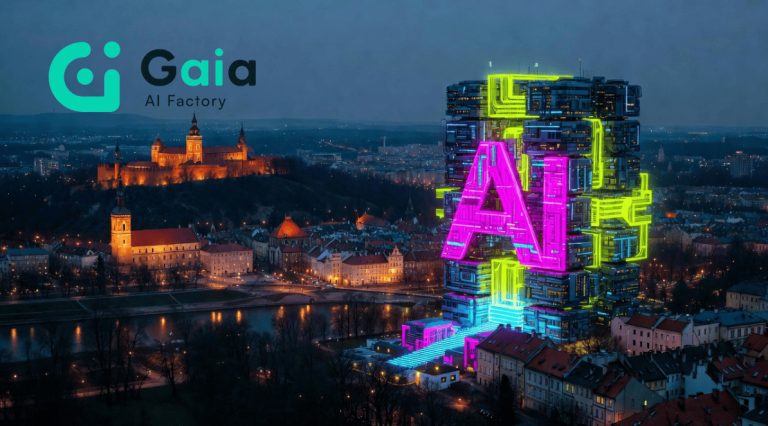
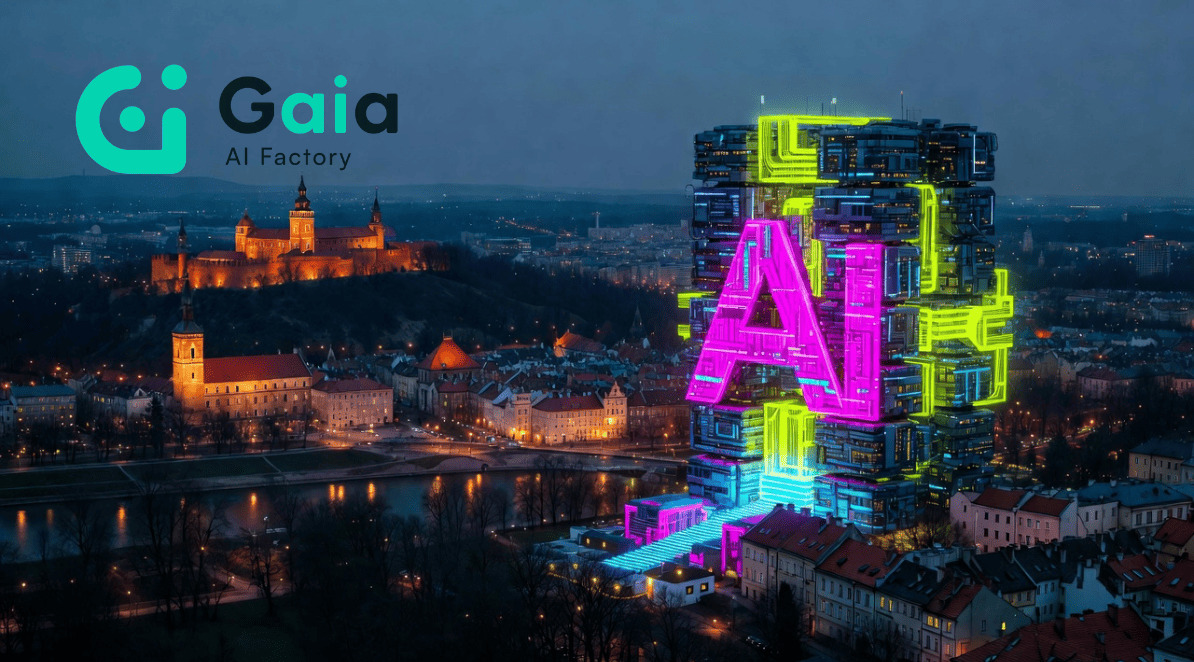
Gaia AI Factory is a €70 million EuroHPC-funded supercomputer in Krakow, Poland, housing over 1,000 GPUs and operated by Cyfronet AGH. It is one of 19 AI Factories confirmed across the EU by October 2025, designed to give European researchers, startups, and public bodies access to sovereign AI compute.
Europe Has an AI Problem. Poland Is Part of the Fix.
Europe’s relationship with artificial intelligence infrastructure is, to put it plainly, one of dependency. American big tech controls more than 70% of Europe’s cloud market. The compute that powers AI is almost entirely owned by companies headquartered outside the EU. This is not just strategically problematic. It’s economically suicidal.
The European High Performance Computing Joint Undertaking (EuroHPC JU) is trying to change that. Its answer: a continent-wide network of 19 AI Factories, purpose-built to deliver sovereign, trusted, energy-efficient AI infrastructure for European industry, research, SMEs, and public services. Finally, this could cut the continent’s dependence on non-European cloud providers.
By late 2025, all 19 sites had been confirmed. And when the selection committee began drawing up that list, most observers expected the usual names. Paris. Berlin. Amsterdam. Cities where research funding, digital infrastructure, and tech investment have clustered for decades.
And yet, on October 10, Krakow’s AI factory was confirmed. And it was named Gaia AI.
The question isn’t whether EuroHPC made the right call. The evidence suggests they did. The more interesting angle is what the choice of Krakow reveals about how Europe is rethinking AI sovereignty, and why the old assumptions about where deep tech belongs are being dismantled.
What Is Poland’s New AI Factory? Meet Gaia AI
Gaia is a next-generation supercomputer housing more than 1,000 GPUs. It nearly sits in Europe’s AI infrastructure ecosystem, joining PIAST in Poznan (already operational/in progress) as Poland’s second major EuroHPC AI Factory.
The factory is not just raw compute. It is designed around specific high-value applications: personalised medicine and AI diagnostics, large language model development, space technologies, climate monitoring, and AI tools for public administration. These are not vague ambitions. They reflect where Polish and Central European research institutions already have deep expertise.
The €70 million investment is split equally between the EU and the Polish government, and it will be operated by a national consortium led by Cyfronet AGH as part of the PLGrid infrastructure.
“Gaia AI Factory is not only an investment in infrastructure, but also a boost for the entire ecosystem of science, administration and innovation”, explained Krzysztof Gawkowski, Poland’s Deputy Prime Minister and Minister of Digital Affairs.
Why Did the EuroHPC Chose Krakow?
As a city, Krakow is known for its castle, Christmas market, and some of the best pierogi in Central Europe. Perhaps not its GPU clusters.
But this perception is becoming increasingly outdated, and may even explain why EuroHPC chose Krakow in the first place. The selection committee wasn’t looking for the most recognisable name on a map. It was looking for a credible ecosystem. Krakow had one.
The case for Krakow rests on several interconnected advantages.
Existing infrastructure
- Krakow already hosts Helios (the fastest supercomputer in the country), making it the logical location to build Gaia. Integration with existing high-performance computing infrastructure and the national PLGrid network reduces both deployment time and cost, while leveraging proven operational expertise at Cyfronet AGH.
A serious research ecosystem
- The city brings rare institutional density for a project of this kind: AGH University’s Faculty of Space Technologies, Jagiellonian University’s Małopolska Centre of Biotechnology, the Sano Centre for Computational Medicine, and Kraków Technology Park all sit within reach. Gaia is amplifying capacity that already exists.
National consortium reach
- While Krakow serves as the physical and leadership hub, the consortium spans partners from Wroclaw, Gdansk, and Warsaw. Gaia’s benefits will flow across Poland, not just concentrate in one city.
Strategic geography
- EuroHPC is building corridors, not just individual nodes. Gaia in Krakow, combined with Poland’s other AI Factory (PIAST in Poznan) and the LUMI supercomputer in Finland, creates a meaningful Central and Northern European compute backbone. Krakow was chosen, in part, because of where it sits on that map.
Poland’s rising AI Startup – ElevenLabs
- Then there’s ElevenLabs. Founded in 2022 by two Polish schoolfriends, Mati Staniszewski and Piotr Dąbkowski, the company turned a frustration with Poland’s monotone film dubbing tradition into a $6.6 billion voice AI business. ElevenLabs now works with Adobe, Cisco, Epic Games, and over 41% of Fortune 500 companies. It has since invested $11 million back into a Warsaw R&D hub, and its EU headquarters sits on home soil.
Rich Talent pool
- ElevenLabs isn’t an outlier. It’s a signal. Poland has over 650,000 IT professionals (the largest talent pool in Central and Eastern Europe) and produces more than 70,000 ICT graduates per year. Demand for AI and machine learning engineers is outpacing supply, with senior roles commanding salary premiums of up to 28% above standard tech positions.
Each of these advantages, combined with Poland’s deep roots with high-performance computing, helped Poland win two of Europe’s 19 AI Factories.
The gap between that talent and world-class compute infrastructure has, until now, been Poland’s biggest constraint. Gaia is designed to close it.
What Gaia Will Actually Power
The most immediate impact will be felt in healthcare AI. Poland has invested heavily in computational medicine, with the Sano Centre being a prominent example. Gaia gives those researchers the compute to move from prototype to production-scale models. Personalised diagnostics and genomic analysis require exactly the kind of sustained GPU throughput that Gaia will provide.
For LLM development, Gaia represents something Europe has been short of: sovereign compute for training and fine-tuning large models on European languages, regulatory frameworks, and datasets. With Gaia being built in Krakow, any organisation that needs to develop AI systems compliant with the EU AI Act, trained on GDPR-compliant data, and auditable within European jurisdiction now has a credible compute option that doesn’t involve shipping data to Virginia.
Climate monitoring and space technology round out the primary use cases. Both areas where Polish institutions already punch above their weight, and both areas where computational demands are growing faster than existing infrastructure can absorb.
Poland’s Place in Europe’s AI Map
Gaia is not an isolated project. It is the second of two Polish AI Factories and signals a deliberate national strategy rather than a lucky grant win.
The timing matters. Poland currently has one of the EU’s lowest rates of enterprise AI adoption: just 5.9% of companies using AI, compared to over 27% in Denmark.
That gap isn’t a weakness in the story. It’s a wake up call.
A country with world-class engineering talent, a fast-growing tech sector, and now sovereign AI compute infrastructure sits at a rare inflection point. The companies and research institutions that access Gaia early will help define what Polish AI looks like at scale. Not just locally, but across Central Europe.
For the broader European ecosystem, the Gaia story is a template. You don’t need to be Paris or Berlin to anchor serious compute infrastructure. You need the right institutions, the right consortium, and the political will to treat AI as a national priority rather than a procurement exercise. Krakow had all three.
Europe’s AI dependence on American AI infrastructure won’t be broken overnight. But the 19 AI Factories aren’t trying to win that battle in a single move. They’re building the foundation that makes it possible to compete on European terms.
Poland has positioned itself as a Central European anchor in that network. Gaia is the infrastructure. ElevenLabs is the proof of concept. The talent is already there. What changes now is what they can build with it.

See Also:
The EU’s Sovereign AI Push: Claiming Tech Independence
Europe’s Sovereign AI Factories: The Top 5 You Need to Know in 2026
What Is Estonia’s X-Road and Is It Key to Europe’s AI Sovereignty?