
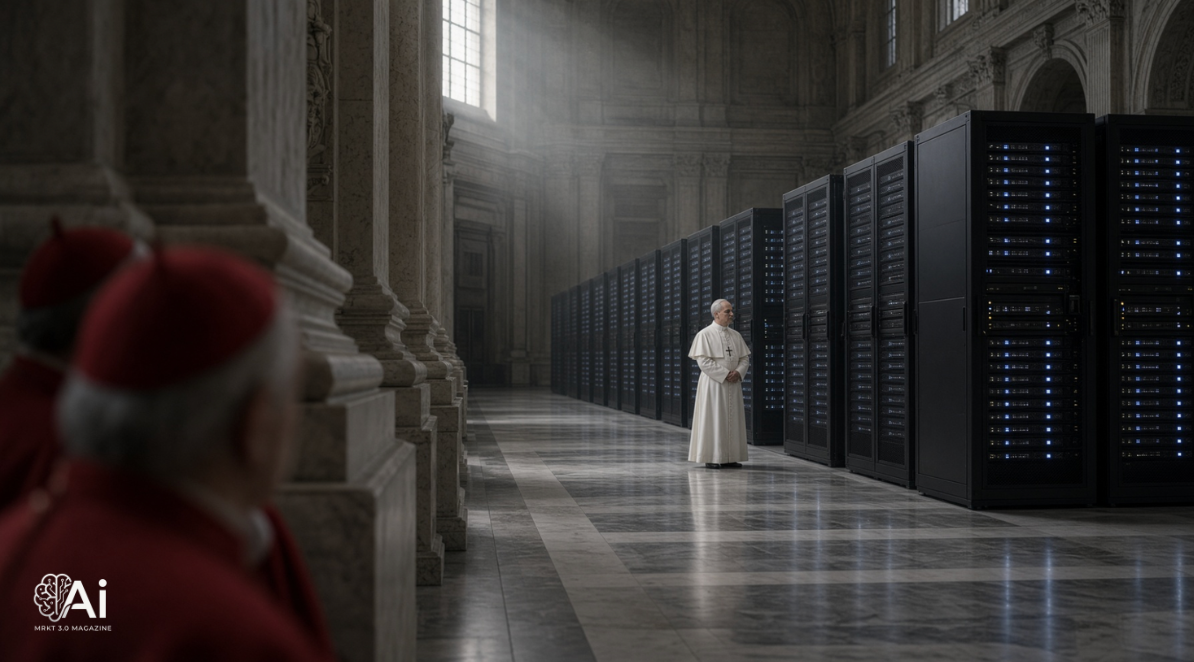
As you will know, the AI industry has many, many critiques. Yet, few of AI’s critics can compare to the man who took holy orders, trained as a mathematician, and now posts about large language models from an X account named @Pontifex.
Pope Leo XIV has made artificial intelligence one of the defining themes of his young papacy, and he has pressed the point everywhere a pope can reach, from a forty-thousand-word encyclical down to his significant X following.
For an industry used to critics it can manage, Pope Leo is turning out to be an awkward kind of opponent.
Why Does the Pope Care So Much About AI?
Leo XIV, formerly Cardinal Robert Prevost, chose his name with intent. His predecessor Leo XIII wrote Rerum Novarum in 1891 to confront the upheavals of the industrial revolution, and the new pope has cast his own mission as the sequel.
In his first address to the College of Cardinals, two days after his election, he made the parallel explicit. In this statement, he explained that “In our own day, the Church offers to everyone the treasury of her social teaching in response to another industrial revolution and to developments in the field of artificial intelligence that pose new challenges for the defence of human dignity, justice and labour.”
What Has the Pope Said About AI on X?
Pope Leo XIV has been very vocal on X about AI, starting in 2025. His posts are clear, compelling and (perhaps most importantly) built for sharing.
The encyclicals are where the argument lives, and the tweets are where it travels, distilled into lines built for sharing. In December 2025, he shared this:
Around the release of his encyclical he went further, describing the grandeur of humanity “the splendor of which no machine can ever replace”.
And in a post this month, he explained:
This post specifically amassed a significant amount of engagement.
What Does Magnifica Humanitas Actually Argue?
Signed on 15 May and released ten days later, Magnifica Humanitas runs past forty thousand words, and Pope Leo XIV presented it in person, a courtesy popes usually delegate.
In this, he singles out as “particularly insidious” the notion that a person must earn or justify their own worth, with greater value quietly assigned to those who are “more efficient or effective.”
Pope Leo XIV is hardly alone in sensing the technology drift onto ground once reserved for faith, a question we have taken apart separately, in the company of robot monks and griefbots.
What is “Economic Colonialism”?
In Pope Leo XIV’s 21 August post, he warned of the risks leaving poorer nations dependent on richer ones. He urged that “we must remain vigilant in this regard, lest innovation become another vehicle for ideological or economic colonialism.”
He then continued to describe “a subtle form of domination when algorithms decide who is seen, and who remains invisible,” and said such systems “reveal a new face of the ancient temptation to domination and mastery without service.”
His remedy was almost defiantly old-fashioned, the family as “the first school of humanity,” which AI must never be allowed to erode by reducing persons and relationships to data and simulations.
His conclusion doubled as a mission statement, that the world needs “technological innovation directed by charity.”
Can the Pope Actually Change How AI Gets Built?
A pretty obvious question follows. Does the pope’s opinion on AI even matter?
Leo commands no legislature, drafts no statute and enforces nothing, and his critics note that the August address largely restated the encyclical he had already published in the months prior.
The writer Christopher Hale, who tracks this papacy closely, read the speech as a redelivery rather than a fresh position, and there could be something to this point. The Church deals in centuries, not product cycles, and Silicon Valley has shrugged off sterner opponents than a homily.
The shrug is harder to pull off than it looks, though. As Hale told Fortune, an industry accustomed to transactional relationships now faces an opponent it cannot buy off, indict or deport. What Leo has managed is a reframing. By translating a critique that was until recently confined to activists into moral and religious language, he has made it portable, and handed a shape to a discontent that already runs across the political spectrum, from data-centre revolts on the right to labour anxieties on the left.
The Trump administration, midway through unwinding federal AI rules, has found the whole thing awkward enough that its own ranks split over the encyclical, with Vice President JD Vance among those who praised it.
So, Why Does the AI Industry Fear Pope Leo XIV?
This brings us back to the all important question: Why Does the AI Industry Fear Pope Leo XIV?
At the end of the day, the AI industry does not fear a Vatican law. Pope Leo XIV cannot ban a model or halt a data centre.
That being said, the industry should fear what he can do instead. He has given a moral frame to arguments that used to sit with activists: dignity, work, dependence, who gets seen. That frame travels. Lawmakers, unions and local campaigns can pick it up without looking like they work for a tech critic.
It also fears the kind of opponent he is. Companies can hire, sue or wait out most critics. They cannot do that with the pope. The argument stays in public, and it does not expire with a product cycle.