
On July 10, 2026, SK Group Chairman Chey Tae-won and SK Hynix CEO Kwak Noh-Jung rang the opening bell at the Nasdaq MarketSite in Times Square. The company had priced 177.9 million American depositary receipts at $149 apiece, raising $26.5 billion, the largest US share sale ever completed by a foreign company. The stock closed its first session at $168.01, up 13%. Just days earlier, the IMF raised Korea’s 2026 growth forecast to 2.6% from 1.9%, the largest upgrade among the 30 major economies in its July outlook, after first-quarter growth hit an annualized 7.5% on semiconductor and AI hardware exports.
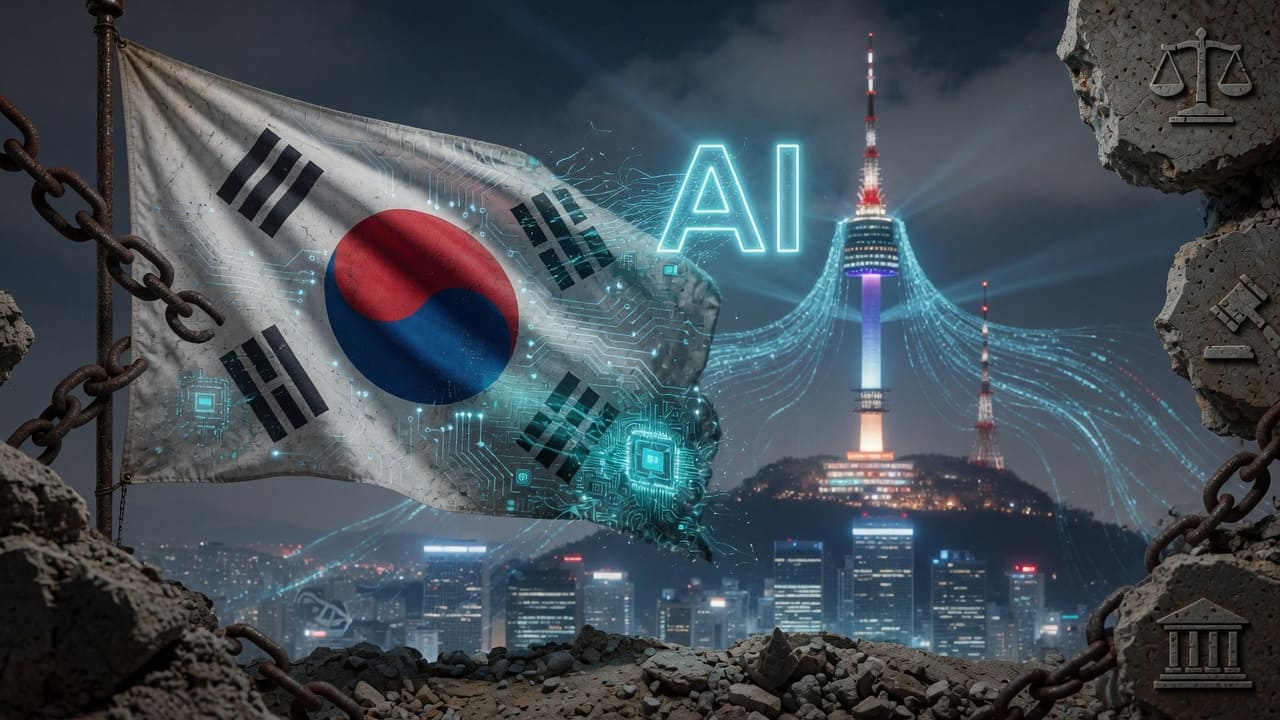
The country behind the loudest AI growth story of 2026 also runs what Seoul presents as the world’s first comprehensive, enforceable national AI law. The Basic Act on the Development of Artificial Intelligence and the Establishment of a Foundation for Trust has been in force since January 22, 2026. Its biggest administrative fine is about ₩30 million, roughly $20,000. The champagne bill at the Nasdaq MarketSite likely ran higher. That gap is not an accident, and any honest account of Korea’s AI law, explained on its own terms, has to start with it.
When Korea’s AI Hardware Paid for Everything
The IMF named Korea one of the world’s four largest net exporters of AI hardware, alongside Taiwan, Thailand, and Malaysia, and judged that chip demand would overwhelm the oil shock from the Middle East war. Semiconductors did not just soften the blow; they flipped the sign on the national forecast while the eurozone and Japan were cut.
The SK Hynix Nasdaq listing shows where that windfall goes next. According to the company’s regulatory filing, proceeds will fund the first fab at the Yongin semiconductor cluster and the P&T7 advanced packaging plant in Cheongju, with ₩11.9 trillion, about $8.5 billion, earmarked separately for extreme ultraviolet lithography scanners due by the end of 2027. Those are the same ASML machines at the center of the export-control fight MRKT3.0 broke down in its MATCH Act explainer.
The euphoria lasted one trading session. On July 13, SK Hynix shares plunged 15.4% in Seoul, the worst day in the stock’s history, dragging the Kospi down 9% and triggering a market-wide trading halt. The whiplash cuts the same way as the boom: when a single trade can move the national index 9% in a day, the state’s instinct is to protect the trade, not police it.
What the South Korea AI Basic Act Actually Punishes
The statute that formally covers Samsung, SK Hynix, Naver, and every foreign AI provider serving Korean users is broad on paper. It regulates generative AI labeling, defines high-impact AI across 10 critical sectors, including healthcare, energy, and hiring, adds safety requirements for high-performance systems trained at 10^26 FLOPs or more, and applies extraterritorially, with a domestic-representative requirement for large foreign operators.
The teeth are another matter. Cooley’s analysis maps the fine schedule, up to ₩30 million for failing to notify users that AI is in use, failing to appoint a domestic representative, or defying corrective orders and inspections. There is no revenue-linked penalty anywhere in the Act. The Stimson Center counts only a handful of violations that trigger the fine, and notes that ₩30 million would not register for any mid-sized company, let alone a chipmaker with a trillion-dollar valuation.
Even that ceiling is suspended. Per trade.gov, the Ministry of Science and ICT (MSIT) is running an enforcement grace period of at least a year through 2026, deferring investigations and fines except in cases of serious social harm such as loss of life. The “world-first” label deserves the same scrutiny: it is Korea’s framing, echoed by analysts, and it rests on the Act being both comprehensive and in force, since the EU AI Act passed earlier but phases in through 2027 and beyond.
The Robot Dogs the Enforcement Decree Left Out
Civil society flagged the design before the decree passed. When Hyundai Steel deployed robotic patrol dogs at its Dangjin plant in August 2025, unions criticized them as worker-surveillance tools. Under the draft enforcement decree, reported by Hankyung, surveillance and control systems that pose no direct threat to life or physical safety generally fall outside the high-impact category, so the robot dogs escape the Act’s core obligations entirely.
The same reporting captured more gaps: hospitals, employers, and banks that deploy AI in diagnosis, hiring, or lending are classified as mere “users” with no legal duties. Also, Oh Byung-il of the Digital Justice Network pointed out that where the EU bans practices like facial recognition in public spaces outright, Korea’s Act prohibits nothing. Human rights lawyers told the Guardian the law would not protect victims of AI-enabled impersonation; a company generating the offending content would face, at most, the ₩30 million labeling fine.
MSIT’s Case: Minimum Regulation Is the Strategy
The strongest defense of the Act is that it is doing exactly what it was built to do. MSIT openly calls its approach “minimum regulation” and pairs it with money: Korea announced a ₩763.2 billion, roughly $503 million, Science and Technology Innovation Fund in early 2026 for AI and semiconductor firms, and lawmakers say 80 to 90% of the Act’s text promotes industry rather than restricts it. Recent plans for free public AI tools further illustrate this pro-innovation stance.
The sequencing argument is harder to dismiss than critics allow. Brussels wrote penalties before the technical standards needed to comply with them existed, and has spent 2026 walking back the timeline. Seoul watched that and chose principles first, enforcement once the compliance ecosystem is ready, adding the grace period partly because even the EU missed its own dates. And with a survey of 101 Korean AI startups finding 98% unready to comply, deferral reads less like capture and more like arithmetic. Judged by the IMF’s numbers, it is hard to argue that the strategy is failing.
Brussels Wrote €35 Million First, Then Blinked
The EU AI Act wrote fines of up to €35 million or 7% of global turnover into the statute from day one. On June 29, the Council gave final approval to the Digital Omnibus, pushing high-risk obligations to December 2, 2027. Korea ran the sequence in reverse: principles immediately, teeth deferred, penalties trivial. Two roads to the same place, except one government spent 18 months negotiating its retreat, and the other never advanced. Worth noting, too, that the Korean tech law Washington is actually fighting is not the AI Basic Act but the DSA-inspired Network Act, in force July 7, which drew a State Department censorship warning within 48 hours.
MRKT3.0’s Taiwan edition found that every jurisdiction regulates hardest where its power resides. Taipei jails chip spies for a decade and leaves AI software to seven aspirational principles. Korea proves the finding in reverse: when the AI economy is the growth engine that just delivered the biggest IMF upgrade on Earth and the biggest foreign listing in US history, the AI law gets built not to slow it down. The Samsung and SK Hynix fabs are where Korea’s power gets protected. The AI Basic Act was never asked to guard anything. That is why it has no teeth, and why, in Seoul’s calculation, it does not need them.
Author: Ayanfe Fakunle
See Also:
Asia’s AI Rulebook: How Asia Regulates AI in 2026
How Does China Regulate AI in 2026? Beijing’s Rulebook Without a Single Comprehensive Law
TSMC Spies Got 10 Years. Taiwan’s AI Basic Act Has No Penalties at All