

What if one small country’s unbreakable data platform could show all of Europe how to safeguard its AI future from Big Tech dominance and geopolitical risks? Estonia’s X-Road, considered to be one of the world’s most secure data exchange layers, survived history’s first major state-sponsored cyberwar in 2007 and is now emerging as a leading model for Europe’s AI sovereignty. Europe’s window to claim its own AI destiny is closing fast. In an era where global powers hoard data and AI control, X-Road’s proven approach demonstrates how nations can maintain digital sovereignty, build trustworthy AI on their own terms, and protect true independence.
That near-collapse in 2007 could have ended Estonia’s digital ambitions. Instead, it ignited them. The crisis forced rapid hardening of the X-Road system into a resilient backbone that powers secure, interoperable services today. This transformation turned vulnerability into strength and positioned Estonia as a real-world example for others facing similar threats.
According to the live National Cyber Security Index (NCSI), a leading independent global benchmark, Estonia scores 96.67 out of 100 as of early 2026, placing it consistently in the global top 5 and frequently the top 3.
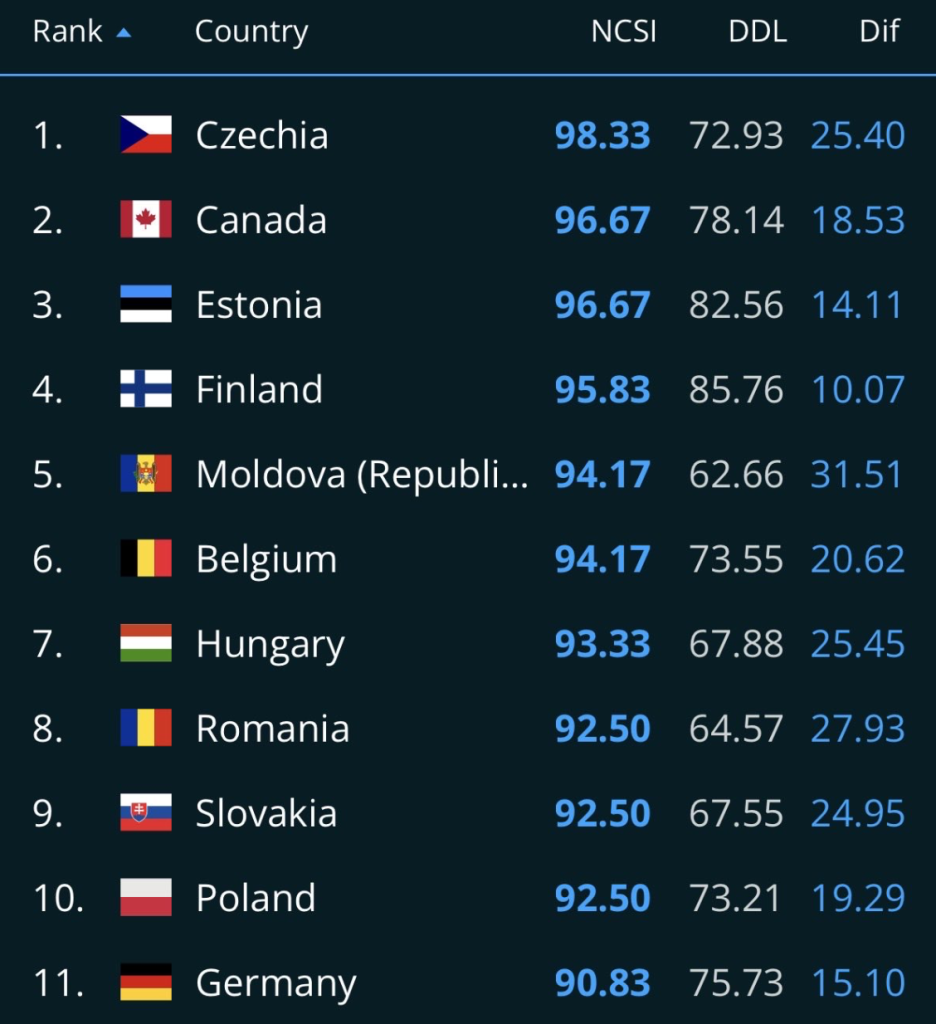
Why Does Estonia Rank So High on the National Cyber Security Index (NCSI)?
The score reflects excellence across legal frameworks, technical capabilities, organisational structures, capacity building, and international cooperation. Estonia also hosts the headquarters of the NATO Cooperative Cyber Defence Centre of Excellence.
Toomas Hendrik Ilves, the former president of Estonia, explained:
“Estonia’s cybersecurity technology is not advanced, but we are ahead on implementation … There is a huge difference between what we do and other countries – our focus was not on the gee whiz technology, but on implementation of a system that relies on positive identity, which is the foundation of the country’s cybersecurity programme.”
How Estonia Turned Independence into Digital Dominance
When Estonia regained independence from the Soviet Union in 1991, it faced a challenging reality: a small population, no significant natural resources, and an economy in urgent need of modernisation.
Rather than relying on traditional industrial paths, Estonian leaders made a forward-thinking choice. They bet on information technology as the fastest route to catch up with and eventually surpass Western Europe.
This vision gave birth to the e-Estonia initiative in the mid-1990s, which positioned digital infrastructure as a national priority.
One of the most transformative early efforts was the Tiger Leap (Tiigrihüpe) programme, launched in 1997. Through a public-private partnership, the government rapidly equipped every Estonian school with computers and internet connections.
By 2000, just three years later, every school in the country was online, an achievement that laid the groundwork for a digitally literate society. Education quickly became the foundation of this digital transformation.
Digital skills and coding were introduced at a young age. Today, children as young as 7 engage in programming through initiatives such as ProgeTiger. To close the gap for adults and prevent a generational digital divide, the government launched programmes to provide free basic computer training to adults, helping drive widespread adoption.
The results were striking. Internet usage rose sharply from about 29% in 2000 to 91% by 2016.
What Happened During Estonia’s 2007 Cyber Crisis?
In April 2007, Estonia faced its defining cybersecurity test. The government decided to relocate the Bronze Soldier, a Soviet-era monument in central Tallinn symbolising the Red Army’s victory over Nazism, to a military cemetery on the city’s outskirts.
For ethnic Estonians, it represented decades of Soviet occupation. For the Russian-speaking minority, it honoured liberation from fascism. The move sparked outrage, amplified by Russian media reports falsely claiming the statue and nearby graves were being destroyed. Protests escalated into two nights of riots and looting in Tallinn, leaving one dead, 156 injured, and nearly 1,000 arrested.
Simultaneously, Estonia became the target of the first known large-scale, state-linked cyberattack on a nation. Massive DDoS waves crippled banks, media outlets, government portals, and telecoms for weeks.
What Is a DoS Attack and How Did It Target Estonia?
A denial-of-service (DoS) attack seeks to overwhelm a website, server, or network with traffic or requests, degrading performance or rendering the service completely unavailable.
Distributed denial-of-service (DDoS) attacks amplify this threat by coordinating floods of traffic from multiple compromised sources (botnets). The distributed nature generates far greater volume than a single-source attack and makes legitimate traffic harder to separate from malicious requests, rendering DDoS attacks significantly more effective and difficult to defend against.
Botnets flooded servers in Estonia with spam and automated requests, disrupting online banking, cash machines, email, and news publication. Journalists could not upload articles. Government workers lost communication. Citizens struggled with basic digital services.
Attacks originated from Russian IP addresses with Russian-language instructions, though direct Kremlin involvement was never conclusively proven. Estonian officials alleged orchestration from Moscow, with opportunistic hackers joining in.
Liisa Past, an Estonian cybersecurity expert, said:
“The coordinated cyber attacks integrated into wider political operations against Estonia were a wake-up call to many others. After that, the centre in Estonia received the accreditation relatively quickly because other countries’ political will was suddenly there, also.”
Estonia responded aggressively by co-founding the NATO Cooperative Cyber Defence Centre of Excellence in 2008, creating data embassies, embedding cyber hygiene in school curriculums from primary level, and raising cyber defence at the UN Security Council in 2020.
The 2007 attacks tested Estonia to its limits and the resulting cyber resilience is what today positions it as a leader in sovereign AI adoption.
Estonia’s X-Road: How Does It Enable AI Sovereignty Across Europe?
In Estonia, X-Road is the beating heart of the nation’s digital society.
Launched in 2001, this secure, decentralised data-exchange platform connects more than 450 public and private organisations and underpins over 3,000 digital services that millions of residents and businesses rely on every day.
Its influence reaches far beyond Estonia’s borders. The open-source software, released under the MIT Licence, has been adopted or adapted in over 20 countries, including Finland, Iceland, Cambodia, Brazil, Japan, and Ukraine, allowing each nation to tailor it to their own needs while benefiting from Estonia’s proven security-by-design model.
Taavi Ploompuu, Head of Personal Services Department at Estonia’s Information System Authority (RIA), said:
“When each nation implements X-Road… any other organisation, either from the public or private sector… can set up their own connection via this data exchange platform and have their information systems, databases, and registries start exchanging data with other organisations over X-Road.”
“From a citizen’s point of view, it’s all the same government, so they really shouldn’t have to enter data they have already entered. Having a good solution for data exchange allows you to eliminate that,” he added.
Estonia Launches Eesti.ai to Double Workforce Value by 2035
Estonia, long a trailblazer in digital innovation with fully online government services, i-voting, and early blockchain adoption, is now charging into the AI era.
In late January 2026, Prime Minister Kristen Michal unveiled Eesti.ai, a national programme designed to embed AI across every sector and double the value of Estonian work by 2035.
Launched alongside Bolt founder Markus Villig, who chairs the international advisory council, the initiative unites Estonia’s tech heavyweights with global experts.
Michal noted that:
“AI development is accelerating and competition in the global economy is intensifying, so Estonia as a digital nation has a tremendous advantage here… Through public-private collaboration and smart use of data, we can develop new and powerful AI applications and capabilities that other countries cannot, and put them to work for our economy.”
The targets are bold: 25% GDP growth within five years and roughly €20 billion added by 2035. By harnessing AI, Estonia aims to offset workforce shortages from demographic trends, enabling fewer people to deliver far higher-value output.
Rather than spreading efforts thinly, Eesti.ai will zero in on a handful of high-impact projects selected this year through public-private partnerships, spanning education (building on the presidential AI Leap), healthcare, industry, energy, security, transport, finance, and more. It also amplifies existing work, including drone initiatives and public-sector AI tools.
“It’s a pretty sensible initiative … in the coming months, we’ll determine exactly what activities and scale the program should include. The goal is to focus on fewer but significant, high-impact projects so that something important can be accomplished within the next 1.5 years,” said Sten Tamkivi, an Estonian tech entrepeneur.
Backed by Estonia’s X-Road data infrastructure, the programme positions the country to lead in trustworthy, sovereign AI, turning digital resilience into lasting economic strength.
Author: Ruben McCarthy
See Also:
How Denmark Quietly Became Europe’s AI Powerhouse in 2026