
Isomorphic Labs is in talks to raise roughly $5 billion at a valuation near $50 billion. That would put a five-year-old Alphabet subsidiary with no drug candidate yet in human trials among the most valuable private biotechs in the world.
It is run by Nobel laureate Demis Hassabis, built on the AlphaFold work that came out of DeepMind, and partnered with Eli Lilly, Novartis and Johnson & Johnson. As of early November 2026 the clinical reality remains preclinical. Hassabis has described the current state of drug discovery as the equivalent of “building an airplane without CAD,” something no one would accept today, but still the industry standard.
Most AI drug discovery companies spend years chasing a single meaningful partnership. Isomorphic already has three of the largest. The problem is that none of its own molecules has yet been tested in a person, which is the point where the valuation and the clinical reality will have to meet.
What Does Isomorphic Labs Actually Do?
Isomorphic Labs designs therapeutic candidates with AI instead of running traditional discovery at commercial scale. Its engine, called IsoDDE, works across small molecules, antibodies, peptides and molecular glues. Large parts of candidate generation happen in silico.
It co-developed AlphaFold 3 with Google DeepMind. The model, published in May 2024, predicts the structure and interactions of proteins, nucleic acids, small molecules and other biomolecules with higher accuracy than earlier tools on several key benchmarks. Isomorphic staff appear as core contributors on the paper. More advanced versions of the design engine have stayed internal.
Work is split between partnered discovery programs and a smaller set of wholly owned internal programs focused on oncology and immune-mediated disease. Currently, no commercial product exists.
The company has offices in London (headquarters), Lausanne and Cambridge, Massachusetts, with headcount in the mid-400s.
Who Owns Isomorphic Labs?
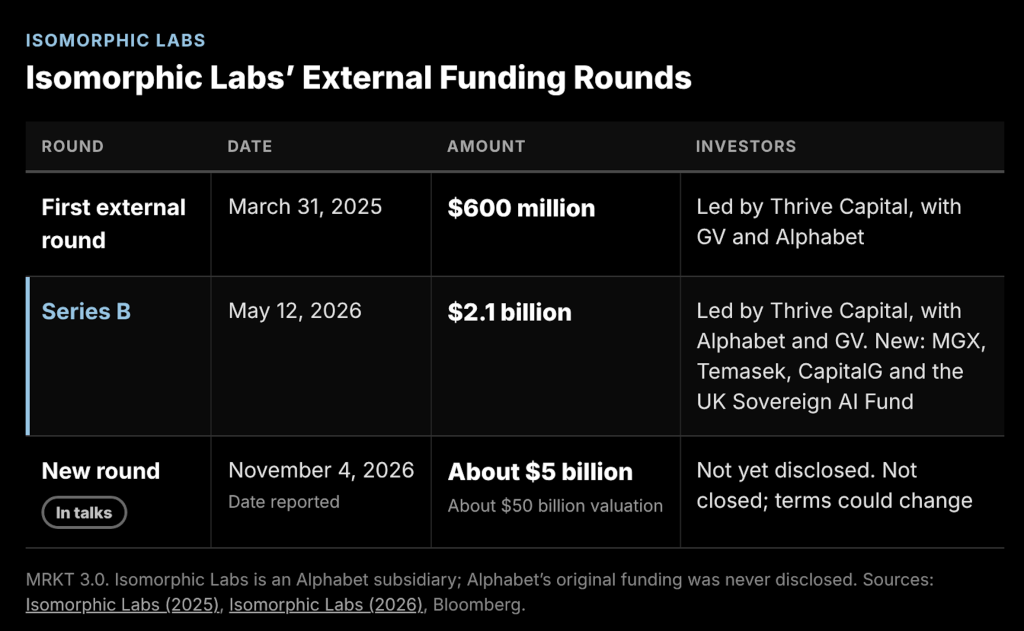
Isomorphic Labs is a subsidiary of Alphabet. Exact ownership percentages after the external rounds are not public, and the size of Alphabet’s original capital commitment was never disclosed. Alphabet continues to participate as an investor.
The external capital has come in two main rounds:
- March 2025: $600 million, led by Thrive Capital, with participation from GV and Alphabet.
- May 2026 Series B: $2.1 billion, again led by Thrive Capital, with existing backers Alphabet and GV plus new investors MGX, Temasek, CapitalG and the UK Sovereign AI Fund.
Company statements said the capital would scale IsoDDE, advance the pipeline toward the clinic and support hiring.
Demis Hassabis said in the Series B release: “Now that we have shown our approach is fundamentally sound, our focus is on scaling our technology to its full potential. This capital injection allows us to build out our drug design engine at scale, driving us forward in our mission to solve all disease.”
Reports on the new talks noted that the financing has not closed and details could change.
The Pharma Deals That Carry the Valuation
The commercial foundation is three large research collaborations.
In January 2024, Eli Lilly agreed to a multi-target small-molecule deal. Eli Lilly paid $45 million upfront, and Isomorphic is eligible for up to $1.7 billion in performance-based milestones plus royalties.
The same day, Novartis signed a deal for three small-molecule targets. It paid $37.5 million upfront, with up to $1.2 billion in milestones plus royalties. Novartis expanded the collaboration in February 2025, adding up to three more programs on the same financial terms.
In January 2026, Johnson & Johnson entered a multi-target, cross-modality collaboration covering small molecules, biologics, peptides and molecular glues. Financial terms were not disclosed. Isomorphic handles in-silico design while partners typically run experimental assays and later development.
Headline deal values exceed $3 billion once milestones are included. So far, the cash actually received is limited to the upfront payments and research funding. Those larger figures only materialise if the programs move forward in the clinic.
When Will Isomorphic Labs Reach the Clinic?
Public detail on specific candidates is thin. No named molecules, targets or IND filings have been released. Internal programs focus on oncology and immunology. Partnered programs also remain undisclosed.
In early 2025 Hassabis indicated AI-designed drugs would reach trials by the end of that year. The target later moved to the end of 2026. As of early November 2026, none have started.
At Bloomberg Tech in London on November 2, president of Isomorphic labs, Max Jaderberg, described the company as still in its “first innings,” with programs deep in preclinical work. He also said he expects AI will eventually design all medicines: “This will happen. All drugs in the future will be AI-designed. There’s no question in my mind. I just don’t want that to take 20 years or 50 years to happen passively.”
The company has joined broader data efforts such as the Virtual Biology Initiative and signed a two-year pre-clinical research agreement with Abu Dhabi’s Department of Health in October 2026. These expand scientific reach, but they do not change the absence of human data on Isomorphic’s own candidates.
Where It Sits Against Everyone Else
Isomorphic combines Alphabet compute access, the AlphaFold technical lineage and large multi-target pharma deals at a scale few pure-play AI discovery companies match.
Public peers such as Recursion Pharmaceuticals have candidates further along in the clinic yet trade at valuations far below the figures discussed for Isomorphic. Groups including Insilico Medicine have moved individual programs into trials faster in some cases.
Isomorphic’s distinctive claim is a single generative and predictive engine that can work across different types of drugs and disease areas, rather than a narrow tool for one specific problem. Realized revenue still comes almost entirely from the partnerships. The high private valuation talk rests on the quality of the predictions, the willingness of large pharma companies to sign deals, and the assumption that those predictions will eventually translate into working medicines. Traditional biotech failure rates after a drug first enters human trials remain high, and AI does not yet have a proven track record of changing those odds at scale.
What’s Next on the Cards for Isomorphic Labs?
The near-term test is whether the first Isomorphic-designed candidates enter the clinic by the end of 2026. A closed $5 billion round at the reported valuation would further separate the company from most AI-native peers on capital and expectations. Dilution, Alphabet’s continuing influence and the conversion of milestone potential into actual clinical progress will matter more than headline funding totals.
Author: Grace Sharp
See Also:
Who Owns Europe’s AI Champions?
Frequently Asked Questions:
Isomorphic Labs is an Alphabet subsidiary that uses AI to design drug candidates. It was founded by Demis Hassabis and builds on the AlphaFold work from DeepMind.
Isomorphic Labs was founded by Demis Hassabis, the CEO of Google DeepMind and a Nobel laureate for his work on AlphaFold.
As of November 2026, Isomorphic Labs is in talks to raise roughly $5 billion at a valuation near $50 billion. The round has not closed.
No. As of early November 2026, Isomorphic Labs remains preclinical. CEO Demis Hassabis previously targeted the end of 2025, then moved the timeline to the end of 2026.
Isomorphic Labs has research collaborations with Eli Lilly, Novartis and Johnson & Johnson. The Lilly and Novartis deals were announced in January 2024, and the J&J collaboration in January 2026.