


Groups opposing data centres in Ireland have shown they can shape outcomes both locally and at national level. In Waterford, City and County Council refused a major proposal in Kilmeaden on October 15 after more than 500 submissions and a protest that drew over 300 people. Locals campaigned against the development, which they said would lead to a “lasting change to the rural landscape.”
And this is not just an isolated case. Similar campaigns have appeared in other counties, and a separate High Court challenge to Ireland’s national grid-connection rules for data centres is already under way.
What’s clear is that these groups are creating quite the commotion for data-centre developments. What is not so clear is who is paying for the fight. From government-funded environmental groups to international law charities and philanthropic foundations, the money behind the opposition is more complicated than it first appears.
Who Is Challenging Data Centres in Ireland Right Now?
Resident groups have organised the most visible local campaigns. Naas Data Centre Awareness has focused on the Herbata proposal in Kildare. Kilmeaden Against Industrialisation led the effort that produced more than 500 planning submissions and the October protest before the council refused permission. These sit inside a wider pattern of opposition across Europe that we mapped earlier this month.
National organisations have taken the same issues into formal appeals and the courts. Friends of the Earth Ireland and Friends of the Irish Environment have worked with ClientEarth on both individual projects and the broader electricity-connection policy.
Where Does Their Money Come From?
The local campaigns remain the least transparent. No public accounts, foundation grant or overseas donor has been linked to either the Naas or Kilmeaden groups. Named organisations, on the other hand, are somewhat easier to trace.
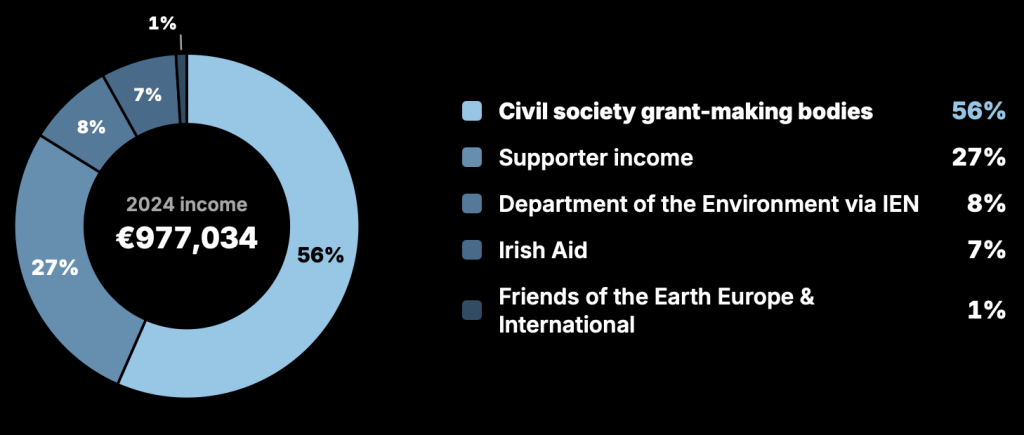
Friends of the Earth Ireland reported roughly €977,034 in income in 2024. Of that total, around €549,996 came from civil-society grant-making bodies and €264,879 from individual supporters. It also received €77,803 through the Irish Environmental Network and €72,930 from Irish Aid.
Friends of the Irish Environment reported €76,179 in income in its 2023 accounts, including €44,806 in general grants. The statements do not name the original source of every grant.
The clearest public funding line runs through the Irish Environmental Network. It received €3.127 million from the Circular Economy Fund in both 2024 and 2025 and spent €1.61 million on core funding for members in 2024.
On the research side, Friends of the Earth Ireland and Beyond Fossil Fuels jointly commissioned a 2026 report that put the household cost of data-centre growth at €715 million between 2015 and 2023. Beyond Fossil Fuels reported €3.26 million in income in 2025, including contributions from the European Climate Foundation and the ClimateWorks Foundation.
There is one important point to note. There is no evidence that all the funding from these organisations went directly to data-centre opposition. Whilst we can trace that each of these groups is actively against data centres, they are also committed to other fights where funding may also be spent. This is an overall look, not just focusing on data centres.
How Local Campaigns, National NGOs and ClientEarth Work Together
The division of labour appears in the public record. Residents have organised the protests and the bulk of the planning objections. National groups have filed the formal appeals and policy challenges.
On the Herbata project in Naas, Friends of the Earth Ireland and Friends of the Irish Environment jointly appealed the planning decision and submitted a legal opinion prepared by FP Logue LLP. ClientEarth later filed a separate formal observation.
In April 2026 the same three organisations brought a High Court challenge against the Commission for Regulation of Utilities’ data-centre connection policy.
ClientEarth’s 2025 accounts showed £44.1 million in worldwide income. The largest contributions came from the Waverley Street Foundation (£9.02 million), the Children’s Investment Fund Foundation (£4.92 million) and the Sigrid Rausing Trust (£2.25 million). No public document identifies which of those donors, if any, is funding the Irish cases.
Gaps, Tensions and Incomplete Disclosures
The major organisations publish their overall income, yet the amount spent on individual data-centre campaigns is not broken out. Three questions remain open. Who paid for the FP Logue LLP opinion on the Herbata appeal? Whether any specific foundation grant supports ClientEarth’s Irish legal work? And who financed the joint electricity-cost report?
*A response is still outstanding from the Companies Registration Office on the Herbata legal costs.
The government funding question is equally unresolved. The Irish Environmental Network distributes unrestricted core grants, but the available records do not show whether any of that money was used for data-centre litigation. Grant agreements and detailed expenditure records would be needed to clarify the point.
What This Means for the Strength of the Opposition
Ireland’s data-centre opposition is not a single centrally funded movement. Residents supply the local organisation. National NGOs supply the campaigning and legal capacity. International organisations supply specialist research and courtroom expertise.
That combination has allowed challenges to move from individual planning applications to the national electricity-connection rules. The financial arrangements behind the most significant legal cases, however, remain undisclosed.
What to Look for Next
The Herbata appeal is expected to be decided by early 2027. The High Court challenge to the Commission for Regulation of Utilities’ connection policy will also continue through the coming months. Further local planning decisions on other large proposals are due in the next year, and any new research or policy papers from the national groups are likely to appear around the same time. Tracking which organisations file the next set of appeals or observations will show whether the same mix of local, national and international capacity continues to drive the opposition.
Author: Connor Fitzgerald