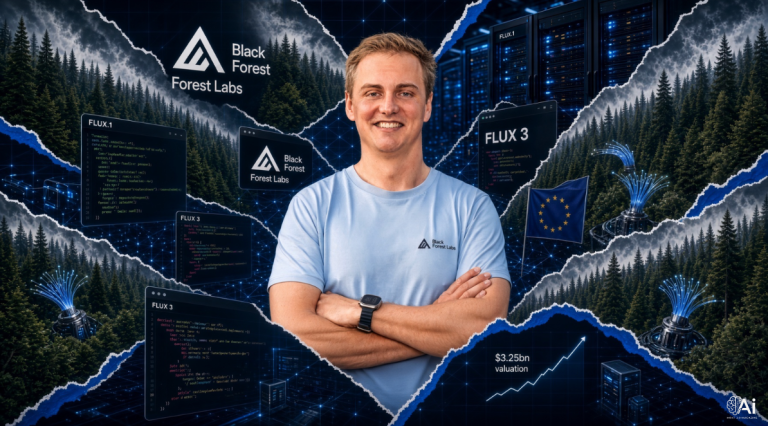

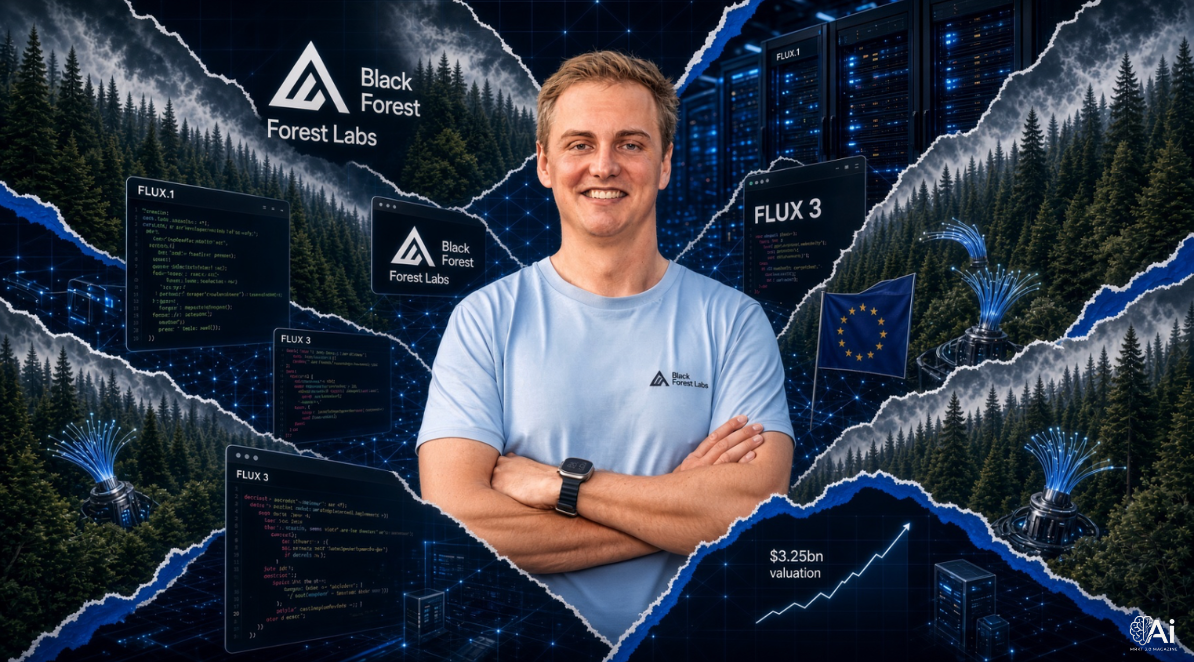
Robin Rombach is co-founder and chief executive of Black Forest Labs, the Freiburg company behind the FLUX image and video models, which investors valued at $3.25 billion in December 2025. Before that he was lead author of Latent Diffusion, the method that powers Stable Diffusion.
Who Is Robin Rombach?
A physicist turned AI researcher. “When I started studying physics I was convinced that I never need to learn programming at all,” he says. On stage at Slush in Helsinki in November 2025, he described how simulating physical systems pulled him into code, and from there into generative AI.
In Björn Ommer’s computer vision lab in Heidelberg he met some of his future co-founders. The group compressed images into smaller representations so that models could run on what he calls “potato GPUs”. That work led to VQGAN and then Latent Diffusion, which became the basis of Stable Diffusion when the lab, by then at LMU Munich, worked with Stability AI and Runway in 2022.
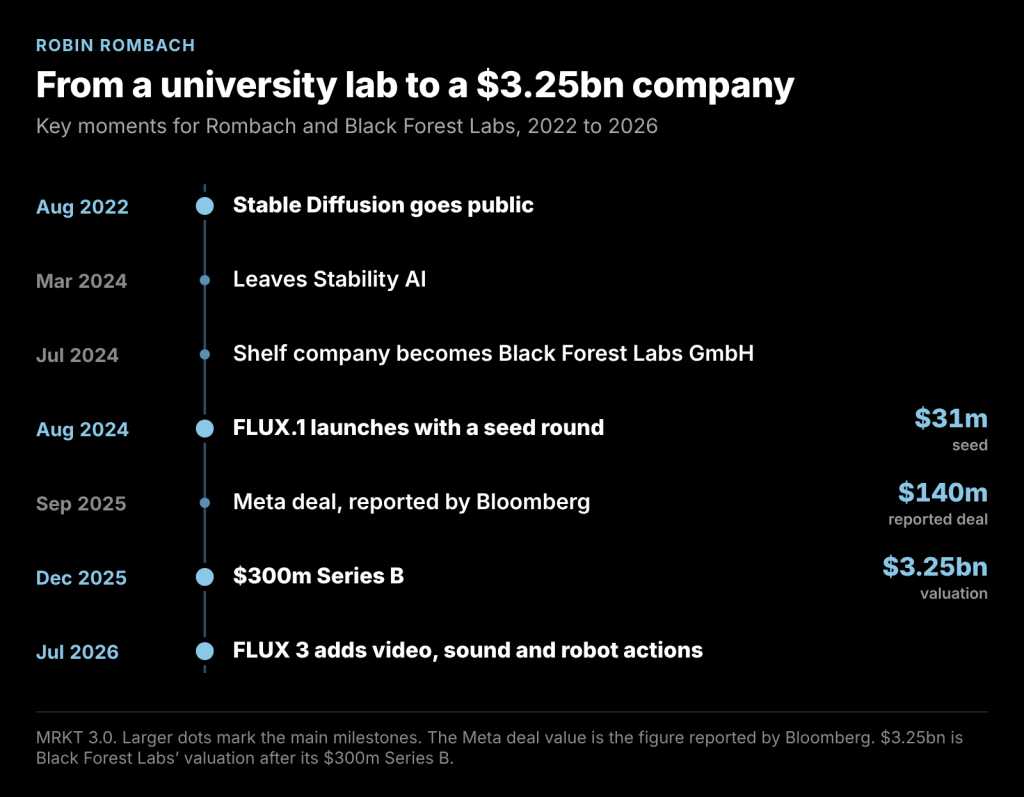
“Being resource constrained actually forces innovation,” he says. He later joined Stability AI’s research team and left in March 2024 with Andreas Blattmann and another member of the original team. On the Slush stage, Hugging Face co-founder Thomas Wolf put downloads of the open models Rombach has helped release at about half a billion.
How Did Black Forest Labs Start?
It came out of stealth on August 1, 2024 with FLUX.1 and a $31 million seed round led by Andreessen Horowitz. The team released three versions at once. Pro is paid, Dev has open weights for non-commercial use and Schnell is fully open source. “Schnell means fast in German,” Rombach says, and he calls the open models a “top of the funnel for developers who then also use our pro model in the end”.
In a September 2026 interview, Rombach said registering the German company took longer than training FLUX.1. The Munich commercial register shows that BFL GmbH began as SCUR-Alpha 1721 GmbH, a ready-made shelf company that its provider registered in March 2024. It took the BFL name on July 3, 2024, with Rombach and Blattmann among its managing directors, four weeks before FLUX.1 came out.
The parent company is American. Black Forest Labs Inc. was incorporated in Delaware in 2024, with its main office in Freiburg.
Who Owns Black Forest Labs?
Its founders and venture investors, but the company doesn’t publish the size of any stake. A Form D signed by Rombach and filed in June 2026 shows $307.6 million of shares sold to 36 investors from November 21, 2025. The timing matches the Series B that Salesforce Ventures and AMP co-led. Rombach, Blattmann and Patrick Esser sit on the board with AMP’s founder, Anjney Midha.
A fund filing adds the price. StepStone’s venture fund reported buying 9,131 preferred shares on November 21, 2025, the Form D’s first-sale date, and 9,131 common shares in a secondary sale on January 26, 2026, at $2,152,632 for each block. That is $235.75 a share either way and, at the $3.25 billion valuation, about 13.8 million shares in total, by our calculation.
Common stock is typically held by founders, employees and some early backers. The filing doesn’t say who sold, and neither the company nor the fund has commented on the sale.
How Big Is Black Forest Labs?
It doesn’t publish revenue. In September 2025 it was reported that Meta would pay $140 million over two years to use its image models, and the company names Adobe, Canva and Microsoft among the partners building on FLUX. The figures on record:
- a $31 million seed round in August 2024, led by Andreessen Horowitz
- a $300 million Series B at $3.25 billion in December 2025
- more than $450 million raised in total, including a Series A it never announced
- about 100 staff in Freiburg and San Francisco by July 2026
On the OpenRouter Show, after FLUX.2 came out, he said editing is now a bigger use of these models than making images from scratch. “Image editing itself is such a massive application. I would say it’s even larger than pure text image generation,” he says. FLUX.2 reads prompts through a Mistral model with 24 billion parameters.
Why Does Robin Rombach Stay In Freiburg?
He argues that the team and the computing power matter more than the postcode. “If you don’t want to sit next to your compute cluster then it doesn’t really matter where you build your team,” he says, adding that southern Germany has “huge talent density”. The company still runs an office in San Francisco.
He also wants the ambition to be global. “We are building it from Europe but we are building it for the world,” he says. Of an AI summit in Berlin the day before his Slush talk, he said the debate “sometimes feels a little bit defensive and too overfocused on Europe alone”. He posted his remarks from the G7 summit in Evian in June 2026.
A 90-person frontier AI lab…
— Robin Rombach (@robrombach) June 18, 2026
What Is FLUX 3?
A single model design for video clips of up to 20 seconds with sound, still images and robot actions, which Black Forest Labs unveiled on July 23, 2026. “You can’t cheat reality. A model that only learns images can only generate images,” Rombach said at the launch. The video model opened to API users in August. A 7 billion-parameter open-weight robot model followed in September, and FLUX 3 Image went on sale on October 1.
The company has also signed up a famous user. In June 2026 it announced Martin Scorsese as an adviser who storyboards scenes with FLUX, and the news drew criticism from parts of the film and creative world. Rombach is looking further ahead. “I’m extremely excited about the potential of real time world models,” he says.
How Do You Contact Robin Rombach?
On X as @robrombach. For a longer listen, try his Slush conversation with Thomas Wolf or the OpenRouter Show episode on FLUX.2.
Author: Akos Szima
See Also:
Who Is Anjney Midha? The Anthropic Backer Selling Computing Power
Frequently Asked Questions:
Its founders, led by chief executive Robin Rombach, and investors including Andreessen Horowitz, Salesforce Ventures, AMP, Nvidia and General Catalyst. The company hasn’t published the size of any stake. Its US parent reported selling $307.6 million of shares to 36 investors from November 2025.
Robin Rombach, Andreas Blattmann, Patrick Esser and other researchers from the team behind Latent Diffusion and Stable Diffusion. Rombach is chief executive.
It was valued at $3.25 billion after its $300m Series B in December 2025, its latest announced round. It has raised more than $450 million in total.
Some versions are. FLUX.1 Schnell and the smallest FLUX.2 Klein model use the Apache 2.0 licence, the Dev models have open weights for non-commercial use, and FLUX 3 Action came out with open weights in September 2026. The Pro models and FLUX 3 Image are paid.