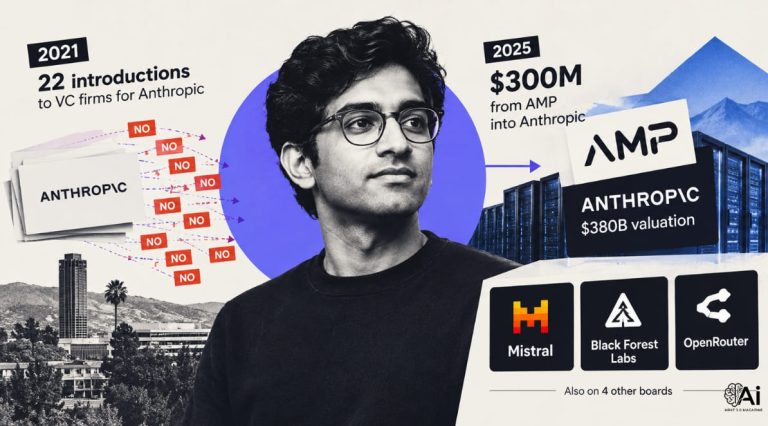

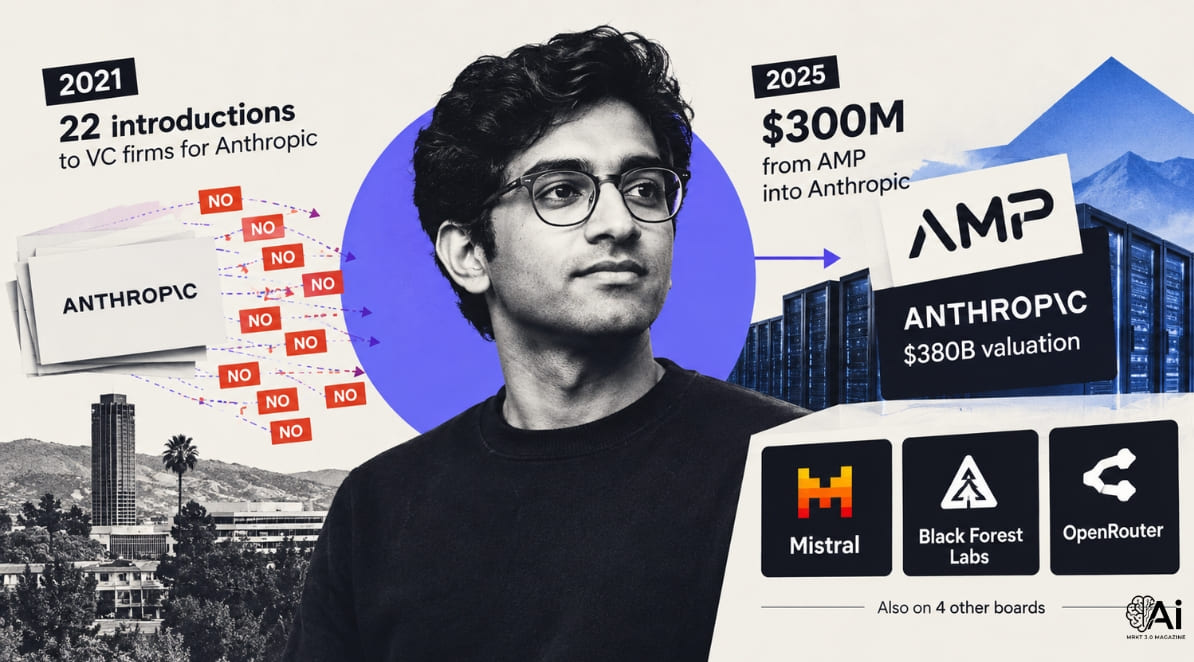
In early 2021 Anjney Midha set up 22 introductions to Silicon Valley venture firms for a young AI lab called Anthropic. Twenty-one of them said no.
Five years later his own firm, AMP, reportedly put $300 million into Anthropic at a valuation of $380 billion. By then Midha also sat on the boards of Mistral, Black Forest Labs and OpenRouter.
Midha says he is not a traditional venture capitalist. He usually helps start companies from the first day. Now, through AMP, he also offers them computing power, which many AI labs struggle to secure.
Who is Anjney Midha?
Anjney Midha is the co-founder of AMP, a Menlo Park company that rents computing power in bulk for AI labs. It is a public benefit corporation, which means a public purpose is written into its charter.
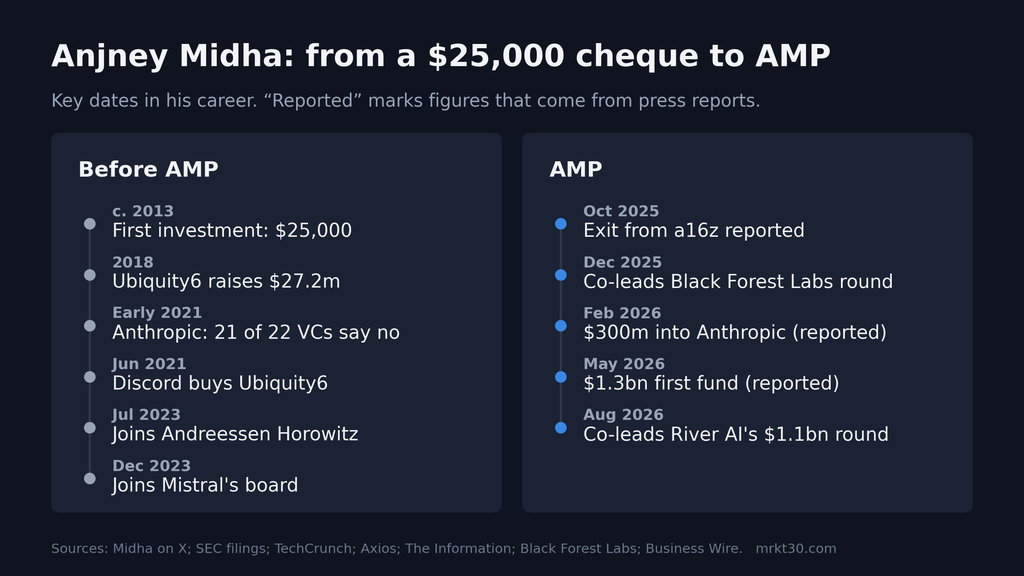
Until late 2025 he was a general partner at Andreessen Horowitz, which now lists him as a venture partner. He left the full-time job, he wrote on X, “to start a public benefit co focused on reducing AI control risks”. He now sits on seven AI boards. Two are in Europe: Mistral AI in Paris and Black Forest Labs in Freiburg.
He was born in India, schooled there and in Singapore, and studied at Stanford, including graduate work in bioinformatics around 2014–15. He still teaches there. The course he co-teaches began four years ago with 50 students and now takes 500. His name, he tells his students, is pronounced Anjani, and friends call him Anj.
How Did Anjney Midha Get to Andreessen Horowitz?
Midha started working at Andreessen Horowitz by backing and building companies that needed a lot of computing. As a student he wrote his first cheque, for $25,000, through Dorm Room Fund. The student-run fund was then backed by First Round Capital. He then spent four years as a partner at Kleiner Perkins, focusing on computer vision and chip-heavy software.
Next he co-founded Ubiquity6, a computer vision start-up. A 2018 SEC filing shows a $27.2 million round from six investors, signed by Midha as president. Then, in June 2021, Discord bought the company and made him a vice president.
In July 2023 he joined Andreessen Horowitz to lead its AI investing. There he ran Oxygen, a programme that pooled graphics chips for the firm’s start-ups. The name came from a founder who told him that without GPUs on day one, “we can’t breathe”.
What Was His Role in Anthropic’s First Funding Round?
He made the introductions, and almost every firm turned them down. He described it on X in January 2026: “when we were raising the first round for anthropic, i set up 22 intros to VCs up and down sandhill, circa early ‘21 we got 21 NOs, including from folks i considered heroes”.
On one podcast he said the round had to shrink from $500 million to $100 million. In the end Anthropic announced a $124 million Series A in May 2021, led by the Skype co-founder Jaan Tallinn. Midha invested as an angel. He has called the round “basically a handful of angels investing tens of millions of personal capital”.
In February 2026 Anthropic raised $30 billion at a $380 billion valuation. AMP’s part was reportedly $300 million.
Which AI Companies Does Anjney Midha Sit on the Board Of?
Seven, according to Andreessen Horowitz. SEC filings from June and July 2026 also name him as a director of Black Forest Labs and OpenRouter.
| Company | Country | Where the seat is recorded |
|---|---|---|
| Mistral AI | France | His own posts; a16z |
| Black Forest Labs | Germany | SEC filing; a16z |
| OpenRouter | US | SEC filings; his own posts |
| Luma AI | US | a16z |
| Sesame | US | a16z |
| LMArena | US | a16z |
| Periodic Labs | US | a16z |
He joined Mistral’s board in 2023, when Andreessen Horowitz led its Series A. Mistral confirmed that round at €385 million, then about $415 million, at a valuation of about $2 billion. Midha has since rounded the raise to $500 million. In September 2026 Mistral raised €3 billion, about $3.5 billion, at a post-money valuation of more than €21 billion, or about $24 billion. That is the same figure we reported at the time. We have also mapped who owns the company.
Stripe bought OpenRouter in August 2026. Reports put the price at $7.5 billion; neither company published official terms. Midha’s OpenRouter seat is therefore likely to lapse.
Why Does Anjney Midha Matter to European AI?
Because he backs two of Europe’s best-known AI model makers, and he says Silicon Valley once wrote them off. In September 2025 he wrote that many there had been sure “Europe would never produce any impactful AI”.
He does not oversell the region, though. In July 2026 he wrote that “America remains the capabilities frontier”. Europe’s shortage of computing power, he added, is pushing its labs towards industrial work.
His new firm ties him to both labs a second way. AMP names Mistral and Black Forest Labs as founding members of its computing network. In December 2025 AMP also co-led Black Forest Labs’ $300 million Series B with Salesforce Ventures. Air Street Capital, whose founder we profiled this month, joined the same round.
What Is AMP, and How Does It Work?
AMP is a public-benefit company that pools computing capacity for independent AI labs and also invests in them. Midha describes the compute side as infrastructure, not a conventional cloud or a conventional fund.
The pitch is about waste. AMP says independent teams often leave 30 to 40% of their computing power unused.
In May 2026 AMP raised $1.3 billion for its first fund. Midha named NEA, Andreessen Horowitz, Y Combinator and StepStone as backers. In late May he appeared on Bloomberg TV, and Bloomberg then reported a $100 billion target over five years, a fifth of it from AMP itself.
AMP invests as well. In August it co-led a $1.1 billion round for River AI with General Catalyst. River is the start-up of xAI co-founder Igor Babuschkin. General Catalyst’s president sits on Mistral’s board as well. AMP has also pledged up to $500 million of profits through 2030 to communities living through the shift to AI.
Why Does Midha Say Computing Power Is Not a Commodity?
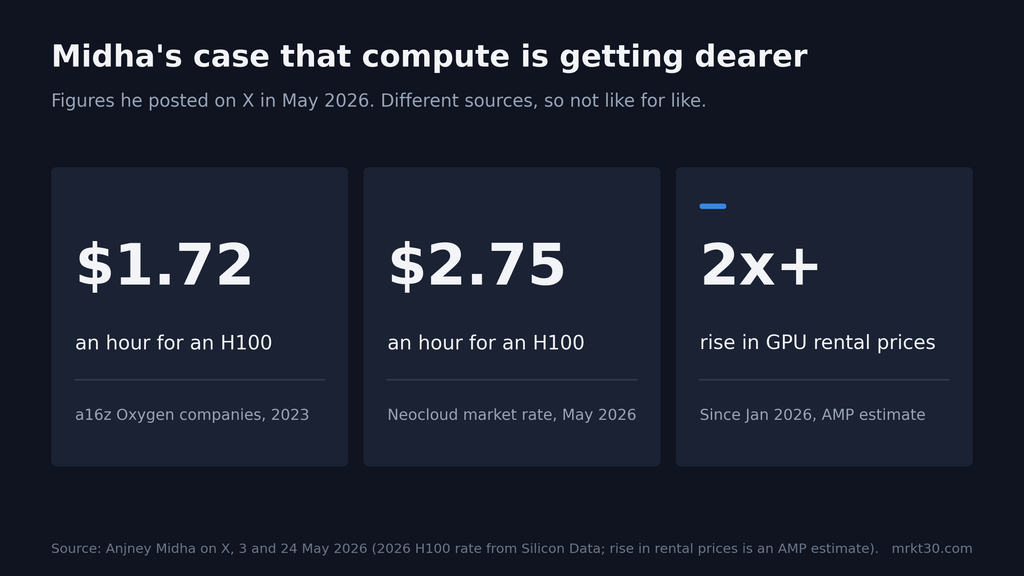
Because, he argues, its price keeps rising. He told his Stanford class that rents for NVIDIA’s H100 chip, the workhorse processor for training large models, fell until August 2024 and have climbed since. In May 2026 he wrote that start-ups on Oxygen had paid $1.72 an hour for one in 2023. Specialist cloud providers were charging $2.75. The two figures come from different sources, so they are not a strict comparison. Three weeks later he said rental prices had at least doubled since January. “We are living through the covid of compute, and all the toilet paper is gone,” he wrote.
In the same lecture he said chips are not interchangeable, even from the same maker. He wants shared standards, of the kind railways and electricity once needed. He also sees the business as infrastructure. “Compute isn’t venture. It’s infra with venture demand curves and utility contract structures,” he wrote in May. His shorter version, posted in June, is “not your chips, not your margins”.
What Do the SEC Filings Show About His Funds?
About $300 million in one fund, and no trace yet of the rest of the $1.3 billion. The clearest number is in a Form ADV, the report that fund advisers file with the SEC.
AMP Foundry GP has reported to the SEC as an adviser since April 2026. Its June filing lists one fund, AMP Foundry Fund I, LLC, with gross assets of $300 million and about 25 investors. That is the size of the Anthropic stake reports indicate. However, the filing does not say what the fund holds.
Seven Form D notices (the SEC’s short filing for a private securities offering) name Midha, and two cover venture funds whose general partner he manages. One, AMP Foundry Fund I, L.P., filed on 11 May 2026, the day before the $1.3 billion reports. It lists no sales and no investors, and marks the first sale as “yet to occur”.
That does not contradict the reports. A fund may file before any money arrives, and SEC staff guidance says no update is needed just because the first sale has happened. The fund also said the offering would not run past a year, so it may never owe an annual update.
The other, AM Engine Fund I, filed in April 2023 and also reported no sales. No public source explains what it was for.
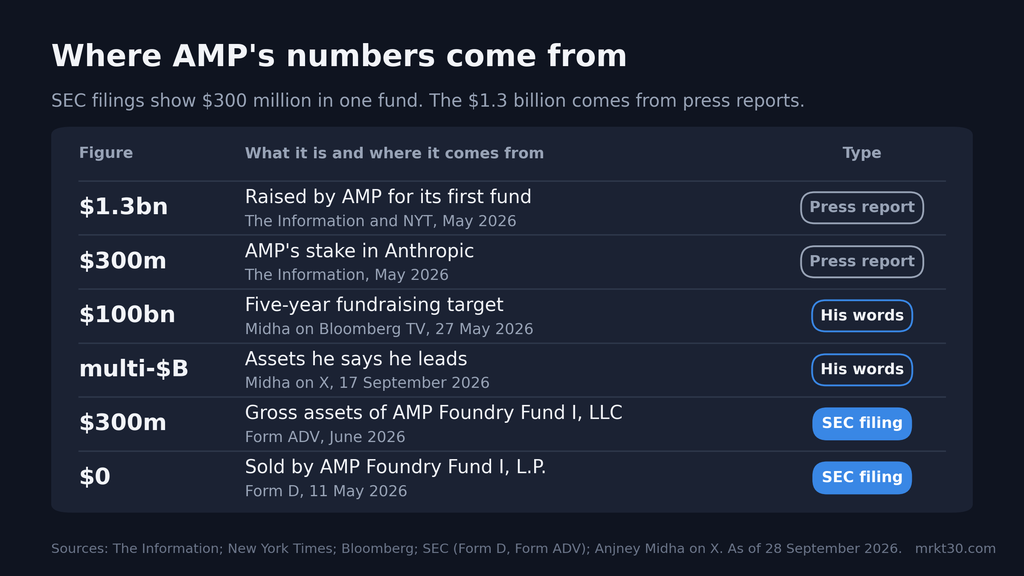
Both Form D filings cite Rule 506(b), which bars public advertising of an offering. In September Midha wrote on X that he leads “a multi-$B aum institution”.
Why Does Midha Say Most Venture Firms Are Dead?
Because, in his view, most of them missed the bets that counted. “You either did the seed/A/B of OpenAI or Anthropic, or you did not,” he wrote in August. He also warned that “an extinction level event is coming for many VCs”
His answer is to put more money in earlier. “If you need the top 0.1% of technical talent and compute, then capital is destiny,” he wrote in 2025.
What Is the Open Question About AMP?
Whether one investor can hold three roles at the same lab and keep them apart. At Black Forest Labs Midha sits on the board, a seat from his a16z years. AMP co-led its latest round, and AMP counts it as a founding member of its network. His posts suggest he sees that as the point.
What the public record does not yet show is how much money stands behind it.
Author: Akos Szima
See Also:
Who Is Shaun Maguire? The Elon Musk Whisperer
Who Owns Mistral AI? What the Company’s Own Filings Show
Europe’s 10 Most Valuable AI Startups to Watch in 2026
How We Checked This:
We read the SEC filings that name Midha and checked quotes against his lecture, posts and interviews; figures that appear only in press reports are credited to those outlets.
Frequently Asked Questions:
Anjney Midha is the co-founder of AMP, a company that pools computing power for AI labs and invests in them. He was a general partner at Andreessen Horowitz until late 2025. He sits on seven AI boards, including Mistral AI and Black Forest Labs.
He has said his full name is pronounced Anjani, and that friends call him Anj. Podcasts such as 20VC introduce him as Anj Midha.
AMP is a public benefit corporation in Menlo Park, California, co-founded by Anjney Midha. It rents computing power in bulk and shares it among AI labs. The Information reported in May 2026 that it had raised $1.3 billion for its first fund.
He left his full-time role. The Information reported in October 2025 that he would start AMP and stay on part-time as a venture partner. The firm’s website now lists him that way.