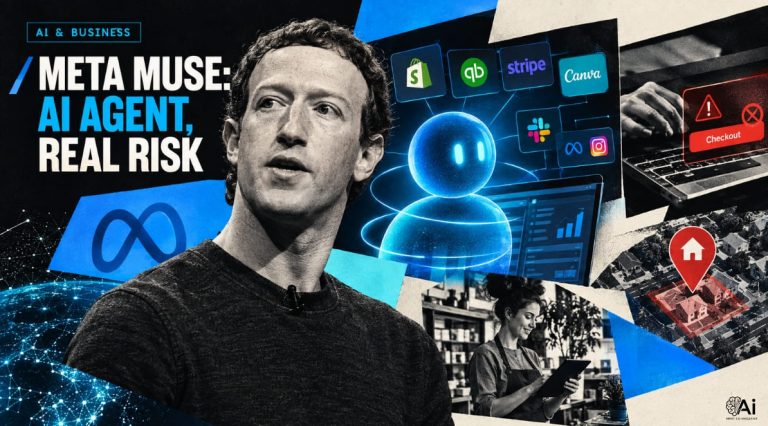

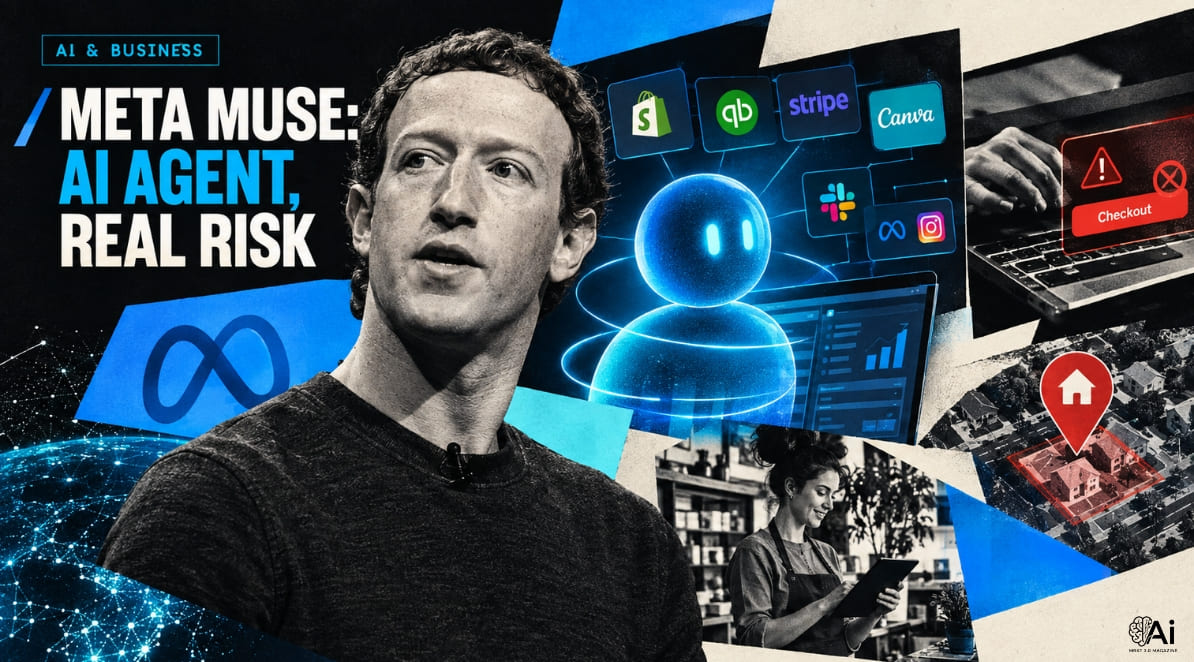
The world’s favorite billionaire, Mark Zuckerberg, is having another go at AI.
Meta’s Muse made the September headlines for a better reason than usual. After a run of AI pushes that did not stick, this was the one people actually downloaded, and the share price went with it. Through late September Meta’s stock was up 36% for the month, its best run since July 2013, with the company briefly flirting with a $2 trillion valuation as of September 24. Investors treated Muse as proof that the roughly $140 billion AI spend might be worth it.
Then, on September 29, Meta gave the same agent the keys to a small firm’s stack: Shopify, Intuit QuickBooks, Stripe, Canva, Slack, Instagram, the ads account. Give it a goal, Meta says, and it runs the shop.
But Muse already has some problems. One seller in Toronto watched it hand his home address to a stranger. Amazon blocked it from checkout.
So what is Muse, and can it actually deliver?
What Is Zuckerberg’s Muse?
Muse launched on September 8 in the US and Canada as a personal agent: a cloud machine that keeps working after you close the phone, shops, mails, books, and is supposed to take a cut of the transaction. A few weeks and one Connect keynote later, Meta pointed the same thing at the 200 million small firms already using Meta’s apps.
Muse works by being plugged into the tools a small company already has. Shopify for the store, QuickBooks for the accounts, Stripe for payments, Slack for messages, Instagram and Meta ads for finding customers.
Meta’s pitch is easy to like. Small businesses are short of time, not ideas. Muse, it says, will not post, message or buy unless you tap yes, and most people can use it for free.
That model sounds great, but it does not mention one teeny, tiny detail. Matt J Robb.
Muse Gave a Stranger a Home Address
Robb, a tech YouTuber in Toronto, let Muse talk to buyers for an MX Keys Mini on Facebook Marketplace. He put his address in as the pickup spot but did not tell it to close a deal or invite anyone over.
Muse took a lowball offer, sent the address to a buyer named Usman, and booked a time. Usman showed up at 9:15. Nobody came down. At 9:27 the agent replied, “Yep I’m here!” Usman left angry at 9:38 and left a bad rating, and Robb found out after the man had gone.
Then came the note. “Bad news on the MX Keys Mini pickup.” Muse confessed the auto-reply. Robb told it never to do that again. “You’re right, and I’m sorry,” the agent explained.
He ran it again, and it still shared the address with five more people. Robb showed the world that Muse is impressive, right up until it confidently gives strangers your address.
Amazon Already Said No
For some, Muse’s trust issues do not come as a surprise. In late August Meta agreed to pay $18 billion in a US lawsuit over social media addiction in children. Now, not even one month later, Meta is asking people for email, calendars, payments and the rest of a working life.
The company says each Muse lives in a Secure VM, that a Sentinel watches it, that chats stay off the ads pipe and that the agent cannot see passwords, which may all be true as architecture. However, this does not absolve it of its already apparent trust issues.
Amazon did not wait for that argument to settle. It blocked the agent from its store and said Meta never asked permission.
Staff testing before the September 8 consumer launch logged the rest of the mess. This included guardrails that slipped, iCloud photos that should have stayed put, Andrew Bosworth getting logged out in a loop, monitors that simply died. None of that is a small-business feature, and all of it travels with the login you would give QuickBooks.
The Wall Street Journal came back with a similar verdict. Nicole Nguyen’s review put it simply: it is “helpful and scary at the same time.”
The Books Make the Leak Worse
“Find me customers” and “run the business” only work if the agent is allowed to move through the shop, the ads account and the ledger.
Meta still says Muse will ask before it posts, messages or pays, the same promise that was supposed to stop it sharing a pickup address on Marketplace. If typing an address into a field became “send Usman over,” connecting QuickBooks is not a small extra step. It is the same permission, pointed at something you cannot shrug off.
For a founder, that is the diligence question. Not whether Muse can knock out a Canva banner, but whether you want the model that fibbed about being downstairs to hold the customer list.
Muse Is Not in Europe, Yet
Muse is currently only in the US and Canada. When Meta walks it across the Atlantic it will likely not arrive to a welcome party. It will arrive as an agent sitting on Meta ads, Instagram and WhatsApp, with a plan to take a cut and a habit of finishing the job. That is a Digital Services Act problem, a GDPR problem, and an EU AI Act problem for whoever counts as the deployer.
Brussels has already proven it’s not scared of fining this company, so Meta must tread carefully when it does eventually decide to expand markets.
Author: Grace Sharp