
China’s AI chip industry no longer needs NVIDIA, and the proof is already running in production. Shenzhen switched on a Huawei-powered cluster on March 28. Alibaba flipped the switch on its own in Guangdong ten days later. This isn’t a race China is trying to win. It’s a race it has decided to run alone.
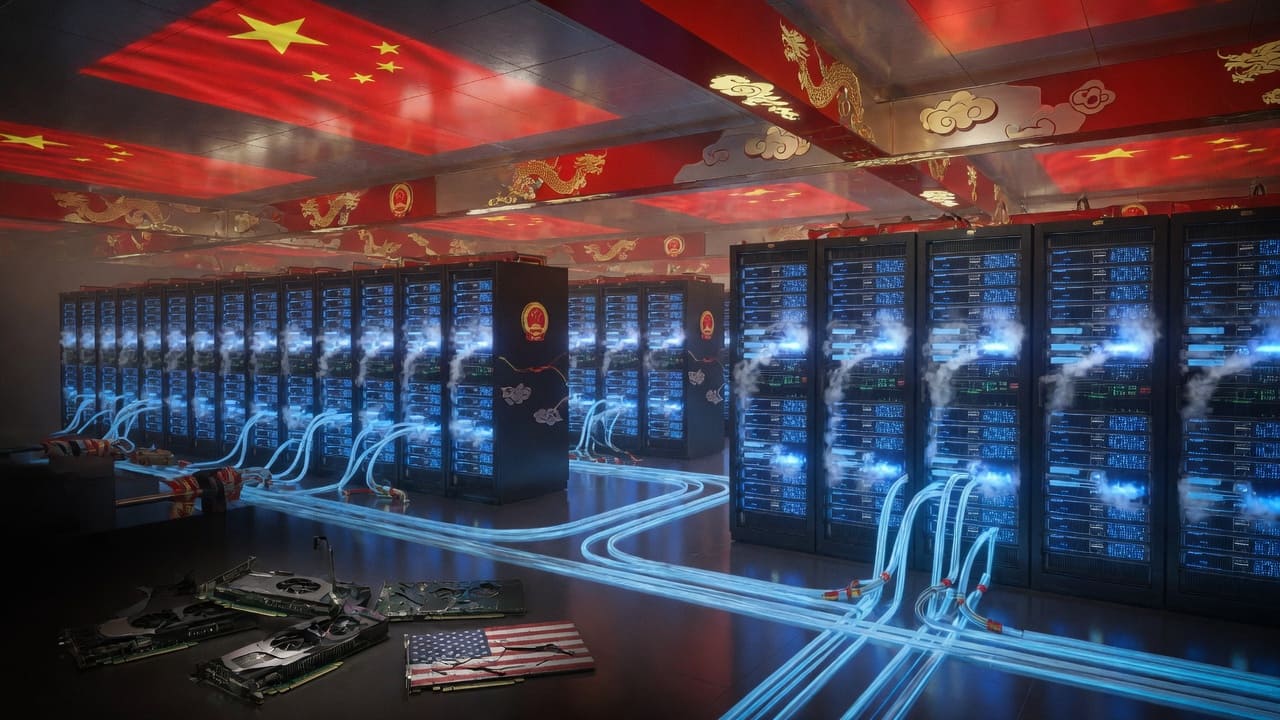
In under 2 weeks, two major AI factories came online in China powered entirely by domestic chips. No NVIDIA GPUs. No US export licences. No dependency on the supply chain the West assumed China couldn’t replace.
On March 28, Shenzhen activated China’s first 10,000-card AI cluster built on Huawei’s Ascend 910C chips. Ten days later, Alibaba switched on a second facility in Guangdong running 10,000 of its own Zhenwu semiconductors. Together, they mark a turning point in the global AI chip race, and a wake-up call for Europe.
On April 16, we reported TSMC’s record profits. This is only one half of the story – the supply side, where Taiwan and its allies are scaling faster than anyone can keep up with. This is the other half: the demand side of China’s semiconductor industry that decided it didn’t need to wait.
Two AI Factories. Ten Days. Zero NVIDIA GPUs.
Ten days apart. Two different cities. Two completely different domestic chip architectures. The same result: large-scale AI infrastructure, built and operated entirely within China’s own technology stack, with no dependency on US silicon.
28 March 2026 — Shenzhen
China’s First 10,000-Card Huawei Cluster Goes Live
- Shenzhen activated an AI cluster built on 10,000 Huawei Ascend 910C chips, delivering 11,000 petaflops of compute.
- Combined with a 3,000-petaflop cluster already running and fully booked, the facility now sits at 14,000 petaflops total.
- Nearly 50 organisations had already signed compute agreements before it switched on. The booking rate across both phases is 92%.
8 April 2026 — Shaoguan, Guangdong
Alibaba and China Telecom Launch the Zhenwu Cluster
- Alibaba, through its T-Head chip division, deployed 10,000 Zhenwu 810E accelerators at a new data centre operated by China Telecom in southern China.
- The facility is capable of running AI models with hundreds of billions of parameters. Expansion to 100,000 chips is already planned.
- Alibaba Cloud called it “fully domestic” and declared that China’s compute buildout had moved from chasing benchmark milestones to “large-scale industrial implementation.”
How China’s AI Chip Industry Closed the NVIDIA Gap
Individually, each factory is significant. Together they mark something different.
They show a transition from China building proof-of-concept domestic AI infrastructure to building production domestic AI infrastructure. The Shenzhen cluster was 92% booked before launch. Alibaba is already planning a 10x expansion. These are not demonstration projects, they are operational systems serving real commercial demand.
The Huawei Ascend 910C runs at roughly 60% of an NVIDIA H100’s raw performance per chip, according to a DeepSeek study. On paper, the performance gap to US silicon is real. In practice, China’s semiconductor industry has found the workaround: cluster scale compensates for per-chip performance. Deploy more chips, engineer the interconnect architecture to make them behave as a single system.
Huawei, Alibaba and the Domestic Semiconductor Stack
Zoom out from the Zhenwu cluster and the picture gets more striking.
Alibaba didn’t just build a data centre. It built one using chips it designed itself, operated by a state telecom partner, and running AI models it also developed. That is a fully domestic vertical stack: chip design, compute infrastructure, model development, cloud deployment, commercial distribution. All under Chinese ownership. None of it dependent on a US export licence.
ByteDance and Alibaba are simultaneously placing orders for Huawei’s next-generation Ascend 950PR chip, which focuses on inference workloads (the AI deployment layer rather than training). Demand for AI inference is surging across China’s tech sector as it shifts focus from model development to real-world deployment.
China’s biggest private tech companies are no longer hedging between domestic and foreign silicon. They are committing to the domestic stack.
Why China’s Semiconductor Strategy Is Working
The original intent of restricting NVIDIA chip exports to China was to slow its AI development. The documented effect has been the opposite.
US export controls removed the competition and created a captive market for domestic alternatives.
“Rocket fuel” was the phrase used by Paul Triolo, partner at Albright Stonebridge Group. Both clusters that went live this month are, in a direct sense, products of US export policy.
Chinese semiconductor firms are posting record revenues as a direct result:
- SMIC hit $9.3 billion in 2025, with projections topping $11 billion this year.
- Moore Threads (directly targeting NVIDIA) reported revenue growth of 231–247% year on year.
- ChangXin Memory saw a 130% revenue jump.
What This Means for Europe’s AI Infrastructure
Europe’s AI infrastructure conversation is mostly about where to buy compute and how to govern its use. The Gaia AI Factory in Krakow, EuroHPC’s sovereign compute programme – these are the right frameworks. But they are answers to a different question than the one China is answering.
China is answering: how do we build a complete AI stack that nobody can switch off?
Europe is answering: how do we access AI compute while keeping data inside EU borders?
There is no European equivalent of Alibaba’s T-Head. No European player designing its own AI chips at this level. No European city switching on a 10,000-card domestic cluster and reporting 92% occupancy before launch. The talent exists. The capital markets exist. The regulatory framework (for better and worse) exists. The industrial will to build rather than buy is the missing piece.
Two factories. Ten days. No NVIDIA. China did not announce a plan to achieve AI sovereignty this month. It demonstrated one.

See Also
Why TSMC’s Record Profits Point to a Bright AI Future
Gaia AI Factory: Why EuroHPC Chose Krakow for Europe’s Most Strategic Supercomputer