
Fire enough workers and eventually you run out of customers. Two economists just proved it. Nobody in power wants to hear it.
“The AI Layoff Trap,” published March 2026 by Brett Hemenway Falk and Gerry Tsoukalas, is the paper the boardroom doesn’t want to exist.
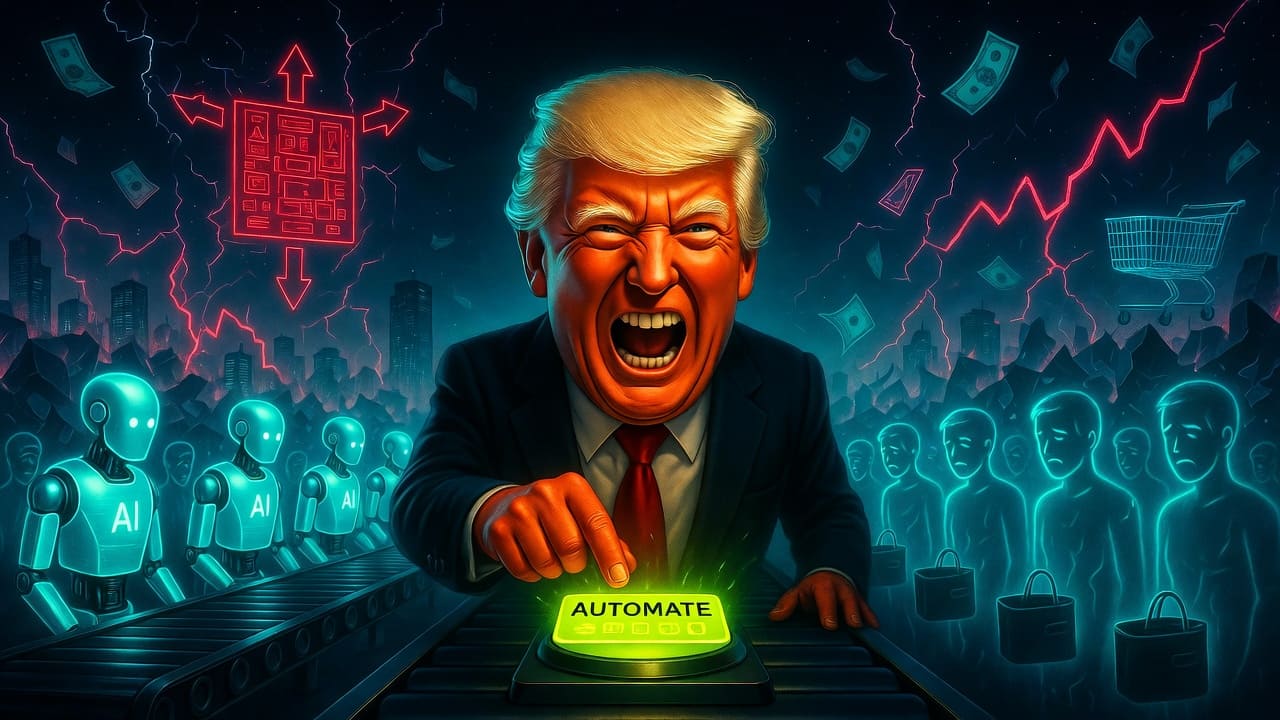
Its key finding is brutal: AI-driven layoffs don’t just destroy jobs, they destroy demand. Every automated worker is a deleted consumer.
And the most terrifying part isn’t the finding itself. It’s that none of it is irrational. No CEO is making a mistake. No board is miscalculating. Every single automation decision is individually correct and collectively catastrophic… a suicide pact dressed up as a strategy deck. The market doesn’t fail because of stupidity. It fails because everyone is playing the rules exactly as written.
AI Layoffs Are Accelerating, Dorsey Warned It’s Only the Beginning
Between January and April 2026, the tech sector shed 78,557 workers, with nearly 48% of those cuts directly attributed to AI and workflow automation, according to Nikkei Asia. Challenger, Gray & Christmas put Q1 2026 tech layoffs at over 52,000, a 40% jump year-over-year (YoY) and the highest quarterly total since 2023.
Block’s February cull was the most explicit data point. CEO Jack Dorsey cut roughly 4,000 workers, 40% of the company’s workforce, and stated publicly that AI had made those roles unnecessary. He warned that within a year, the majority of companies would reach the same conclusion. Oracle laid off up to 30,000 workers globally in April as it pivots toward AI spending. Salesforce, meanwhile, had already replaced 4,000 customer support agents with agentic AI. In March alone, tech shed 18,720 jobs, a 24% YoY increase. Over 60,620 non-tech workers were cut in that same month, according to Bloomberg.
This is the backdrop Falk and Tsoukalas wrote against. The paper was a diagnosis, not a forecast, of something already in motion.
The Prisoner’s Dilemma: Rational Firms in a Collective Suicide Pact
Falk and Tsoukalas use a competitive task-based model to formalise the problem. Each firm’s automation decision is individually rational. Collectively, it destroys the consumer base. Displaced workers are also consumers. Strip enough purchasing power from the market, and every firm eventually suffers lower revenue. The researchers call this a demand externality, the hidden cost that each firm’s layoff decision imposes on every other firm’s revenue base.
The trap is structurally identical to a prisoner’s dilemma. Refuse to automate, and your competitor will — undercutting your prices, stealing your market share, and removing you from the field. Automate, and you survive short-term while contributing to the systemic erosion of demand that ultimately shrinks the entire market. So every firm automates. Wages compress. Consumer spending falls. The market erodes.
The researchers also describe what they call the “Red Queen effect”: better AI does not ease the pressure, it intensifies it. Each capability improvement raises the competitive advantage from automating faster. The race accelerates. Demand weakens faster. The result is not a transfer of wealth from workers to company owners. Both sides lose. The paper is explicit in its findings: it is a deadweight loss that harms workers and firm owners alike. No market force corrects it.
UBI, Profit Taxes, Worker Equity: The Paper Ruled Them All Out
Falk and Tsoukalas stress-tested every mainstream policy response. Universal basic income raises income floors but changes nothing about the per-task economics driving automation. Capital income taxes alter profit levels, not the individual decision to replace a human with a cheaper automated process. Worker equity participation narrows the distortion but cannot close it. Collective bargaining is unenforceable because automating remains a dominant strategy, no voluntary compact between competing firms can hold.
This is the part policymakers should find most uncomfortable. In January 2026, Anthropic CEO Dario Amodei warned that AI could push unemployment to 10–20% within five years and that tackling it would require government intervention through progressive taxation targeting AI firms specifically. Senators Bernie Sanders and Mark Kelly have both advocated for AI-specific taxes. Former presidential candidate Andrew Yang has called for shifting the tax burden from labour to AI entirely. The political machinery has not moved.
There is also a complicating factor: not every AI-attributed layoff is genuinely AI-driven. OpenAI CEO Sam Altman has pointed to “AI washing”, companies blaming automation for job cuts that would have happened anyway, due to poor business decisions or past overhiring. Deutsche Bank analysts similarly warned that “AI redundancy washing will be a significant feature of 2026.” That caveat is relevant to this discourse, but it does not dissolve the structural problem the paper identifies. Even a partial version of the dynamic is damaging at scale.
The Only Fix: An Automation Tax
Falk and Tsoukalas conclude that only one mechanism breaks the cycle: a Pigouvian automation tax. This would mean a per-task charge levied each time a firm replaces a human worker with an automated process, forcing that firm to internalise the demand destruction it creates. The logic mirrors a carbon tax. You price the externality at the point of decision, not in the aftermath.
A few days ago, OpenAI published a 13-page policy document calling for a public wealth fund, a robot tax, and a four-day workweek, a striking alignment with the paper’s conclusions from a company at the centre of the disruption. Hours later, a man threw a Molotov cocktail at Altman’s San Francisco home. No one was injured, but the incident illustrated plainly how raw the social anxiety around AI’s economic consequences has become.
The Data Is Accelerating. The Market Won’t Self-Correct.
Mercer’s 2026 Global Talent Trends report, which surveyed 12,000 workers worldwide, found that 40% now fear losing their jobs to AI, up from 28% in 2024.
A November 2025 MIT study found AI can already perform the tasks covering 11.7% of the U.S. labour market, representing up to $1.2 trillion in annual wages across finance, healthcare, and professional services.
Gartner forecasts that worldwide spending on all AI technologies (infrastructure, services, software, etc.) will rise from approximately $1.76 trillion in 2025 to over $2.5 trillion in 2026, driven by a massive build-out of data centers and application deployment.
The paper’s conclusion is unambiguous. Competitive markets, left alone, will over-automate beyond what is collectively rational or economically sustainable. No retraining initiative, UBI pilot, or shareholder equity programme changes that structural dynamic. The firms moving fastest are not acting irrationally. They are playing the only game the current rules allow.
Without a policy instrument, specifically one that forces the real economic cost of automation into each firm’s individual decision, the math says this does not self-correct. It simply runs until something much larger breaks.
“The AI layoff trap” is not a hypothetical future risk. According to Falk and Tsoukalas, it is the present. And the burning question now is whether anyone with the authority to act will do so before the damage compounds past the point of easy remedy.

See Also:
Europe’s AI Is Collapsing, and China Is Feasting on the Wreckage