
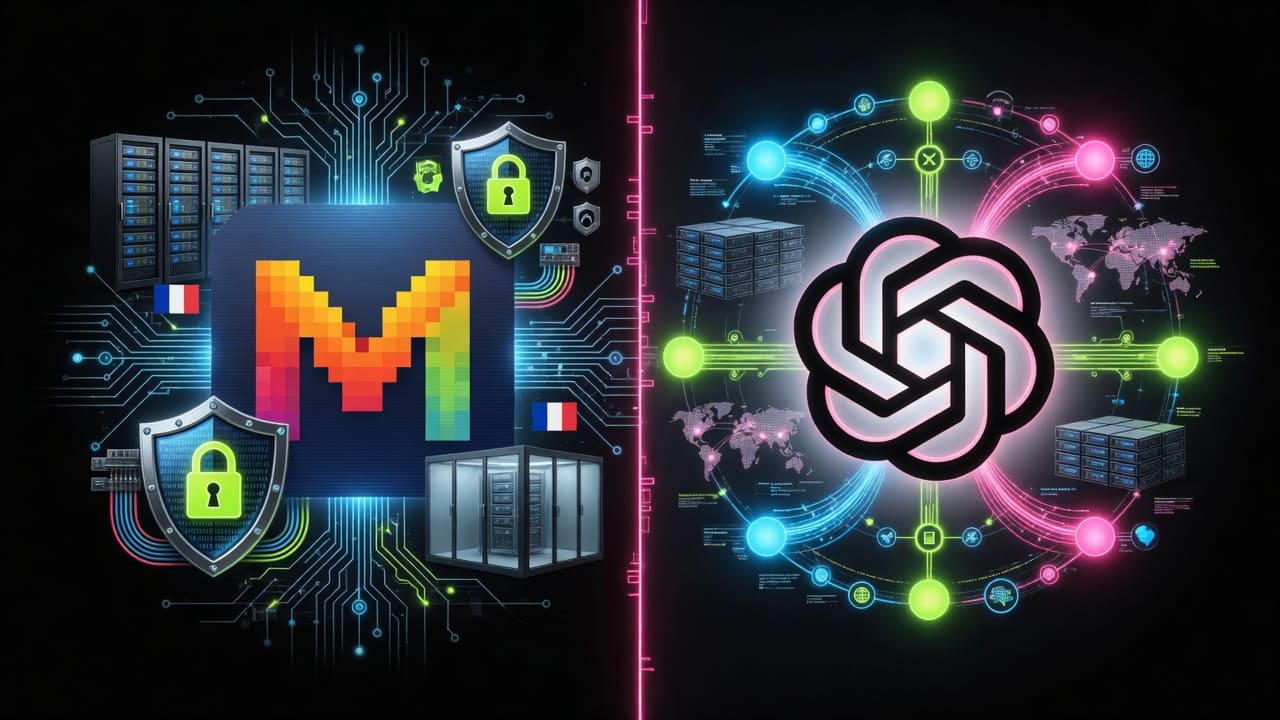
Mistral vs OpenAI: which AI is better? The question is asked constantly. And it misses the whole point almost every time.
When people ask whether Mistral can beat OpenAI, they are measuring a Paris-based startup valued at €11.7 billion against a company that closed a $122 billion funding round at an $852 billion valuation in March 2026. On those terms, Mistral doesn’t have a case.
The more important question is whether Mistral needs to beat OpenAI globally to win the markets that matter.
Why Companies Choose Mistral: Data Sovereignty Explained
OpenAI generates $2 billion in revenue every month, has over 900 million weekly active users, and is pushing hard into the enterprise market. European banks, hospitals, and government agencies are among that user base. And many of these European organizations are uncomfortable with this dependency.
The discomfort is practical, not philosophical. When a regulated institution runs a sensitive workflow through an American AI software, every data point transits infrastructure controlled by American companies, under U.S. legal jurisdiction. The EU AI Act now imposes audit, documentation, and transparency obligations on high-risk AI deployments in financial services, healthcare, and public administration. These are obligations that are harder to satisfy when the model is a closed system governed abroad.
This is where Mistral’s market position begins. Not as the world’s biggest or most capable AI model. As the infrastructure option European institutions can audit, customise, and actually govern.
Where Mistral Has Built a Real Edge
Mistral’s open-weight strategy is not marketing language. While OpenAI keeps its model weights locked inside its own infrastructure, Mistral releases most of its models under Apache 2.0 licences, allowing any enterprise to download, self-host, and run them privately. A bank can run inference on its own servers and never send a single prompt to an external endpoint. That distinction matters acutely in risk management, compliance, and procurement.
Mistral has backed that positioning with aggressive product development. The product cadence accelerated sharply in early 2026. In March, Mistral launched Small 4, a unified model combining reasoning, multimodal vision, and agentic coding, priced at $0.15 per million input tokens, five to seven times cheaper than comparable GPT-5 tier models. In April it followed with Medium 3.5, a 128-billion-parameter dense model built specifically for private infrastructure deployment and enterprise-grade reliability.
At NVIDIA GTC in March, Mistral unveiled Forge, a platform enabling organisations to train frontier-grade AI models on their own proprietary data rather than defaulting to models built from public internet text. ASML and the European Space Agency are among its early customers.
On infrastructure, Mistral raised $830 million in debt financing in March 2026, backed by BNP Paribas, Crédit Agricole, HSBC, and MUFG, to fund a European data centre cluster powered by 13,800 Nvidia GB300 GPUs.
Mistral CEO Arthur Mensch has targeted 200 megawatts of European compute capacity by 2027. This isn’t positioning – it’s capital deployment at scale.
As MRKT30 previously covered, Mistral built early European trust through ‘Le Chat‘ and strategic partnerships with BNP Paribas and Orange. This foundation has been converted into a full-stack AI platform with models, enterprise tooling, and European compute.
Where OpenAI Is Still Categorically Ahead
The scale gap is not a rounding error. OpenAI has over 900 million weekly active users, more than 50 million paying subscribers, and over nine million paying business users as of February 2026. Enterprise revenue now accounts for more than 40% of OpenAI’s total and is on track to reach parity with consumer by end of year. Mistral has not published a comparable global active user figure.
The developer ecosystem runs deeper by an order of magnitude. OpenAI’s APIs process more than 15 billion tokens per minute. GPT-5.4 is driving record engagement across agentic workflows, and Codex serves over two million weekly users with month-on-month growth above 70%.
At the frontier of model performance, the gap persists. Mistral Small 4 is impressive for its price tier, but independent benchmark evaluations consistently place it below GPT-5.4 and Claude Opus 4.6. Benchmarks can be gamed or quickly outdated, but the directional signal is consistent across multiple valuations. Mistral’s flagship open model, Large 3, released in December 2025, is competitive in the mid-tier, but it has not challenged the frontier.
Le Chat is capable. ChatGPT is used by more than 900 million people weekly. Treating them as comparable would misrepresent both products.
Mistral AI’s Winning Market: European Regulated Enterprise
60% of Mistral’s revenue already comes from Europe. Its annualised revenue run-rate exceeded $400 million in 2025, with Mensch targeting more than $1 billion annual recurring revenue (ARR) by the end of 2026. The company reported over 1,000 high-value customers by mid-2025, concentrated in finance, healthcare, and regulated industry.
The EU AI Act is a structural tailwind that Mistral’s competitors cannot neutralise. OpenAI can comply with documentation requirements. It cannot reposition itself as a European infrastructure company. Mistral can, and is actively doing so. In procurement processes for public sector AI, regulated finance, and defence contracting, the ability to self-host models, audit inference behaviour, and demonstrate European data residency is increasingly non-negotiable. That is a market OpenAI cannot enter on Mistral’s terms.
Europe Doesn’t Need an OpenAI Clone. It Needs Mistral
Mistral is not OpenAI’s equal as a global AI platform. The funding gap, user base, developer ecosystem, and product polish are different in kind, not just degree.
But the global frame is the wrong one for evaluating Mistral’s strategic importance. The better question is whether Mistral can become the AI infrastructure layer for Europe. The evidence in 2026 says yes, credibly: enterprise traction, compute investment, open-weight architecture, and regulatory alignment all point in the same direction.
If Mistral executes on its infrastructure buildout and Forge gains enterprise contracts at scale, Europe won’t just have an AI alternative to OpenAI. It will have its own AI infrastructure layer. For a continent that has rarely produced one in any technology category at this level, that outcome is worth watching very carefully.