

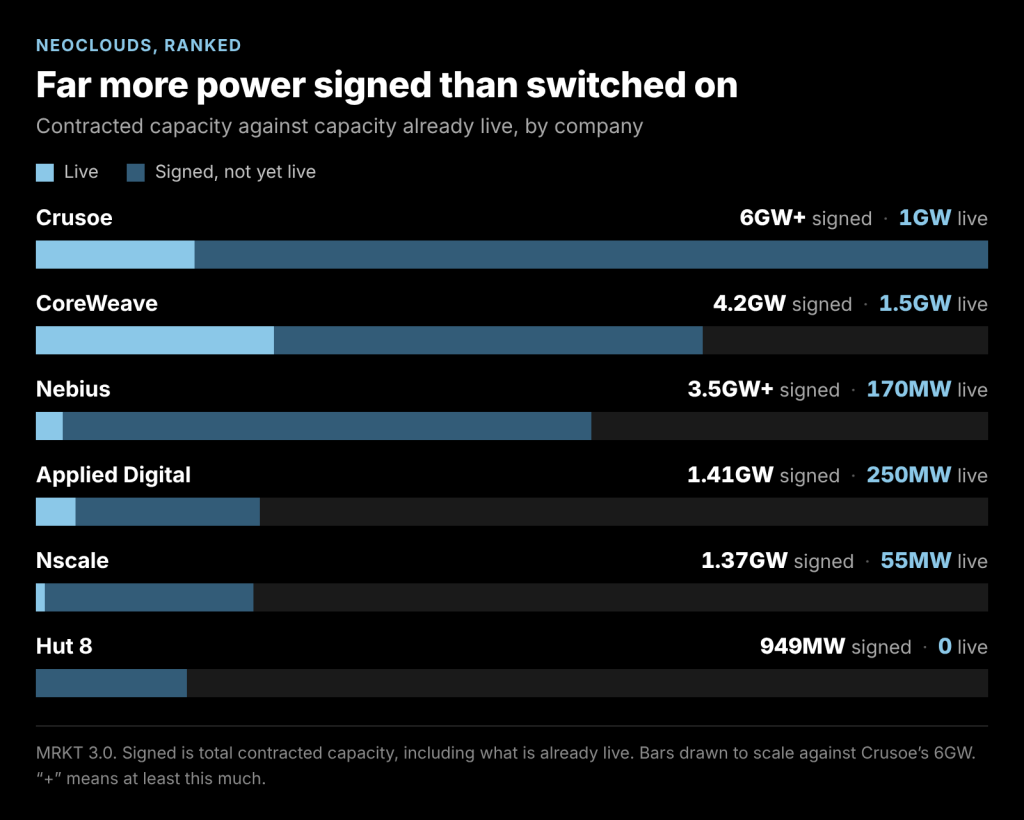
Neocloud companies rent out AI computing power, mostly on NVIDIA chips, outside the big three hyperscalers (Amazon, Microsoft and Google). CoreWeave is the biggest, with 1.5 GW running. Most of the companies on this list have far more power signed than live. Hut 8, for example, has 949MW under contract with none of it switched on yet.
| Neocloud | Power live / contracted |
|---|---|
| 1. CoreWeave | 1.5GW / ~4.2GW |
| 2. Crusoe (private) | 1GW / 6GW+ (gross, self-reported) |
| 3. Core Scientific (landlord) | 437MW / ~1.1GW |
| 4. Applied Digital (landlord) | 250MW / ~1.41GW |
| 5. Nebius | ~170MW (Dec 2025) / 3.5GW+ |
| 6. Galaxy Digital (landlord) | 133MW / 526MW |
| 7. TeraWulf (landlord) | 102MW / ~839MW |
| 8. IREN | ~90MW / 200MW+ |
| 9. Nscale | 55MW / 1,370MW |
| 10. Firmus (private) | ~46MW / 900MW+ (self-reported) |
What Is a Neocloud?
A neocloud is a cloud company built mainly for AI work. It rents out racks of AI chips, often on multi-year contracts. The label now also covers the landlords that build the halls, many of them former bitcoin miners.
Which Neocloud Companies Are The Biggest?
CoreWeave leads by a wide margin on power that is actually running. Almost every company on the list has far more capacity signed than switched on.
1. CoreWeave
The New Jersey company ended June with 1.5GW of active power, and its contracted power reached about 4.2GW by August 11. Its revenue backlog stood at about $104 billion, while one unnamed customer brought in 36% of second-quarter revenue.
2. Crusoe
Crusoe, which built the Abilene, Texas campus behind OpenAI’s Stargate, says it has 1GW of gross capacity running and more than 6GW contracted. In September, investors valued the private company at $30.9 billion.
3. Core Scientific
Once one of America’s biggest bitcoin miners, it was billing for 437MW by mid-July, mostly to CoreWeave. It has also leased about 530MW to AMD from 2027, so its total comes to about 1.1GW.
4. Applied Digital
The Dallas company brought Polaris Forge 1, its first North Dakota campus, to 250MW on October 1, leased to CoreWeave. Altogether, its leases across five campuses cover about 1.41GW and $36 billion of rent over their base terms.
5. Nebius
The Amsterdam company, formerly Yandex’s parent, reported about 170MW of active power at the end of 2025. Its letters to shareholders since then have not updated the figure. By May it had also contracted more than 3.5GW, led by Microsoft (about $17.4 billion) and Meta (up to $27 billion).
6. Galaxy Digital
Its Helios campus in Texas, built as a bitcoin mine, had all 133MW of its first phase in service for CoreWeave by June. In total, CoreWeave has leased 526MW there.
7. TeraWulf
The bitcoin miner had switched on 102MW of AI capacity at Lake Mariner, New York, by July, against about 839MW contracted. That includes 401MW in Kentucky for Anthropic, which is not due until the second half of 2027.
8. IREN
The Sydney-founded miner runs its own AI cloud, with about 40MW live at the end of June. In August it added the first 50MW of four for Microsoft, under a $9.7 billion, five-year deal. The other three are due by the end of 2026. Bitcoin still brought in 49% of its revenue in April to June.
9. Nscale
The London start-up listed 55MW live against 1,370MW contracted in its IPO filing. Its flagship site in Norway was running 6.4MW of a planned 30MW in October, six months late. Its biggest customers are Microsoft and Anthropic, with contracts worth up to $43.8 billion and $44.6 billion.
10. Firmus
The Australian company had about 46MW running when it pulled its stock market listing on October 9 after weak investor demand. It says it has more than 900MW under contract, with OpenAI as an anchor customer.
Not ranked: Hut 8, with nothing live
Hut 8 has 949MW of AI capacity under contract and none of it live, more than Galaxy or TeraWulf has signed. Its first hall at River Bend, Louisiana, leased to Fluidstack, is due in the second quarter of 2027. Its $74.9 million of second-quarter revenue came almost entirely from the segment it calls Compute, which includes bitcoin mining. Research firm SemiAnalysis has traced the tenant at its Beacon Point campus in Texas to NVIDIA, which passes the space to Lambda for Anthropic.
Just below the cut sit WhiteFiber, with up to 40MW, and Riot Platforms, with 25MW for AMD. Fluidstack, founded in Oxford, and Lambda, which is raising up to $4 billion before a planned listing, don’t publish live capacity. AMP, Anjney Midha’s investment firm, has started selling computing power too.
Can You Invest in Neocloud Companies?
Most of the companies on the list already trade publicly. CoreWeave, Nebius, IREN, Applied Digital, Core Scientific, Galaxy Digital, TeraWulf and Hut 8 all list on Nasdaq. Crusoe, Firmus, Fluidstack and Lambda remain private, while Nscale has filed to list in New York as NSCL.
Roundhill launched the first neocloud ETF on August 6. Its definition includes companies moving “from cryptocurrency mining or blockchain operations to AI and HPC data center operations”. Miners appeal because their sites already have big grid connections, which new data centres often wait years to get.
Seven of its ten largest holdings on September 30 mine bitcoin or used to. They are IREN, Hut 8, Galaxy, TeraWulf, Riot Platforms, Cipher Digital and Core Scientific. By weight, though, Nebius and CoreWeave make up about 61% of the fund. Roundhill’s own pitch on X in August conceded that “most of that power isn’t online yet”.
Short sellers are betting the gap will hurt. Data firm S3 Partners tracks six of the listed landlords, including Hut 8 and TeraWulf. Their median short interest rose from 18.5% of tradable shares in July to 22% in mid-October.
Who pays for all this capacity?
A handful of buyers account for most of the contracted power.
- Microsoft has deals with CoreWeave, Nebius, IREN, Nscale and Lambda, and Meta with Nebius and CoreWeave.
- Anthropic is building with Fluidstack, TeraWulf and Nscale.
- Google guarantees part of Fluidstack’s rent at TeraWulf, Cipher and Hut 8.
When one buyer moves, the contracted column moves too. Microsoft dropped its plans for Nscale’s Monarch site, and Anthropic has since signed for 460MW there.
The gap matters because rent and chip fees mostly start when capacity goes live. Until then the contracts pay little, while the debt costs interest. CoreWeave carried about $35 billion at the end of June, before selling more convertible bonds in September. In mid-October its shares fell more than 15% in a day. The yield on its 2031 bonds rose around 15%, a level that usually signals distress. Nebius had $8.5 billion and then raised $5.75 billion more in August, and IREN, Hut 8 and Applied Digital each owe between $6 billion and $8 billion. Even in Europe, most of the money comes from American investors and tech giants.
TeraWulf’s chief executive, Paul Prager, set out the test operators now face on October 15.
6/ Execution. Ultimately, investors want proof. Capacity energized. Customers operating. Contracted revenue converting into cash flow.
— Paul Prager (@PaulBPrager) October 15, 2026
Author: Akos Szima
See Also:
Nscale IPO: $103 Billion of Contracts, Only 55MW Live
Is Nscale Really European Sovereign AI? The $14.6bn Question
Europe Is Hosting an AI Build-Out It Cannot Afford to Fund
How We Checked This:
We took live and contracted power from each company’s latest filing or results before October 16, 2026, or its own announcements if private. Companies measure power differently, so treat the ranking as a guide. IREN’s live figure, Nscale’s contracted total and the debt totals are our sums. We will update the table after November’s results.
Frequently Asked Questions:
CoreWeave. It had 1.5GW of active power and a revenue backlog of about $104bn at the end of June 2026. Its contracted power reached about 4.2GW by 11 August.
Yes. Roundhill launched the Neocloud ETF (NCLD) on 6 August 2026. Nebius and CoreWeave make up about 61% of it, and seven of its ten largest holdings mine bitcoin or used to.
Nebius, based in Amsterdam, and Nscale, based in London, are the largest. Fluidstack was founded in Oxford.