
Europe’s artificial intelligence ecosystem shows no signs of slowing down. A record capital surge hit deep tech in late 2025 and rolled forward into the new year. In January 2026 alone, high-valuation funding rounds pushed multiple companies across the unicorn threshold, signaling enduring and robust investor appetite.
The growth is partly driven by the European Union’s strong focus on strategic autonomy in critical technologies. As a result, the continent’s leading AI companies now span foundational models, defense tech, robotics, and biotech.
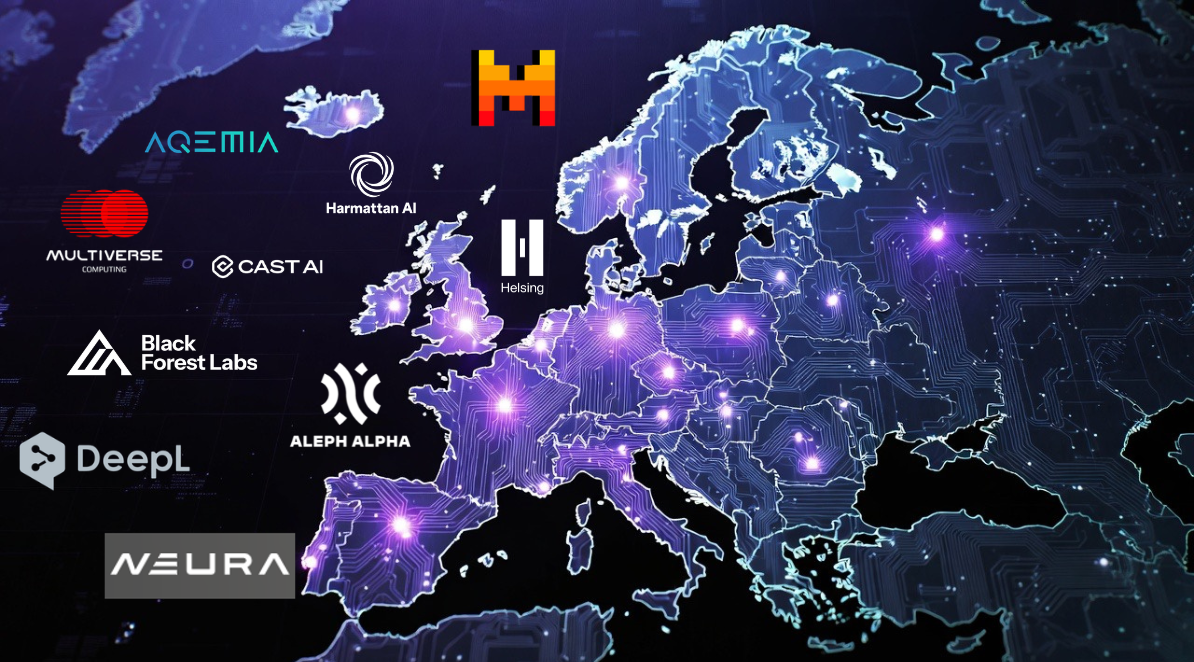
What are the top AI startups to watch in 2026? These ten AI startups (all founded in EU countries) top the charts today for scale, momentum, and pure impact. Ranked by their current values, funding momentum, and strategic significance, these are the need-to-know companies of 2026.
1. Mistral AI (Paris, France) – €11.7B Open-Model Leader
Paris-based Mistral AI has become one of Europe’s most valuable AI startups. It raised a record €1.7B Series C in September 2025 at an €11.7B post-money valuation, signaling massive investor faith. The company develops large open-source language models and AI tools, like the “Le Chat” bot, for industry and government.
Mistral reports over 100 large enterprise customers (including European governments like France, Germany and Greece). Following this, it is expected to generate well over €1B in revenue in 2026.
CEO Arthur Mensch says the new funding “brings together two technology leaders” (referring to lead investor ASML). He continued that the company will “solve current and future engineering challenges through AI”. In short, Mistral aims to be Europe’s answer to OpenAI, empowering governments and companies with custom AI models.
2. Helsing AI (Munich/Berlin, Germany) – €12B Defence AI Powerhouse
Founded in 2021, Helsing AI has become Europe’s top defense-tech startup. In June 2025, its smart software for drones and command systems earned a €600M funding round led by Spotify’s Daniel Ek, which pushed its valuation to about €12B, making it one of Europe’s largest tech private companies.
The German firm started by providing AI analytics for the Ukraine conflict and is now extending into building its own drone, aircraft, and submarine platforms. Helsing’s co-founder and co-CEO Gundbert Scherf notes that “drones have become the most effective system in Ukraine,” underlining the firm’s focus.
In other words, defence firms have embraced European AI fast. This reputation (and funding) has made Helsing a poster child for EU strategic AI independence.
3. Harmattan AI (Paris, France) – €1.3B French Defence Unicorn
Harmattan AI, a 2024-born startup, builds autonomy software for fighter jets, drones, and layered air defense. In January 2026, the startup raised a €170M Series B led by Dassault Aviation (maker of Rafale jets), pushing its valuation to about €1.3B.
Harmattan’s systems now run test flights with NATO partners. CEO Mouad M’Ghari explains their mission: “by combining frontier AI with world-class military aviation expertise, we are shaping the future of collaborative air combat,” reflecting how Harmattan’s French-German team plans to embed advanced autonomy in Western defense.
4. NEURA Robotics (Metzingen, Germany) – €9B Funded Robotics Factory
NEURA Robotics develops humanoid and cognitive industrial robots designed to collaborate safely with humans in factories, warehouses, and more. Its “physical AI” enables reliable on-device operation with limited connectivity, setting it apart from cloud-dependent models.
By late 2025, Tether led discussions for a roughly €1B later-stage round, targeting a valuation of €8–10B. Secondary market data now shows a current valuation of around €9.5–10B at current rates.
The company has a €1B+ order book, impressive partnerships (e.g., NVIDIA), and beta deployments planned for 2026–2027.
CEO David Reger explained NEURA’s differentiator: “our AI model… is built for being physical, while…most other models are not.” This innovative “physical AI” method has elevated NEURA to a formidable contender in the European AI sector.
5. Black Forest Labs (Freiburg, Germany) – €3B Gen-AI for Vision
Emerging from the Stable Diffusion pioneers, Freiburg-based Black Forest Labs soared to a €3B valuation in 2025. Its FLUX text-to-image/video model family has tens of millions of downloads and powers tools at Adobe, Microsoft, Canva, Meta, and beyond.
The 50-person team Black Forest Labs gained fame (and grew its valuation) partly because Elon Musk’s Grok chatbot was found using its models.
The startup emphasizes open, responsible AI for creative industries. As CEO Robin Rombach puts it: “we built Black Forest Labs to advance visual intelligence at the frontier… We’re building multimodal models that unify perception, generation, and reasoning – foundational infrastructure for how we’ll shape and experience the visual world.”
Essentially, the team at Black Forest Labs sees “visual AI” evolving from novelty to core tech.
6. Aleph Alpha (Heidelberg, Germany) – €450M European Sovereign AI Stack
Heidelberg’s Aleph Alpha is one of Europe’s early AI flagships (founded 2019). It initially pitched itself as “Europe’s answer to OpenAI” and raised over €100M to build proprietary language models.
Since Aleph Alpha’s partnership with Lidl/Kaufland’s Schwarz Group cloud in 2023, its focus has shifted from consumer chatbots to enterprise/government AI with strict data privacy. It now offers on-prem and hybrid cloud LLM services (brand name PhariaAI) hosted entirely in EU jurisdictions.
Aleph Alpha’s new leadership emphasizes building “trusted AI infrastructure” for regulated industries, rather than viral demos. It raised $500 M in 2023, which drew commendation from Robert Habeck, Germany’s Vice Chancellor and Minister for Economic Affairs.
Former CEO and founder Jonas Andrulis (who stepped aside in late 2025 as the Schwarz retail giant took operational control) once boasted: “a systematic comparison… shows our team is playing in the Champions League. Luminous… is a strong alternative in many environments and thus serves as an important step towards Europe’s technological sovereignty.”
Aleph Alpha aims to keep data onshore and compliant with EU rules, addressing concerns big-tech models won’t.
7. DeepL (Cologne, Germany) – €1.8B Language AI King
DeepL (founded 2009) has quietly become a household name in AI language tech. Its translation and writing-assist AI tools now serve millions of users worldwide. A TIME profile notes DeepL has over 200,000 enterprise customers (including half of the Fortune 500).
DeepL’s CEO Dr. Jaroslaw (Jarek) Kutylowski highlights why: the team’s own multilingualism gives them an edge in knowing better what the customer needs.
DeepL is expanding from text translation to voice and other business-language tools. It recently added real-time video call subtitles (now covering 36 languages).
In Europe, DeepL is the trusted go-to for secure, high-quality machine translation.
8. Multiverse Computing (San Sebastián, Spain) – €1.5B Quantum-AI Enabler
San Sebastián’s Multiverse Computing applies “quantum-inspired” methods to compress and speed up AI models. It made headlines in June 2025 with a €189M Series B (the largest in Spanish AI history).
The idea behind Multiverse Computing: shrink large language models (LLMs) by up to 95% in size with minimal accuracy loss.
CEO Enrique Lizaso Olmos explains: “the prevailing wisdom is that shrinking LLMs comes at a cost. Multiverse is changing that… we can now further advance our laser-focused delivery of compressed AI models that offer outstanding performance with minimal infrastructure.”
By cutting compute needs, they hope to democratize AI (even running LLMs on mobile devices) and reduce Europe’s energy and cost footprint in AI.
9. Cast AI (Vilnius roots, Lithuania) – €844M Cloud Automation Platform
Cast AI ,which was co-founded in Lithuania, has built an AI-driven cloud optimization service. Its platform automatically adjusts Kubernetes clusters in real time to minimize costs and latency.
In January 2026 Cast AI closed a new round (led by Shinsegae’s PAC) that lifted its valuation above €844 million, making it “Lithuania’s 5th unicorn”.
CEO Yuri Frayman says the milestone reflects “market confidence in our platform vision” to automate cloud infrastructure globally. He adds that, “enterprises don’t just need cheaper infrastructure – they need infrastructure that adapts automatically as workloads and constraints change,” and that is exactly what Cast AI’s agents do.
The company also recently added an “OMNI Compute” feature to unify GPU resources across clouds, further cutting lock-in. With offices worldwide, Cast AI exemplifies a European cloud startup scaling to serve global AI workloads.
10. Aqemia (Paris, France) – €85M AI‑Driven Drug Discovery
Paris-based Aqemia brings AI and physics to biotech. Founded in 2019, it uses “physics-informed” AI to design novel drug candidates for oncology and other critical areas.
In 2024–2025 Aqemia raised over €85M total. It has collaborations with pharma leaders (e.g. a multi-year deal with Sanofi) on experimental cancer drug targets.
CEO Dr. Maximilien Levesque says recent funding “enables us to extend the reach of our technology to previously unexplored targets, opening the door to new classes of treatments”. In essence, Aqemia’s algorithms generate synthetic data on protein interactions (much like DeepMind’s AlphaFold did for structures) to predict drug efficacy before synthesis.
The startup is still unprofitable but has built a robust pipeline of AI-designed molecules. Its blend of AI and chemistry puts it among Europe’s most-watched biotech-AI ventures.
Europe’s €11B AI Leaders Are Setting the Pace for 2026
Each of these startups have made a name for themselves with bold funding or breakthrough products. They illustrate key themes in the EU’s AI scene: from building sovereign models (Mistral, Aleph Alpha) and military AI (Helsing, Harmattan) to industrial intelligence (NEURA, Cast AI) and vertical applications (DeepL, Aqemia).
The inclusion of company valuations and seed funds above shows why investors are betting on them. As one observer notes, Europe’s venture capitalists have shown “a strong appetite” for AI innovation at unicorn scale – and the 2026 outlook is likely to see these startups (and perhaps more) at the forefront of the New European AI ecosystem.
Author: Richardson Chinonyerem
See Also:
How Mistral’s ‘Le Chat’ Became Europe’s AI Darling