
Europe is building AI factories it won’t use, training talent it won’t keep, funding infrastructure for companies that won’t adopt, and writing regulations that competitors won’t follow. And while it does, the continent’s sovereignty is quietly bleeding out.
An “AI unemployable” is not a worker made redundant by automation. It is the European enterprise, and by extension the European economy, that missed the AI adoption window.
French President Emmanuel Macron cautioned that European industry is facing a “life or death” moment. It is being squeezed between an ultra-competitive China and a protectionist America. What the continent is facing is not merely a technology lag, it is a strategic and cultural choice with compounding economic costs.
The EU AI Act was supposed to be Europe’s masterstroke. Instead, it became the world’s most elaborate permission slip for inaction. European enterprises didn’t need another reason to delay. Brussels handed them one anyway, wrapped in 458 pages of compliance obligations.
The Compliance Trap: When Safety Becomes Surrender
To be fair, the impulse behind the EU AI Act was not irrational. The surveillance risks from AI are real and there needs to be rules to prevent them and hold people accountable. But there is a profound difference between writing the rules and believing that writing the rules is the strategy. Europe has confused the two, and while it did, China and America acted.
What the Act has quietly produced is a continent of enterprises so preoccupied with what AI cannot do that they have forgotten to ask what it can. Only 20% of EU enterprises are currently using AI technologies, a figure that has nearly tripled since 2021. This sounds impressive until you note that it still means four out of five European businesses are sitting on the sidelines. In Romania, that figure drops to 5.2%. In Poland, a country with not one but two of Europe’s AI factories, it sits at 8.4%.
The contrast with China is stark. Beijing does not issue risk frameworks and wait. It mandates, funds and executes. While European businesses were filing risk assessments, Chinese parents were enrolling their four-year-olds in weekend coding classes. Rules matter. Standards matter. But there is a difference between building guardrails and building a cage, and the EU AI Act handed European enterprises the blueprint for the latter.
Europe’s Infrastructure Irony: Empty Factories, Full Press Releases
In February 2025, the EU launched its InvestAI initiative, mobilizing commitments toward €200 billion, including €20 billion dedicated to up to five AI factories.
And yet Europe’s most powerful supercomputers remain better suited to traditional high-performance computing than to large-scale AI training. The US has 17 times Europe’s AI supercomputing capacity. The US also invests between four and ten times more in AI than the EU.
Meanwhile China is racing to deploy computing power at a scale Europe has not seriously contemplated, building a national network of over 250 AI data centers. The country added more net electricity generation capacity in 2024 alone than the entire installed capacity of most European nations.
Europe is constructing the infrastructure of an AI superpower. However, the continent’s adoption rates suggest it is building it for someone else to use.
Europe’s Brain Drain is Exporting Its Own Future
Here is a number that should cause genuine discomfort in every EU capital: Europe has approximately 30% more AI professionals per capita than the United States. It is not losing the talent race because of a shortage. It is losing it because of an export problem.
One third of non-US AI specialists globally relocate to the United States. Swedish AI companies are acquired by American firms. Founders consistently turn to American investors to scale. For many founders remaining in Europe, scaling their startup on the continent means navigating 27 different markets with no single startup ecosystem.
The result is a perverse cycle. Europe trains the people who build the tools that American and Chinese platforms then sell back to European enterprises. These are enterprises that, in many cases, still haven’t adopted them. The talent is world-class. The ecosystem that should absorb it is not.
The exceptions prove the rule. Mistral AI, Europe’s closest answer to OpenAI, now valued at $13.8 billion and Helsing, the Munich-based defense AI firm building autonomous combat systems for Ukraine, show what happens when European talent stays and builds in Europe.
However, in many ways these companies are the outliers within Europe. And the system should be producing them at scale. Every AI researcher who builds at OpenAI, Anthropic, or a Chinese national lab instead of in Munich or Paris is one fewer node in a European AI ecosystem that doesn’t yet exist at the scale it needs to.
How Europe is Funding the Competition
If European enterprises are slow to adopt AI, European institutions are actively accelerating the problem by paying for it.
America’s biggest cloud providers, including Amazon Web Services, Microsoft Azure, and Google Cloud hold 65% of the European cloud market. Overall, US providers control around 70% of European cloud infrastructure, while EU-based companies account for less than 20%. European governments, hospitals, schools, and agencies are running on American platforms, paying American companies, generating data that flows through American legal jurisdictions.
The pattern repeats across every sector where Chinese technology has entered European markets faster than European policy could respond. Brussels is currently scrambling to regulate Temu under the Digital Services Act, an e-commerce platform that captured 93 million European users before a single meaningful barrier was in place. The sequence is always the same: China moves, Europe regulates, the market has already shifted.
The EU knows this. The AI Continent Action Plan, the Digital Europe programme, the Horizon Europe allocations, all of them point in the right direction. But intent and execution are different things, and the gap between Europe’s stated ambition on digital sovereignty and its actual behavior remains enormous.
The Human Capital Paradox: The Companies That Made Themselves Irrelevant
There is one more dimension to this that rarely appears in the policy papers, and it is the most quietly devastating of all.
Companies that do not adopt AI will not be able to attract or retain AI talent. The inverse is also true: the best AI talent gravitates toward organizations that are doing serious work with it. As AI becomes embedded in every serious industry (finance, logistics, healthcare, manufacturing, defense) the enterprises that delayed are not just falling behind on productivity. They are making themselves structurally unattractive to the workforce that will define the next decade.
The superpowers have now embedded AI across their entire economies with a precision that would make a Brussels policy committee weep with envy, if it ever looked up from the paperwork long enough to notice. The European enterprise that missed the adoption window did not just lose ground on productivity. It made itself irrelevant to the talent that stopped looking.
The Sovereignty Sum
Add these five failures together and a single coherent picture emerges.
Europe is not losing the AI race because of bad luck, or insufficient funding, or a lack of talent. It is losing it because of a naivety that runs from the enterprise boardroom all the way to the Brussels policymaker. It is the collective assumption that being thoughtful, responsible, and procedurally correct is a substitute for moving.
China produced 15 notable large AI models in 2024. The US produced 40. Europe produced 3.
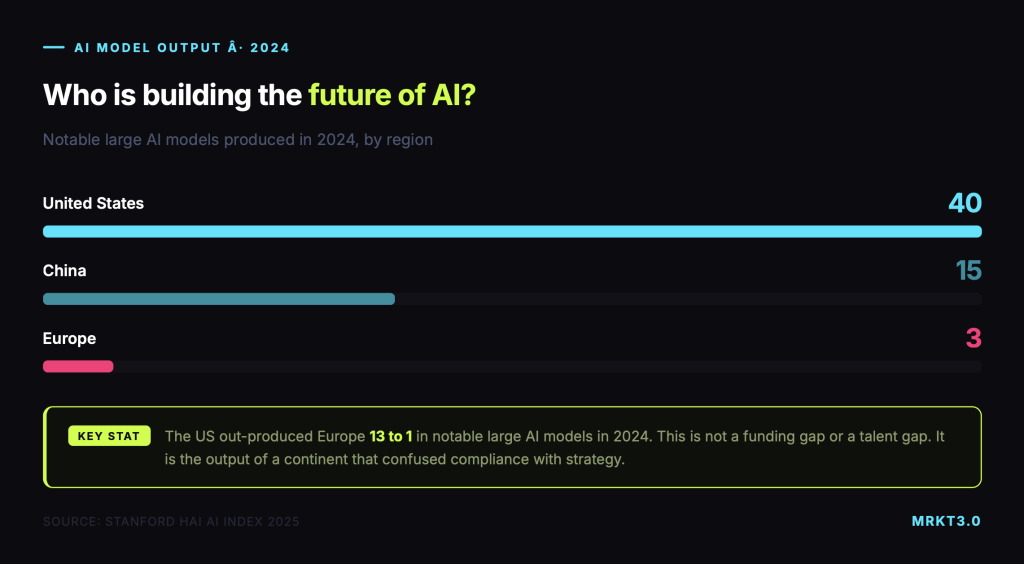
That number is the real metric of where this is heading. Not the gigafactories. Not the investment pledges. Not the EU AI Act. The question Europe needs to answer, urgently, is whether it wants to be a player in the AI era or merely a well-regulated consumer of the tools that others build.
The answer will not come from another framework. It will come from enterprises, governments, and institutions that decide to use the technology they keep saying they believe in.

See Also:
The EU’s Sovereign AI Push: Claiming Tech Independence
OpenAI Needs to Grow 20x in 5 Years. Europe Might Not Play Along.
European Tech Sovereignty: ASML’s Crown Jewel in the AI Race 2026