
On June 16, the Beijing lab Z.ai released GLM-5.2, an open-source frontier AI model that competes in several metrics with Anthropic and OpenAI. However, unlike its American competitors, GLM 5.2 is an open-weight model under an MIT license, meaning anyone can download, run and adapt the AI model for free.
While there are still sizable compute and infrastructure costs to run GLM 5.2 at scale, GLM 5.2 costs roughly a fifth of what American frontier AI models cost. Developers and enterprises alike have taken notice.
On the Diary of a CEO podcast, Scott Galloway recently pointed out that China could crash the US economy with what he called “AI dumping.” He said, “If I were Xi, I would just dump cheap AI into the US market. The moment large corporations start announcing they’re not engaging these multimillion-dollar site licenses with Anthropic or OpenAI, that they’re using these inexpensive Chinese models, and the market realizes there’s no way they can justify these incredible valuations, I think the US market crashes because 40% of the S&P is directly or tangentially related to this giant bet America is making on AI.“
He went on, “The majority of GDP growth over the past two years has been from AI capex (Capital Expenditures). If that slows down, we’re automatically in recession.”
The Bleeding Edge
GLM 5.2’s context window reaches a million tokens, which means the open source model can process repository-scale coding, massive documentation and hyper long-horizon workflows. By comparison, Anthropic’s Fable 5 is restricted to approximately 200k tokens, which requires manually summarizing or compacting code and documentation.
When tested on the long-horizon coding benchmark, FrontierSWE, GLM 5.2 rated within one percentage point of Anthropic’s Opus 4.8. It outperformed OpenAI’s GPT 5.5 by 1% and Opus 4.7 by 11%.
FrontierSWE measures AI software agents’ ability to perform complex real-world engineering tasks for up to twenty hours per task. Unlike previous, more limited benchmarks, FrontierSWE tasks AI models with building end-to-end systems from scratch and complex data computational challenges. GLM 5.2 performed far better than Western competitors anticipated.
Additionally, two independent security researchers say that GLM 5.2 matches Anthropic and OpenAI’s ability to detect security vulnerabilities. Conversely, GLM 5.2 significantly lowers the barrier of entry for cybercriminals. Unlike American frontier models, which are distributed via cloud services and controlled by the vendor, GLM 5.2 offers localized flexibility, potentially for nefarious use cases.
Beyond the threat of cybercrime, GLM 5.2 is equally attractive to legitimate organizations. While GLM 5.2 falls behind Anthropic’s Fable 5 in overall metrics, its price tag makes its “good enough” agentic abilities compelling to enterprises and developers. Additionally, American AI is being throttled by the US government amidst security concerns, an issue that could further offer Z.ai an entry point.
China Benefits from a Fractured American AI Landscape
While GLM 5.2 has proven its cost-effectiveness, it is also benefiting from a fractured American AI landscape, in which the Trump administration has kneecapped one of the US’s prominent frontier AI models, Anthropic’s Fable 5, amidst contentious circumstances. The dispute began when Amazon reported to Treasury Secretary Scott Bessent that it had found a way to bypass Fable 5’s security settings, known as a jailbreak.
While Anthropic’s CEO Dario Amodei assumed this was a technical misunderstanding, the Trump administration demanded that Anthropic immediately take down the model. When Amodei declined, the export restriction was imposed.
Anthropic has not ingratiated itself with the Trump administration in the way Amazon, Google, or OpenAI has, and is perhaps seeing the adverse results of its approach. Amazon is developing its own agentic AI in the cybersecurity space, while simultaneously becoming more entrenched in OpenAI’s products.
The Jailbreak That Wasn’t
Despite certain advantages OpenAI, Amazon, and Google might gain from Anthropic’s woes, restrictions have also been placed on OpenAI’s latest model launch. At the request of the US government, GPT 5.6 is only available to select government-approved partners.
Some US developers are crying foul, claiming that this new regulatory hurdle has created a de facto licensing regime in which the government can pick winners and losers. An open letter, signed by 175 American tech leaders, was sent to the Trump Administration asking that Anthropic’s export control be lifted:
“The Chinese open-weight models are only months behind the best American models, and those are the models we know about. It seems likely that the PRC government has access to private capabilities beyond what has been published. To pull the best capabilities away from defenders without a good reason when our adversaries are rapidly advancing is dangerous.”
Even though the Trump administration just lifted the export restriction on Anthropic, open-source Chinese AI is proliferating around the world and gaining investor support.
The Year of AI IPOs
The initial public offering of SpaceX caused quite a stir on June 12th. Beyond its sky-high evaluation, the company disclosed that it identifies itself as an AI company, as opposed to a company that makes rockets. Later in the year, investors are expecting Anthropic and OpenAI to go public with similar fanfare.
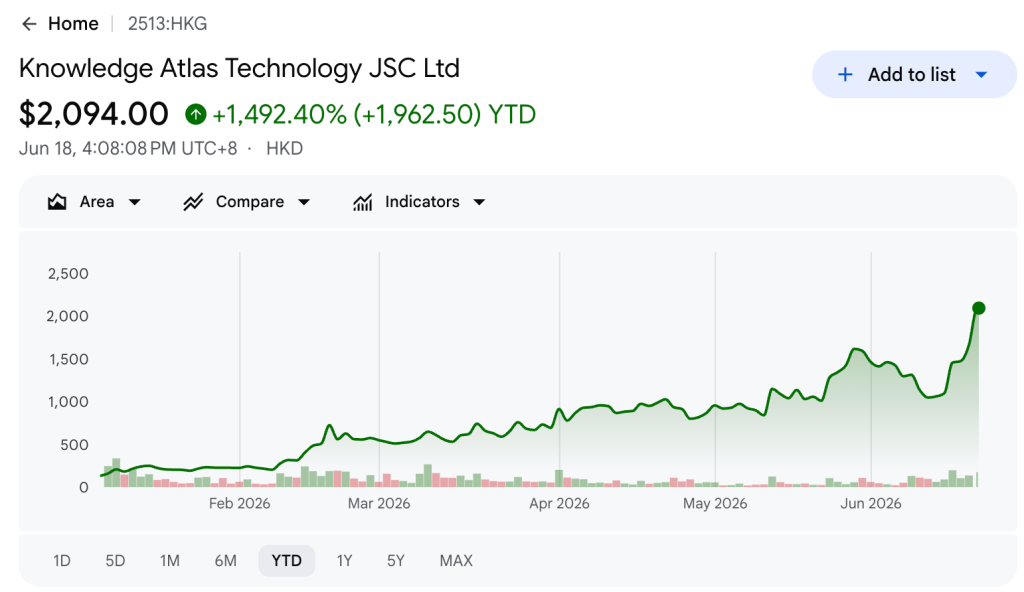
Meanwhile, Z.ai, or Knowledge Atlas Technology Joint Stock Company, Ltd., went public in January of 2026. The IPO was the first among major Chinese LLM companies. Its value has nearly doubled since mid-June. Like its American competitors, its value is based more on forward projections than current profits. However, GLM 5.2 arrives at a time when enterprise AI costs are becoming untenable for many companies.
Tokenmaxxing
Enterprise buyers are already reaching for cheaper open models as token costs ramp up while quality gaps close. In May, Uber’s COO revealed that the company had spent its entire annual AI budget in four months on Claude code. On June 16, Axios reported that Microsoft is weighing a self-hosted, fine-tuned version of DeepSeek V4, another Chinese open model, as a lower-cost engine for Copilot Cowork.
Washington set out to protect American AI supremacy and instead handed Beijing a marketing department. Every export restriction, every throttled release, every closed-door demand to pull a model offline sends developers watching from the sidelines the same message: American AI now comes with government-issued training wheels. Chinese labs, unshackled and hungry, are happy to sell you the alternative at a fifth of the price.
Scott Galloway calls the endgame “AI dumping.” Xi needs Chinese models cheap and good enough that corporations start walking away from their multimillion-dollar Anthropic and OpenAI contracts. Forty percent of the S&P 500 rides on the bet that AI capex keeps climbing. Most of the country’s GDP growth over the past two years has come from that same bet. Slow the spending and the recession isn’t a forecast, it’s a mechanism already built into the numbers.
GLM 5.2 matching Opus 4.8 on a benchmark was never the real test. The real test is whether American policymakers can tell a security threat from a competitive one before Beijing dumps the floor out from under Wall Street’s favorite trade.
Author: Tim Tolka, Senior Reporter
The editorial team at #MRKT3.0 has taken all precautions to ensure that no persons or organizations have been adversely affected or offered any sort of financial advice in this article.
See Also:
OpenAI Needs to Grow 20x in 5 Years. Europe Might Not Play Along.
Why AI Super PACs Are Avoiding the Word “AI” at All Costs
“The AI Layoff Trap”: Congratulations, You’ve Been Automated.