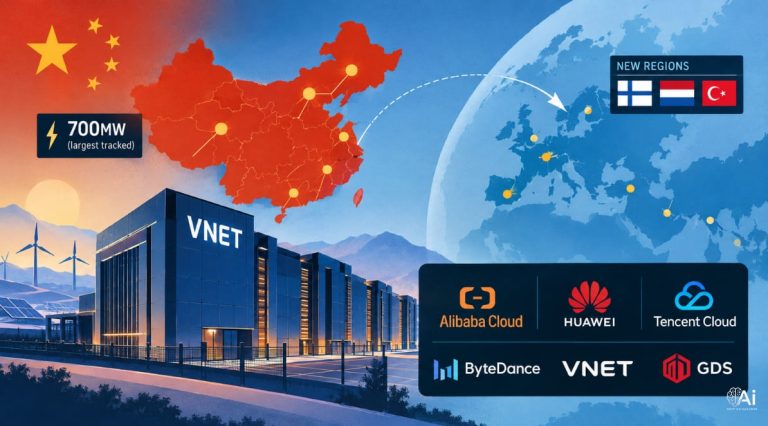

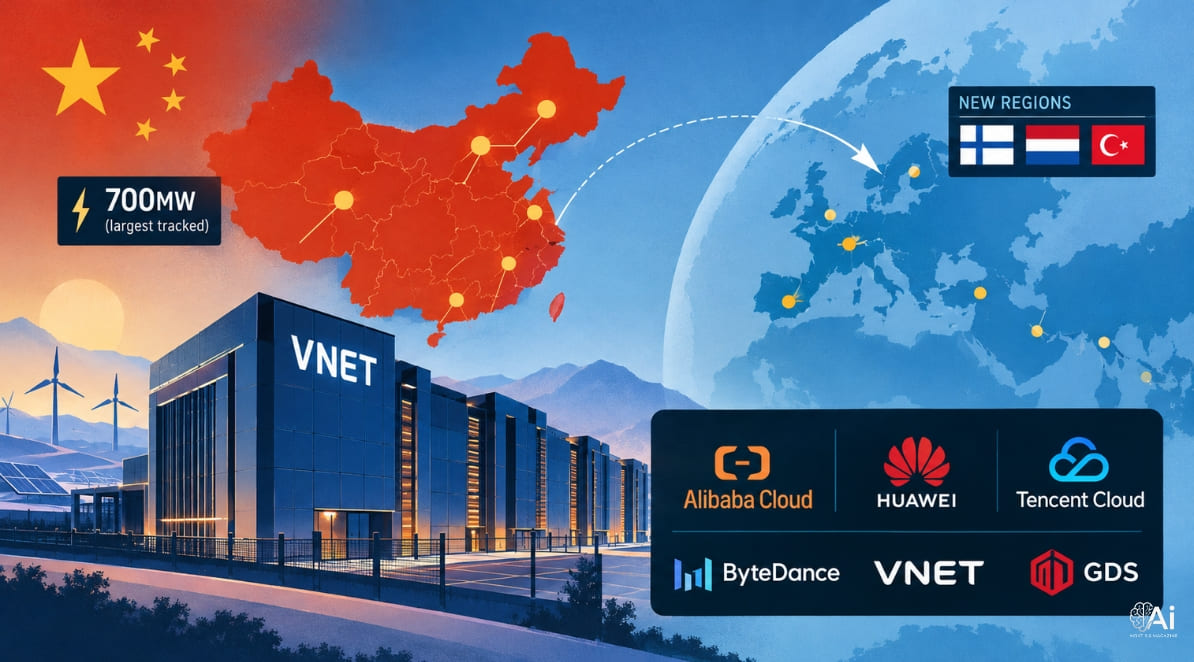
On 23 September, Alibaba Cloud international business president and CTO Feifei Li used the company’s Apsara Conference to announce its first cloud regions in Finland, the Netherlands, and Türkiye, all due within 12 months. A day earlier, chief executive Eddie Wu set a target for Alibaba Cloud to operate more than 20GW of data centre capacity worldwide by 2032.
For scale, the largest data centres in China today are measured in hundreds of megawatts. Only a handful of companies run them, and several of those companies are now building in Europe.
The Largest Tracked Data Centres in China by Planned Power: VNET’s Ulanqab Campus Leads
Data Centre Index, which draws partly on Epoch AI, only attaches a power figure to a handful of Chinese campuses. The table splits estimated live IT power from planned IT power. Rank is by planned power. This is not a census of every large site in China.
| Rank | Campus | Location | Operator | Est. live IT power | Est. planned IT power |
|---|---|---|---|---|---|
| 1 | VNET Ulanqab (Bayin) | Ulanqab, Inner Mongolia | VNET (reported tenant: ByteDance, speculative) | 221MW | 700MW, around Q3 2027 |
| 2 | Huawei Wuhu | Wuhu, Anhui | Huawei | 157MW | 457MW, around Q4 2027 |
| 3 | Huawei Cloud Guizhou | Gui’an, Guizhou | Huawei | Not split | 400MW, tracker figure only |
| 4 | Huawei Cloud Horinger | Horinger, Inner Mongolia | Huawei | 184MW | 346MW, around Q1 2028 |
| 5 | Alibaba Zhangbei | Zhangbei, Hebei | Alibaba Cloud | 169MW | 169MW; Epoch models no further expansion |
| 6 | Volcano Engine AI cluster | Horinger, Inner Mongolia | ByteDance | Not published | 100MW at completion |
Treat the wattages as estimates. China usually counts racks, not campus megawatts. The trackers also miss other large Inner Mongolia projects, including Envision’s planned 2GW Galaxy campus, and DeepSeek’s reported 1GW plan in Ulanqab.
Who Runs China’s Biggest Data Centres? Huawei, Alibaba, Tencent, VNET, and GDS
Two kinds of company run the big Chinese campuses: the clouds and platforms that build for themselves, and the independents that build and lease.
In the tracked table:
- Huawei runs three of the six ranked campuses: Wuhu, Gui’an, and Horinger.
- Alibaba Cloud runs Zhangbei.
- ByteDance runs the Volcano Engine cluster at Horinger.
- VNET, an independent operator, owns Ulanqab (Bayin), the planned-power leader. The campus is widely reported as serving ByteDance; that tenant link is still speculative.
Large sites not in the megawatt ranking
Baidu runs Yangquan. Tencent runs Tianjin. Both belong on a “who runs the big sites” list. They are not in the table because public trackers have not published a comparable planned-IT-power split. Yangquan has been put at about 6,000 40A cabinets, 160,000-plus servers, and about 234MW of connected electrical capacity. Tianjin has been reported at 15,000 racks and 300,000 servers, with power demand described as 165MVA (not the same unit as MW).
Other independents
GDS is the other large listed operator. Chindata, once the third, sold its China business for $4bn in September 2025 to a consortium led by the parent of HEC Technology. Owner Bain Capital kept the overseas arm, Bridge Data Centres.
Foreign clouds in China
Foreign providers do not own the China regions themselves. Sinnet operates AWS in Beijing, and NWCD operates AWS in Ningxia. Microsoft Azure in China is operated by 21Vianet, now VNET.
Why Inner Mongolia, Guizhou and Shanxi? China’s “East Data, West Computing” Plan
Most of these campuses sit inside a state programme. Beijing launched “East Data, West Computing” in 2022, with eight national computing hubs and 10 planned data centre clusters. By June 2024, direct investment had passed 43.5 billion yuan ($6.1bn), and the programme counted more than 1.95 million racks.
Each location has its own draw:
- Ulanqab and Horinger, Inner Mongolia: wind and solar power, cold air for cooling, and fast links to Beijing. Around Hohhot, which includes Horinger, one operator says power costs about two-thirds less than in Beijing, and round-trip latency to the capital is under 5 milliseconds.
- Gui’an, Guizhou: a cool climate, hydropower, and an established cluster. Apple’s iCloud service for mainland users is operated by Guizhou-based GCBD.
- Yangquan, Shanxi: one of China’s main energy-producing provinces, within reach of users in northern China.
- Tianjin: next door to Beijing and its concentration of internet companies.
- Wuhu, Anhui: part of the Yangtze River Delta hub serving Shanghai and nearby cities.
Where Chinese Operators Build Abroad: Finland, Frankfurt, Dublin, and Southeast Asia
DayOne is the clearest case of a Chinese-born operator going global. It started inside GDS in 2022, rebranded as DayOne, and closed a $4.5bn Series C in June 2026 led by Coatue and Hillhouse. It reports more than 1.5GW of bookings across Asia-Pacific and Europe and is preparing a US listing at a possible $20bn valuation. GDS sold $385m of DayOne shares back to the company in January and held about 19.9% as of 29 April 2026, according to its annual report filing.
| Company | Latest move in Europe | Wider overseas footprint |
| Alibaba Cloud | First regions in Finland and the Netherlands, plus Türkiye, within 12 months; more capacity in Germany and France (Sept 2026) | 107 availability zones in 31 regions; expanding in the UAE, Malaysia, and Hong Kong |
| Huawei Cloud | Third availability zone in Ireland (2026) | Says it serves 7,000+ European organisations |
| Tencent Cloud | Third Frankfurt availability zone (March 2026) | Two zones in Saudi Arabia; wider Middle East plans |
| DayOne (formerly GDS International) | 560MW campus planned near Helsinki; sites in Lahti and Kouvola | Singapore, Malaysia, Indonesia, Thailand, Japan, Hong Kong, Spain |
| China Telecom Global | European arm China Telecom Europe | 40 facilities listed on the Data Centre Map |
| China Mobile International | London data centre | 7 facilities listed on the Data Centre Map |
How US Chip Export Controls Push Chinese AI Training Offshore
Chip rules are one reason for building abroad. Alibaba and ByteDance train some of their largest models in leased data centres in Singapore and Malaysia, where they can use NVIDIA GPUs barred from China.
The setup is legal when a compliant third party owns and manages the hardware. That path opened after Washington withdrew a proposed Biden-era rule in May 2025, according to reports. Chinese user data must stay in China, so fine-tuning on that data occurs domestically.
Washington is also pursuing the shipping chain, as MRKT3.0 covered in the Apex Logistics probe, and the equipment makers, through the MATCH Act. At Apsara, Alibaba showed its own Zhenwu V900 AI chip. The company said the V900 delivers three times the performance of its predecessor, the Zhenwu M890. Several news sites reported the H20 comparison that circulated around the launch; there is no independent public benchmark of the V900 against NVIDIA silicon.
China vs Europe: Europe Has More Data Centres, China Has Bigger Ones
By count, Europe leads. Germany had 529 data centres and the UK 523 in 2025, against 449 for China, according to Cloudscene figures. The EU as a whole had 2,269, about 42% of the US total of 5,427. Counts vary widely by tracker.
Size tells a different story. China’s largest tracked campus is estimated at 700MW once expansion is included. Europe’s response is the AI gigafactories call: up to seven sites, backed by up to €10bn of EU and national money and at least €20bn of expected private investment. Bids close on 12 November, with awards expected in early 2027. Brussels also adopted an A-to-G sustainability label for data centres on 21 September.
Alibaba’s first Finnish and Dutch regions are due in the same 12-month window.
Author: Ayanfe Fakunle
See Also:
The Data Center Boom Has Found Its Political Ceiling