
AI Super PACs (Political Action Committees that can raise and spend unlimited amounts of money to influence elections) are spending big on the 2026 midterms.
AI Super PACs are flooding the 2026 midterms with cash—and they’re not even pretending to care who wins. The strategy is simple: buy everyone, control the outcome later.
They’ve taken a page straight out of Sam Bankman-Fried’s political playbook: spray money like champagne on both parties and let influence compound quietly.
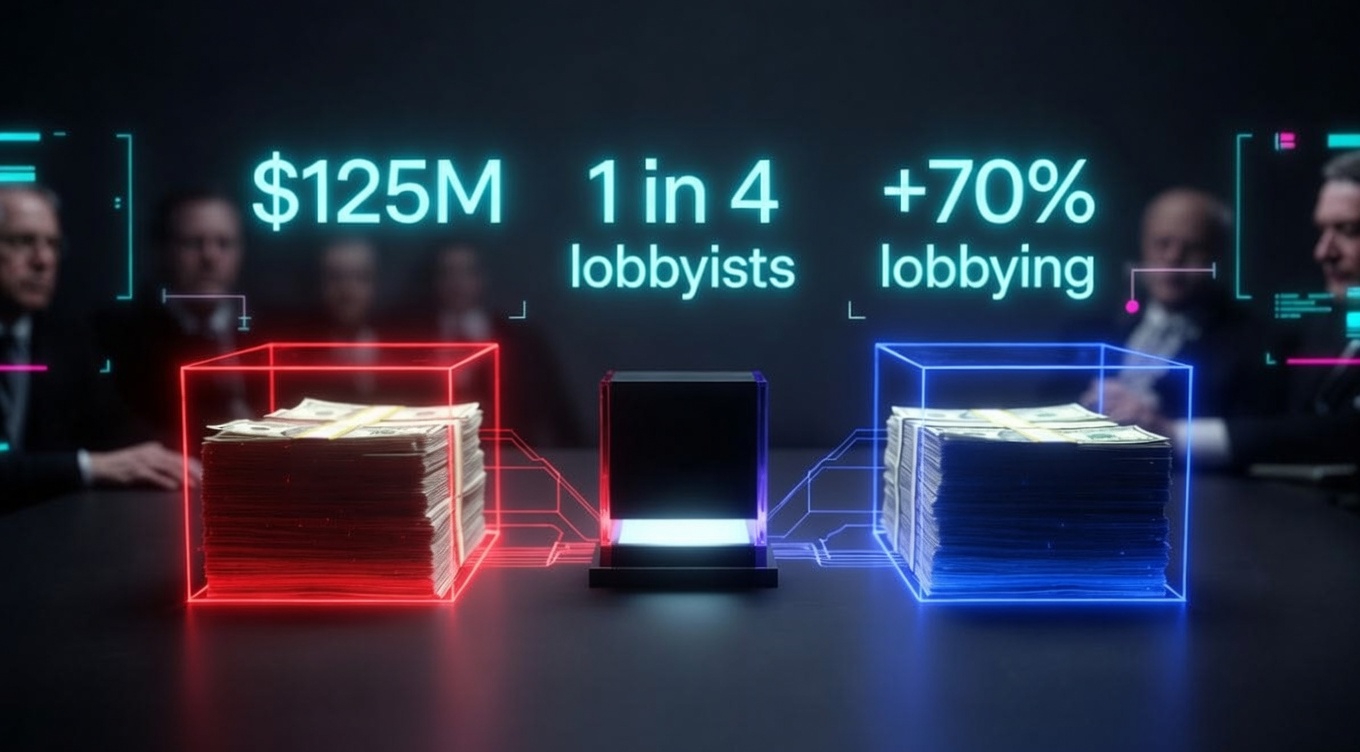
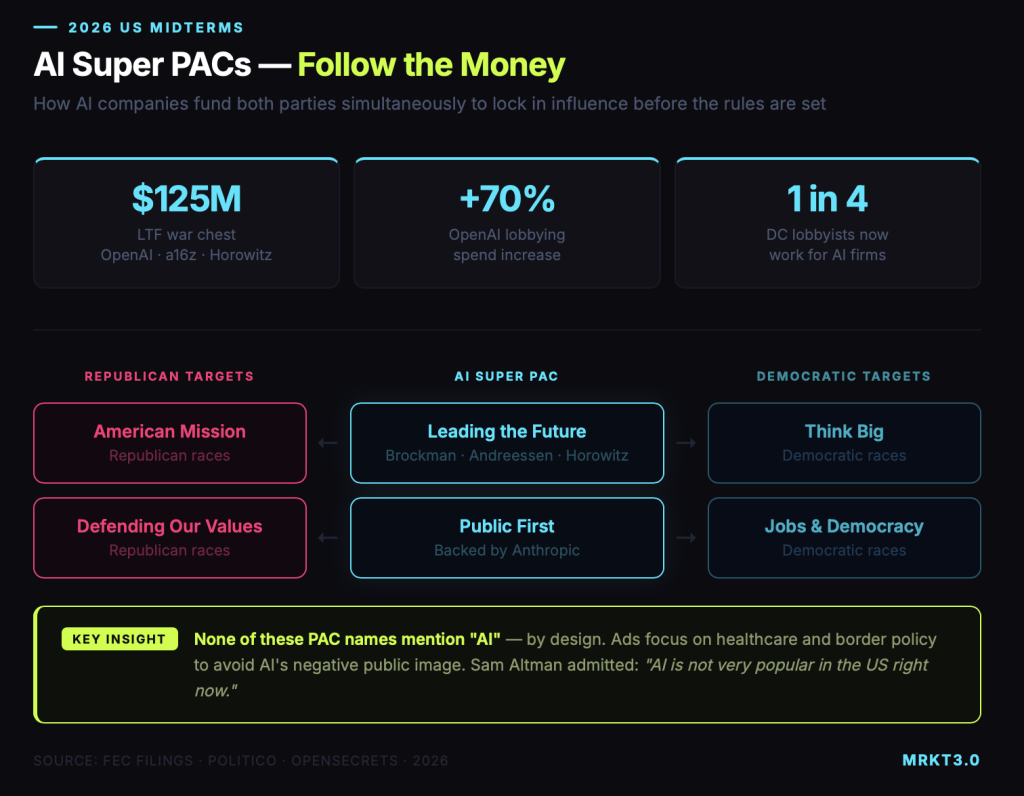
Chief among them is Leading The Future (LTF), a PAC funded by OpenAI President Greg Brockman and venture capitalists Benjamin Horowitz and Marc Andreessen with a $125 million war chest. Also involved: Joe Lonsdale, one of the more bloodthirsty co-founders of Palantir, who recently tweeted that the AI dataminer was founded to blow up communists in the hemisphere.
Upon learning LTF would support Democrats, Trump threw the typical hissy fit, breathlessly threatening vengeance that never materialized. Last year, a White House official warned, “any group run by Schumer acolytes will not have the blessing of the president or his team. Any donors or supporters of this group should think twice about getting on the wrong side of Trump world. We are carefully monitoring who is involved.“
Hedging Their Bets
Politics make strange bedfellows. While the AI industry has mostly supported and benefited from Trump’s policies, they could be hedging their bets. Just as crypto-aligned Super PACS supported both Republicans and Democrats in the 2024 election, so are the AI Super PACs in the 2026 midterms. Congress Passed Crypto. Now AI Wants the Same Treatment.
The reason is simple math. The GENIUS Act, the stablecoin bill championed by the crypto industry, was signed into law in July of 2025. With narrow Republican majorities in both the House and Senate, Democratic votes were essential to its passage.
The same could be true for future legislation pertaining to AI. Since several states are enacting their own AI laws, guys like Sam Altman and Elon Musk want to install enough friendly lawmakers, on both sides, to force through a federal AI framework that overrides state laws before states can slow them down.
Buy Both Sides, Lose Nothing
Many forecasters predict that Democrats will take back the House majority in November. While President Trump actively wants to avoid this outcome for a variety of reasons, AI-aligned Super PACS are more circumspect in their approach.
Similarly, Republican and Democratic candidates alike are signalling their support through seemingly innocuous social media posts and sly messaging, then benefiting from huge ad spends.
Meanwhile, the political rhetoric surrounding AI has started to become more partisan. While President Trump and his supporters speak of innovation and the ever-present need to dominate China in the AI sovereignty race, some of his Democratic detractors see a threat closer to home.
Senator Bernie Sanders explained: “If there are no jobs and humans won’t be needed for most things, how do people get an income to feed their families, to get healthcare or to pay the rent? There’s not been one serious word of discussion in Congress about that reality.”
A Game of Obfuscation: Don’t Say AI
There is an increasing trend in Super PAC strategy, dancing around and obscuring the interests of the Super PAC paying for TV and internet spots. Instead of trying to actually sell voters on a given candidate’s stance on AI, crypto, etc., ads instead focus on entirely different issues.
This strategy went hyperbolic in the 2024 election via the crypto PAC Fairshake. In 2026, it appears AI Super PACS are following the same playbook. It’s unsurprising, considering the cross-pollination between the two industries.
However, there are differences. In 2024, the average voter was not particularly concerned about crypto as a key issue. That being said, Fairshake and their ilk instead promoted candidates via their respective stances on the border, healthcare, etc., while glossing over the candidates’ position on the cryptocurrency industry.
Too Toxic To Advertise
In 2026 for the AI industry, super PACs aren’t campaigning on AI. They’re actively avoiding it, but the reasoning is different.
Unlike crypto in 2024, which was seen by many as a niche industry, there is widespread public distrust of the AI industry today, even by the leaders of the sector.
In early March at BlackRock’s US Infrastructure Summit, OpenAI CEO Sam Altman conceded, “AI is not very popular in the US right now.” Recent polls would concur. Turns out, you can’t spend years describing how disruptive and potentially dangerous your technology is, then expect it to work as a clean campaign selling point.
This shouldn’t be all that surprising when one considers the frequent doomsday scenarios AI evangelists have touted as distinct possibilities. In 2023, at a Senate hearing, Altman himself said “I think if this technology goes wrong, it can go quite wrong.”
Of course, his point in saying this, like similar statements made by Elon Musk or Arthropic’s Dario Amodei, is that the technology will go wrong in someone else’s hands. In his hands, the world is safe.
Follow the Money, Not the Messaging
It seems voters don’t entirely buy this. And even if they did, the good people running AI Super PACS know better than to use AI as a selling point. In just two years, AI has suffered one of the worst brand image declines in marketing history.
Thus, much like crypto in 2024, AI Super PAC’s massive ad spend on the U.S. primaries and general election won’t mention AI by name.
OpenAI has ramped up its lobbying spend by 70% and AI companies now command 1 out of every 4 D.C. lobbyists.
The midterms are turning into a crowded field of competing interests trying to lock in influence before the rules are set. While AI Super PACs are ascendant in 2026, they are far from alone, or even in agreement with one another.
After LTF, there’s “Public First,” funded in part by Anthropic, which supports state-level laws, in the absence of robust federal regulations.
At the more granular level, there are the partisan affiliates of these Super PACs. In the case of Leading the Future, the money either flows to “American Mission,” targeting Republican races, or “Think Big,” targeting Democratic races.
In the case of Public First, the Republican money goes to the “Defending Our Values Pac,” the Democratic money going to the “Jobs and Democracy PAC.”
Despite these awe-inspiring names, note that the words “AI” or “Artificial Intelligence” are nowhere in sight. At least with MAGA Inc., President Trump’s de facto Super PAC, you know who you’re dealing with.
Fear Sells, Just Not at the Ballot Box
What is the likely outcome of this spending spree? The AI industry has been lock-step with the Trump administration 2.0, but their respective goals are beginning to diverge.
Many in the AI industry have not been happy with the administration’s treatment of Anthropic, seeing the Department of Defense’s salvos lobbed at Anthropic as detrimental to maintaining a decentralized, competitive market. Meanwhile, AI-aligned PACs are spending millions on Democratic candidates, angering Trump.
The real story of the 2026 midterms will be regulatory capture happening in real time. AI companies aren’t betting on Republicans or Democrats; they’re building a system where either outcome serves them. By funding both sides, avoiding public scrutiny, and pushing for federal preemption, they’re preloading policy. And by the time voters realize what’s happened, the rules governing AI may already be locked in.
Voters won’t have a say in how AI is used and as we’ve been seeing, the most frightening, least democratic use cases (i.e. bombing civilians, Palantir’s work with the US and foreign governments, denying healthcare insurance claims, and more) will be the most impactful and the most carefully protected.
See Also:
OpenAI Needs to Grow 20x in 5 Years. Europe Might Not Play Along.
Anthropic Defies Pentagon: Trump Bans Claude AI in Military Dispute