
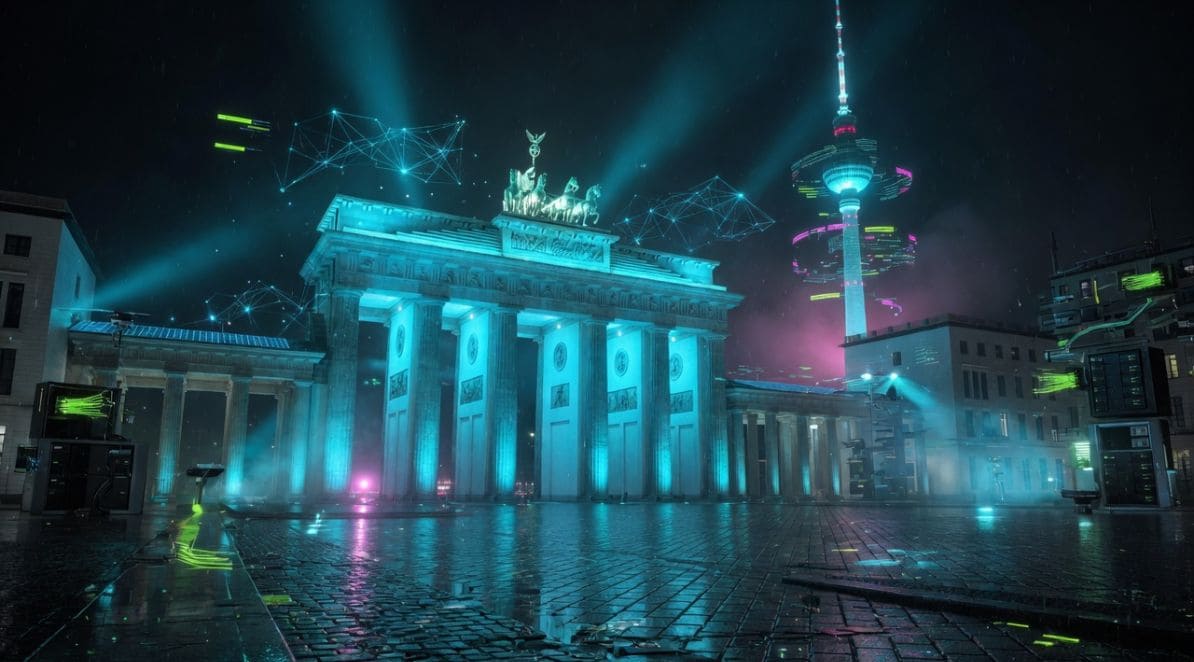
Berlin’s startup reputation was built on cheap rent, creative migration, and a post-reunification identity that pulled in founders who couldn’t afford London or Zurich. The early wins were software and consumer internet: N26 in banking, Delivery Hero in food delivery, and Zalando in fashion. But the underlying city was always more layered than its consumer-internet reputation suggested.
Today, Berlin accounts for 43% of Germany’s total startup ecosystem value, with over 1,600 venture capital (VC) backed companies and a combined ecosystem worth €169 billion (over $198 billion), according to the Berlin Startup Ecosystem Report 2025. The city ranks fourth in Europe for VC investment and of the roughly €7 billion ($8+ billion) invested in German startups in 2024, approximately 32% (or €2.7 billion) went to Berlin-based companies.
But the directional story matters more than the headline figure. Deeptech and climate hardware are steadily displacing software and fintech as the sectors attracting the most serious capital.
Berlin Was Not Built Like London or Paris
London became Europe’s fintech capital through proximity to global capital markets, English-language dominance, and a regulatory environment that welcomed financial experimentation. Paris built an AI cluster through elite engineering schools and state-backed ambition, a model that produced France’s AI darling, Mistral.
Berlin’s path was different. Post-reunification, it attracted founders who wanted to build without Frankfurt’s financial overhead or Munich’s corporate conformity. Its deeper advantage is structural: access to Germany’s engineering supply chain, Mittelstand supplier networks, and a public research infrastructure that is among the densest in the world. That substrate is now being actively leveraged by a new generation of hardware and deeptech founders.
Germany’s Industrial Base Gave Berlin a Hardware Edge
Hardware is brutal because capital costs are higher, lead times are longer, and failure is more expensive. Not to mention the constant risk that a single engineering or production failure can destroy years of work and hundreds of millions in investment. But hardware is also harder to copy, harder to commoditize, and strategically more valuable as geopolitical competition over manufacturing capability intensifies.
Berlin is home to roughly 70 non-university research institutes affiliated with the Max Planck Society, Fraunhofer Gesellschaft, Helmholtz, and Leibniz networks. These are not passive institutions. They produce spinouts, share lab infrastructure, and connect scientists directly with commercialization pathways. German deeptech companies raised €1.7 billion across 78 deals in 2024, rising to approximately $2.54 billion in 2025, a nearly 39% year-on-year (YoY) increase.
Climate hardware has driven much of Berlin’s momentum. The city hosts 340+ climate tech startups and has raised over €800 million in climate VC since 2024, ranking fourth in Europe in the sector. Enpal, the Berlin-based solar-and-storage company, secured €1.1 billion in refinancing during 2024. This was marked as one of the largest climate hardware deals in European history. Unlike software-only competitors, Enpal installs physical systems in German homes. That physical installation model distinguishes it from software-only competitors.
The Institutions Making It Real
Berlin’s deeptech push is not purely market-driven. The Fraunhofer Heinrich Hertz Institute runs Silicon Allee, a venture lab connecting its photonics, AI, and quantum research with early-stage startups. Through the xG-Incubator, teams receive up to €800,000 in equity-free funding plus access to state-of-the-art lab infrastructure. The Berlin University Alliance’s joint service, Science & Startups, covers IP transfer, co-founder matching, and VC introductions across TU Berlin, Freie Universität, and Humboldt-Universität.
Berlin Partner and the Berlin Senate launched the Deep Tech Hub in June 2024 with an explicit mandate: help deeptech startups reach market and raise the city’s international visibility as a hardware location. IBB Ventures, the state-backed investment arm, has deployed over €300 million into more than 300 Berlin companies and added a new pre-seed fund specifically for deeptech.
These institutions are driving Berlin’s deeptech transformation.
Ukraine Changed the Defence Tech Conversation
Before Russia’s full-scale invasion of Ukraine in February 2022, defence and dual-use technology were largely untouchable in Berlin’s investor community. The ethical constraints were real, the funding non-existent. The procurement pathways were unclear. That has changed structurally.
In December last year, the Berlin Senate passed a formal resolution to establish a defence tech ecosystem in the city. Across Germany, defence tech attracted nearly €900 million in investment in 2025, a record figure driven by post-Ukraine urgency and growing US strategic disengagement from European security under the Trump administration.
The clearest signal of where European defence tech capital is flowing is Helsing. The Munich-based AI defence company raised €450 million in a Series C in July 2024 and a further €600 million in June 2025 at a €12 billion valuation, led by Spotify co-founder Daniel Ek’s Prima Materia.
Helsing is headquartered in Munich. But its rise reflects a German defence tech shift that Berlin is now deliberately positioning itself to capture. The broader effect is already felt, which is that dual-use technology (robotics, autonomous systems, satellite communications, secure hardware) has become fundable across Germany in a way it was not before 2022.
Berlin Is Not Germany’s Only Deeptech Engine
Germany’s deeptech geography is distributed. Munich leads on aerospace, automotive AI, and defence tech, powered by TU Munich’s UnternehmerTUM venture lab, which produces over 50 scalable startups annually, and an industrial base anchored by BMW, Siemens, and the Airbus supply chain. Silicon Saxony in Dresden owns semiconductor manufacturing, hosting GlobalFoundries, Infineon, and the ESMC FinFET fab under construction.
Hamburg builds in logistics and maritime systems. Stuttgart anchors automotive manufacturing. Aachen is quietly developing one of Europe’s most credible semiconductor spinout ecosystems. Black Semiconductor, for example, raised €234 million in 2024 for graphene-based chip interconnects through an RWTH Aachen spinout.
Berlin’s specific edge is not industrial capacity. It is founder density, international talent (42% of Berlin startup employees come from abroad, per the German Startup Monitor 2025), capital visibility, policy proximity, and cultural pull, layered on top of Germany’s wider industrial machine. Berlin can function as the commercial and creative hub that translates deep German engineering capability into globally competitive companies.
The Test Is Commercialization, Not More Demos
Berlin’s deeptech case is more credible at present than it was three years ago. The research infrastructure is real. The capital is moving. The defence conversation has shifted. The climate hardware sector is producing companies with genuine revenue and physical products. International founders keep choosing Berlin over Frankfurt or Düsseldorf.
But the decisive test is not whether Berlin can produce impressive research or raise venture rounds. Europe does not need more deeptech demos. It needs hardware companies that manufacture at scale, export globally, sign enterprise contracts, and survive long procurement cycles without running out of capital. Germany ranks only 18th globally in VC as a share of GDP. For deeptech founders, that capital gap at the growth stage is the ecosystem’s most dangerous structural weakness. Roughly 29% of German founders say they would go abroad to launch their next business, primarily for easier capital access and less bureaucracy.
Berlin has built the foundation. Whether it can deliver category-defining hardware companies, not just the next wave of European software with a Berlin postcode, is the question that the next five years will answer.
See Berlin’s Deeptech Future Take Shape at DTM 26 this May
The research is real. The capital is moving. Now comes the hard part: turning European deeptech into companies that scale globally.
On May 20-21, 2026, Deep Tech Momentum returns to Berlin as Europe’s defining deeptech marketplace, bringing together 3,000+ corporate leaders, investors, and founders. Structured deal-making programs pair senior executives with direct budget ownership from Europe’s leading enterprises with deeptech builders – designed to deliver commercial contracts, not just pitch practice.
Deep Tech Momentum is where Europe’s deeptech ecosystem decides whether it can deliver category-defining hardware companies, or just another wave of well-funded demos. Learn more here.

See Also:
Is Tesla Overhyped? Enter NEURA Robotics, Europe’s AI Robot Challenger