

China cannot make the world’s most powerful AI chips. For years, it found a way around that: buy the machines that help build the next best thing, then mass-produce until the gap closes.
On April 2, 2026, a bipartisan group of U.S. lawmakers introduced legislation that would significantly tighten restrictions on the sale and servicing of semiconductor manufacturing equipment to China. The bill, formally titled the Multilateral Alignment of Technology Controls on Hardware (MATCH Act), targets the specific equipment China depends on, names the chipmakers that will lose access, and gives America’s allies 150 days to fall in line before Washington acts alone.
In Europe, one company sits directly in the crossfire. ASML made 33% of its revenue from China in 2025. It has declined to comment.
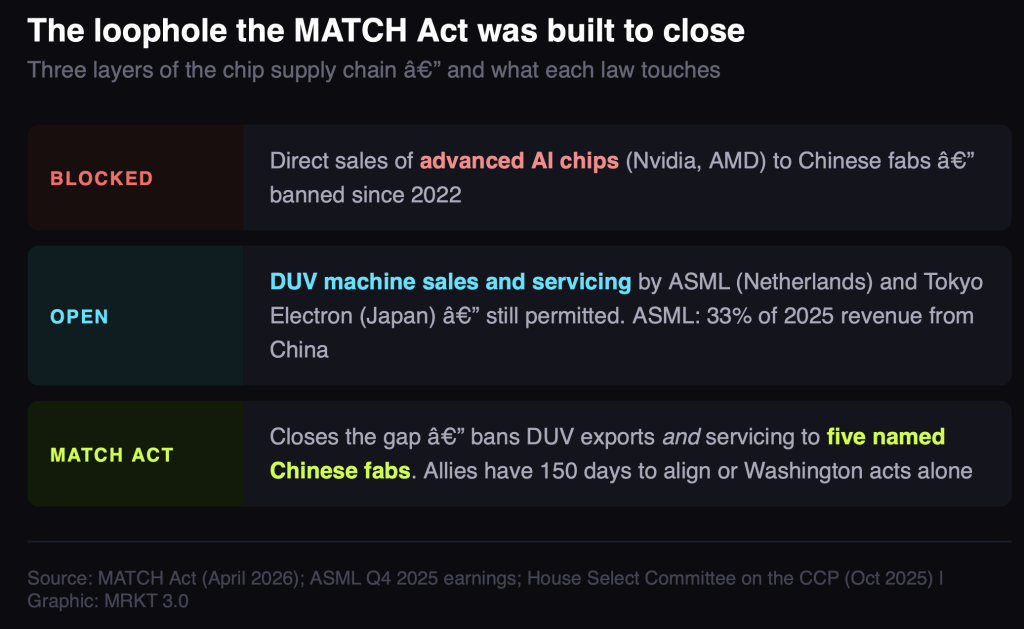
The Loophole the MATCH Act Was Built to Close
The U.S. has been trying to strangle China’s AI hardware ambitions for years. The country blocked sales of the most advanced chips, banned Nvidia from shipping its top-tier GPUs and put China’s leading chipmakers on the Entity List. And still, China kept building.
Current export rules block sales of specific machines to specific Chinese companies. This bipartisan legislation is designed to modernize U.S. export controls. This is meant to ensure that adversaries cannot buy “chokepoint” semiconductor manufacturing equipment that they cannot build themselves.
The bill targets a specific class of machine: deep ultraviolet (DUV) immersion lithography tools. These are older than ASML’s most advanced EUV systems, but still critical. Previous rounds of export controls allowed sales of older, lower-grade machines that perform deep ultraviolet immersion lithography, which are capable of manufacturing very advanced, but not the most advanced, chips.
What the MATCH Act Does – and Why It Goes Further
The MATCH Act was introduced by Rep. Michael Baumgartner (R-WA) in the House, with companion legislation in the Senate from Sen. Pete Ricketts (R-NE) and Sen. Andy Kim (D-NJ). Co-sponsors include Senate Democratic Leader Chuck Schumer (D-NY) and Sen. Jim Risch (R-ID). The bill’s bipartisan reach is not incidental, it reflects a rare consensus in Washington that this particular fight cannot wait.
The bill also addresses a long-standing gap in after-sales service. ASML and Tokyo Electron have continued servicing semiconductor manufacturing equipment inside Chinese facilities, while U.S. companies have been prohibited from selling the same solutions. Experts say that servicing has allowed Chinese chip factories to repair broken machines and continue manufacturing powerful chips. Other factories have also been able to upgrade their DUV machines to approach EUV levels of performance.
Five Chipmakers. Entity-List Rules. No Exceptions.
The MATCH Act designates as covered facilities all factories run by ChangXin Memory Technologies (CXMT), Hua Hong, Huawei, Semiconductor Manufacturing International Corp (SMIC), and Yangtze Memory Technologies Corp (YMTC), including all subsidiaries and affiliates, applying restrictions equivalent to those under the Entity List. This includes restrictions on exports, servicing, and technical support to these facilities.
The bill also includes trade sanctions on these major Chinese chipmakers. Congress previously banned these firms from selling to the federal government under the 2023 National Defense Authorization Act due to their alleged ties to Beijing and the Chinese military.
Saif Khan, a former official at the National Security Council and the Commerce Department, described the bill’s significance:
“America’s advantage in AI computing power over China, driven by the ability to produce large volumes of the most powerful AI chips, is the linchpin of its leadership in AI. Export controls on chipmaking equipment have already dramatically decreased the quality and quantity of competing AI chips China can produce domestically. The MATCH Act would close key remaining gaps in those controls, strengthening the long-term U.S. advantage in AI.”
ASML: 33% of Revenue, Zero Comment on the Bill
No company has more at stake here than ASML, the Dutch firm that holds a near-monopoly on advanced lithography machines. China accounted for 36% of ASML’s total sales in Q4 2025 and 33% for the full year. Both figures are higher than any other regional market. ASML expects its China business to fall to approximately 20% of total sales in 2026, a projection that predates the MATCH Act’s introduction.
If the MATCH Act passes, it would constitute a forced breach of existing contracts and a significant reduction in sales, with SMIC, Hua Hong, Huawei, CXMT, and YMTC all explicitly named as affected facilities.
ASML declined to comment on the proposed legislation. The Dutch foreign ministry also stated it does not comment on draft laws put forward by lawmakers in other countries.
A report by the House Select Committee on the Chinese Communist Party in October 2025 warned of remaining loopholes, noting that China spent $38 billion on imported chipmaking equipment in 2024, equaling 39% of global revenue for the main tool suppliers. The committee recommended broader bans on DUV immersion tools to slow China’s chip industry growth.
Allies Get 150 Days. Then Washington Acts Alone.
The bill offers a 150-day window for allies and partners, particularly Japan and the Netherlands, to demonstrate progress toward tightening trade restrictions before the Department of Commerce unilaterally intervenes under the Foreign Direct Product Rule.
The Foreign Direct Product Rule allows the Commerce Department to assert that its export control regulations apply to items manufactured in foreign countries when those items are the direct product of, or incorporate, U.S.-made technology or software.
On the use of that authority, Greg Stewart of Silverado Policy Accelerator said: “We have to always prioritize moving forward with allies on the most cooperative basis possible. If we can’t get to that place of alignment, though, then we do need to have these backstopping tools. Hopefully, they are used only as a last resort, but they need to exist.”
The bill includes a national security waiver that would allow for additional time if diplomatic negotiations require it.
China Spent $41 Billion on Chips It Still Can’t Make
The MATCH Act arrives as China continues a massive state-backed push to develop its own semiconductor manufacturing ecosystem. China spent $41 billion on wafer fabrication equipment in 2024, accounting for about 40% of total global purchases in this field. It is not for lack of investment that China remains dependent on foreign tools.
The problem is structural. As of 2024, China’s semiconductor equipment self-sufficiency rate has risen to only 13.6%. In the markets for etching, cleaning, photoresist stripping, and CMP equipment, the self-sufficiency rate has surpassed double digits, but in metrology, coating, developing, lithography, and ion implantation equipment, China still remains relatively weak.
Beijing has set a target of 50% domestic equipment use for new chip plant approvals. It is a target that signals ambition and current failure in equal measure. U.S. lawmakers have warned that “left unchecked, China could render US and allied export controls irrelevant by replacing foreign chipmaking tools entirely.”
The Bill Has Momentum. Europe Has a Problem.
The MATCH Act still needs to pass both chambers. But its bipartisan architecture – Senate Democratic Leader Schumer co-sponsoring alongside Republican leadership – signals the kind of political consensus that tends to survive a legislative session. The scale of co-sponsorship is not noise. It is a signal.
For Europe, this bill carries direct commercial and diplomatic consequences.
ASML sits at the center of a tripartite pressure system involving Washington’s legislative demands, Beijing’s purchasing power, and Brussels’ push for centralized export control authority. The EU’s bid for tech sovereignty is being tested across multiple fronts, and the MATCH Act now adds a concrete legislative deadline to that pressure.

See Also:
European Tech Sovereignty: ASML’s Crown Jewel in the AI Race 2026
Will the EU’s AI Act Cripple Europe’s Innovation Edge?
Europe’s AI Is Collapsing, and China Is Feasting on the Wreckage