
Reported live from Deep Tech Momentum 2026, Wilhelm Studios, Berlin. 20 May 2026.
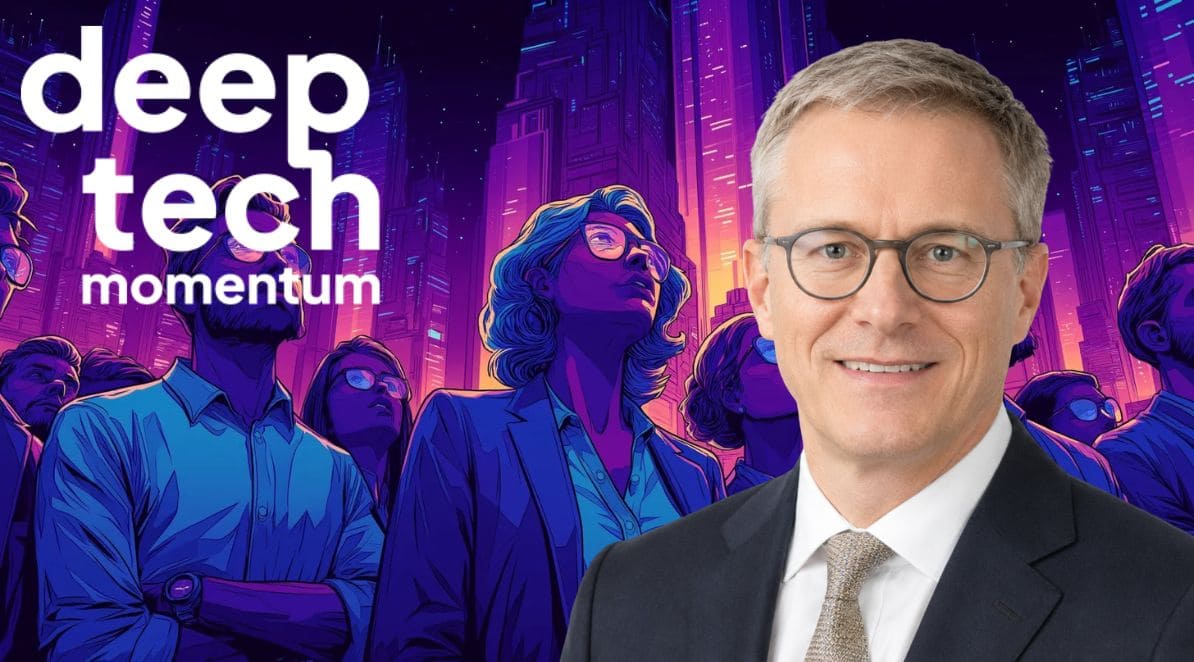
Deep Tech Momentum 2026 (DTM) kicked off to a flying start this morning in Berlin. Then, at 13:00 on the main stage, Germany’s first Federal Minister for Digital Affairs and Government Modernisation, Karsten Wildberger, joined DTM CEO Martin Schilling for a 30-minute fireside chat.
The room leaned forward. This was the matchup everyone had been waiting for – one of Europe’s sharpest deep tech conveners and the minister tasked with fixing Germany’s digital lag.
“The future is not something we wait for,” Wildberger said in his opening remarks. “It is something we build together.”
What came next showed he meant it.
Germany‘s Scaling Problem
Wildberger didn’t sugarcoat the numbers. The US stock market went from $25 trillion in 2016 to nearly $70 trillion today. Germany moved from $1.8 trillion to $2 trillion in the same period. That’s ten years of near-stagnation while platforms, standards, and business models were built elsewhere.
“Patterns prove that we are not lacking in entrepreneurial spirit… What we are lacking is something else. We invest at a world class level, but we scale in a very mediocre way.”
Germany continues to punch above its weight in innovation. In 2025, it filed 24,500 European patent applications second only to the United States. The country also launched 3,600 new startups, with one in three built on AI. It remains a powerful innovation engine. What’s missing is scale.
This, he said, is “the task of this decade.” But he sounded genuinely hopeful: “the decade belongs to those who act now.”
Sovereign AI in Europe
For Wildberger, sovereignty and AI are the same conversation.
“Sovereignty and artificial intelligence, are not two topics, they are one. Whoever depends on AI from elsewhere depends politically and economically.”
There are three crucial parts to this. Rules we can shape. Infrastructure we can trust. And an ecosystem that can scale. That means unifying Germany’s 18 different GDPR interpretations, quadrupling AI compute capacity, and building a sovereign cloud and tech stack with open-source, interoperable standards.
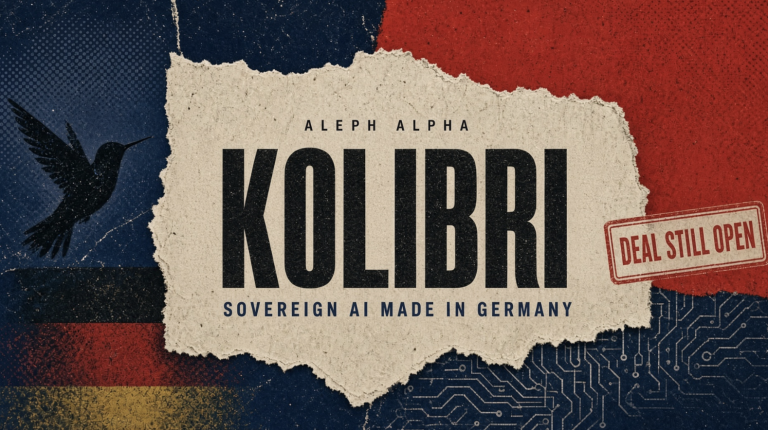
On April 24, Aleph Alpha and Cohere announced their merger – creating a new AI champion with dual German-Canadian citizenship, backed by €500 million from Schwarz Group and positioned as a sovereign alternative to US hyperscalers. The combined entity is valued at around $20 billion.
“When capital, compute, customers, and political will come together, Sovereignty stops being a concept, it becomes a possibility,” he explained.
Stop Being Nostalgic
Wildberger delivered one of the most powerful moments of the conversation with a direct challenge to the room:
“Let us stop spending so much energy on what Europe may have missed. Let us stop being nostalgic about Da Vinci, Copernicus, and Marie Curie only as figures of the past. Let us use our energy for something greater: to create the next generation – the new Da Vincis, the new Curies.”
The room went quiet.
“Let us honor and celebrate the talents we have, those who dare to dream big and who dare to build. And let us also celebrate those who do not succeed the first time, but learn and start again – not somewhere, but here. In Germany. In Europe.”
You could feel the weight of his words. This was more than a speech, it was a call to action.
The Honest Part
When asked about resistance to change, Wildberger paused. “I wish I had the answer.”
His approach is to unleash potential within the system and be honest about what’s broken. “So many people say ‘I’m responsible,’ but no one is accountable. That’s the real challenge.”
Then the bigger question: “With the speed at which technology is moving, we have to ask ourselves: is the system as we know it able to cope with the speed of change? Or, what’s the role that governments play?”
Another audience member challenged him on the EU’s tech funding gap. Wildberger flipped it: “What is missing is that people in the US see this as a business opportunity, but here I’m having conversations about ‘How can you risk that?'”
The challenge isn’t infrastructure or talent. It’s risk appetite.
What Happens Next
Sitting in the audience, it was clear something had shifted. Wildberger spoke not like a typical minister, but like someone who understands what it takes to move from ideas to execution.
The fireside chat between Schilling and Wildberger distilled the real purpose of DTM: Europe has talked about digital and technological sovereignty for years. This time, the conversation felt more grounded – and more urgent.
Now the hard part begins: turning the ambition into actual scale.
Follow MRKT 3.0’s coverage of DTM26 throughout the two days.

See Also:
Deep Tech Momentum 2026: Driving the Commercialisation of Deep Tech in Europe
Is Berlin’s Deeptech Pivot Real or Just Hype?