
Reported live from Deep Tech Momentum 2026, Wilhelm Studios, Berlin. 20 May 2026.
Wilhelm Studios filled up fast this morning for Deep Tech Momentum 2026 (DTM). By 9:15, the converted Spandau industrial space was already packed. Look around the event and you’ll see corporate innovation leads, Tier-1 fund partners, and Europe’s top tech founders.
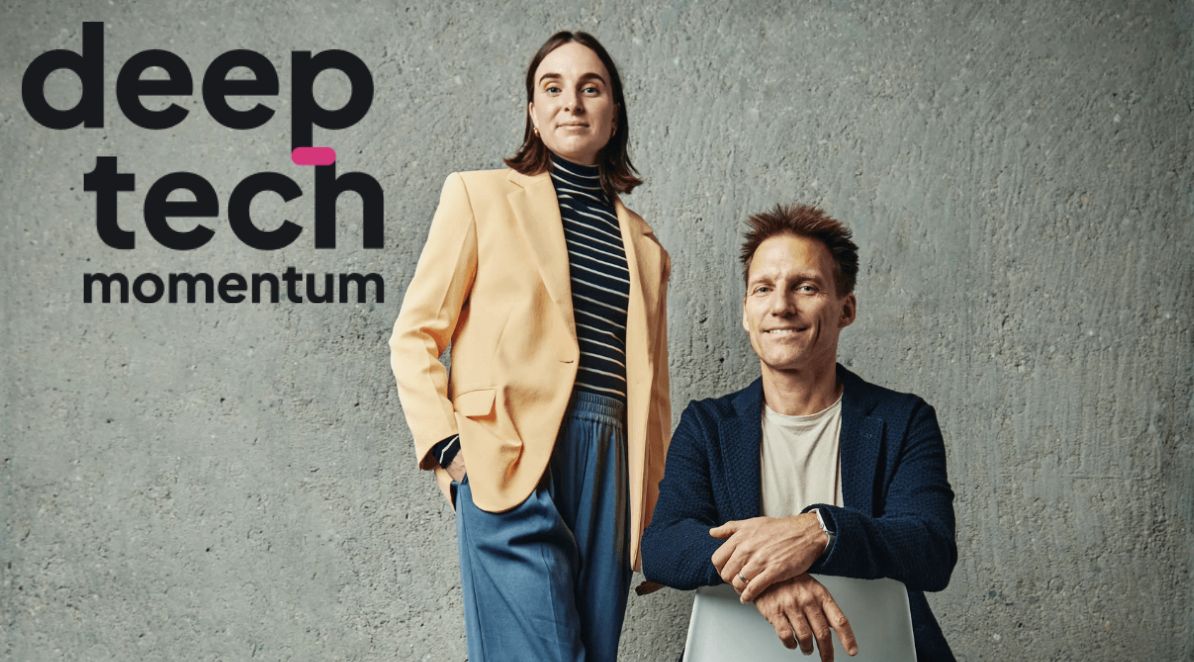
That’s the point. DTM co-founders Isabelle Simon (COO) and Martin Schilling (CEO) didn’t build it as another conference. They built it as an innovation marketplace targeting €1 billion in investments and 500 commercial contracts.
By 9:30, the crowd had settled and focused on the main stage. If you’re serious about European deep tech, the opening address wasn’t optional. The founders were about to explain what’s broken and how they’re betting it can be fixed.
The Execution Gap Europe Won’t Talk About
Schilling has been saying it for months, most recently in an interview for MRKT 3.0: Europe’s problem isn’t over-regulation. No, Europe’s problem is unclear ownership, fragmented go-to-market, and companies that optimize for compliance instead of outcomes.
This morning, he doubled down with two specific bets: “building a new demand stack for deep tech and AI, 100 billion additional procurement volume for deep tech and AI companies“. The second bet: “a venture capital stack, 100 billion additional venture capital, state stepping up, pension funds stepping up… because these two stacks demanded capital returns scientific strength into serenity and prosperity.“
The room paid close attention. These are not founders who need to be told Europe produces world-class research, they already know that. What they need to know is whether Europe can finally deliver the commercial infrastructure to turn that research into category-defining companies.
Berlin’s Deep Tech Bet Is Getting Real
Berlin isn’t trying to be London or Paris. It’s leveraging something neither of those cities has: direct access to Germany’s industrial Mittelstand, 70 non-university research institutes, and a post-reunification scrappiness that makes hardware founders choose it over other European cities.
The numbers back it up. In 2025, Berlin-based startups raised approximately €2.7 billion, capturing around 32% of Germany’s total startup investment. Climate hardware and defense tech are displacing fintech as the sectors attracting serious capital. Enpal’s €1.1 billion refinancing and Helsing’s €600 million raise at a €12 billion valuation show that Germany is deploying real capital into physical systems.
DTM is Berlin’s bet that it can function as the commercial hub that translates deep German engineering into globally competitive companies. The research is real and the founders are technical. The question is whether the ecosystem can deliver contracts, not just demos.
Simon frames it plainly:
“We are enabling this by building the deep tech and AI innovation marketplace. We have the deep conviction that the breakthroughs Europe very much needs urgently are not built in isolation within one market. They happen at the edges, at the intersection.”
That intersection theory isn’t abstract. When a space founder discovers the Ministry of Defence as their next customer, or when a quantum startup signs its first contract with a bank working on quantum cryptography – that’s where DTM is placing its bet.
3,000 Decision-Makers, 20,000 Meetings, One Question
The next two days are not going to be short of ambition or deal flow. The specific experiments include:
- Guardian Connect, where 300 corporate buyers with active budgets meet technical founders across six verticals.
- Signals from the Frontline, an invite-only program bringing NATO armed forces and European defence primes together to spec next-generation capabilities.
- CXO Sovereignty Summit, hosted with BCG, where 50 people who can actually change Europe’s commercialization policy sit in one room.
DTM’s AI-powered matchmaking will facilitate 20,000 meetings in 48 hours.
The targets are specific. Simon states:
“We will trigger over a billion euro in investments between the investors walking through these rooms and the founders. We will trigger over 500 commercial contracts and POCs between the corporate innovators and the founders”
Not aspirational. Measurable.
The Test Europe Keeps Failing
Schilling opened with history. CERN in 1954, founded nine years after the worst war in human history – confirmed the fabric of the universe and invented the World Wide Web as a side project. Airbus in 1970, when Boeing ruled the skies. The Euro in 1999, when Germany gave up the Deutsche Mark despite a significant percent of the country opposing it.
Three times Europe made the impossible possible.
Then he lands the challenge:
“These big bets are not built by people who are permission seekers or rule memorizers. These are built by explorers.“
Europe doesn’t need more strategy papers on technological sovereignty. It needs its best deep tech founders in rooms with customers who have the courage and budgets to deploy at scale.
The opening address ended at 10:50. The real work starts now. DTM has two days to prove that European deep tech can move from world-class research to category-defining companies. Not in five years. This week.
Although it’s MRKT 3.0’s first time at DTM, it’s certainly off to a promising start.
Follow MRKT 3.0’s coverage of DTM throughout the two days.

See Also:
Deep Tech Momentum 2026: Driving the Commercialisation of Deep Tech in Europe