
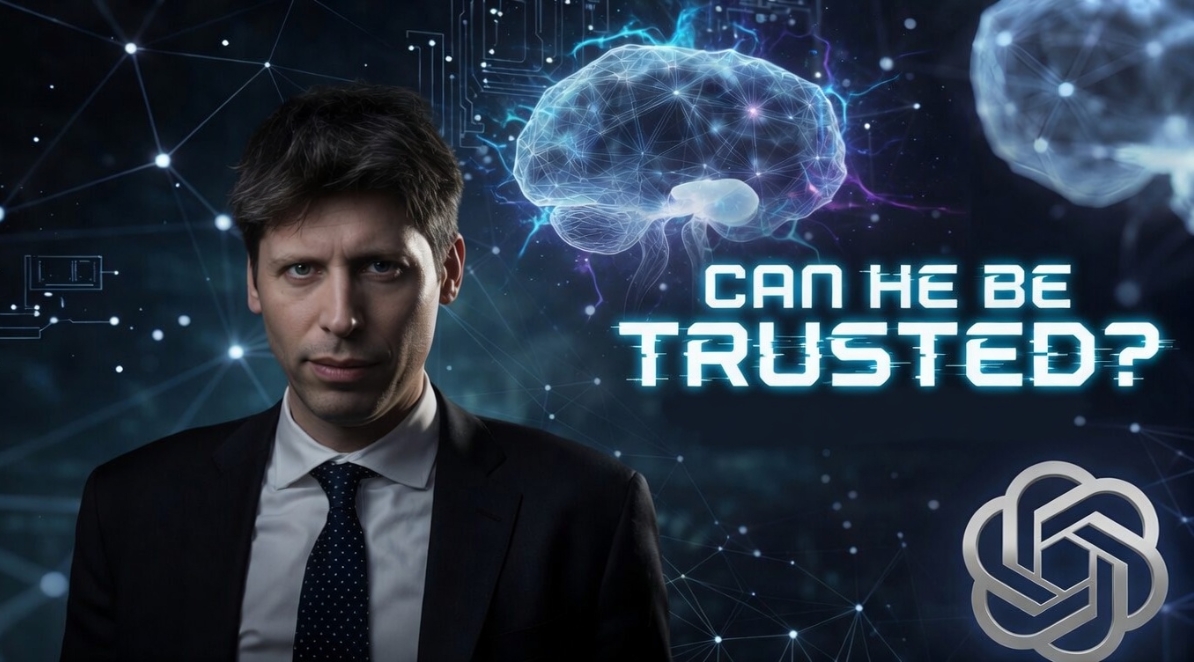
OpenAI is facing one of its most serious credibility tests yet. On April 6th, The New Yorker dropped a shocking new exposé that calls Sam Altman a pathological liar and places OpenAI under intensified scrutiny. Under the headline, “Sam Altman May Control Our Future–Can He Be Trusted?”, Ronan Farrow and Andrew Marantz dive deeply into Altman’s reputation for playing fast and loose with the truth among colleagues and investors.
Meanwhile, on April 2nd, OpenAI announced it had acquired Technology Business Programming Network or TBPN, a one-year-old tech-centric podcast with a modest YouTube following of 75K, for an amount estimated in the “low hundreds of millions of dollars.”
TBPN is a live video podcast that broadcasts for three hours a day, five days a week. Altman has appeared on the podcast several times and enjoys a congenial relationship with the show’s two hosts, who are unapologetically techno-optimists and offer a friendly venue to their high-profile guests. That being so, the podcast is popular with tech CEOs and tech elite, having been called the “SportsCenter of Silicon Valley“.
Taken together, these developments point to a battle over who controls the narrative around artificial intelligence at the very moment public trust is most fragile.
An 18-Month Probe Meets a 5-Day Comeback
Ronan Farrow, who won a Pulitzer for his exposé on Harvey Weinstein’s sexual misconduct, spent a year and a half researching Altman, having interviewed him several times for the piece, as well as Dario Amodei of Anthropic, among many others. The article sheds light on Altman’s brief firing from OpenAI by its board of directors, his subsequent rehiring, and the structural changes that occurred afterwards as OpenAI became a for-profit company.
In 2023, Altman’s alleged pattern of lying and concealing the truth already troubled many of the board members. Prompted by some of these board members, OpenAI’s chief scientist, Ilya Sutskever, himself a member of the six-person board, sent secret memos to three other board members detailing how Altman misrepresented facts to investors and company executives.
Altman was fired with only a vague explanation given to employees and the public. At the time, OpenAI had already entered into large contracts with powerful, extremely motivated investors. Altman and his allies went to work, while the board did little to articulate the reasons for his ouster. Without any details, employees overwhelmingly signaled their desire for Altman to return as CEO. It only took five days.
The Nonprofit That Wasn’t Meant to Last
OpenAI was specifically created as a nonprofit so that a board of directors could fire a CEO who was deemed unfit. With Altman back at the helm, that structure has been undone in the last two years, and now OpenAI’s Byzantine corporate structure includes a for-profit arm, of which OpenAI, the nonprofit, only owns 26%.
In an interview with Katie Couric, Farrow states: “Sam Altman was saying publicly and to recruits, ‘this is a nonprofit. That’s all it will ever be.’ Simultaneously, the internal communications of the company show he and his cofounders were talking about how to get out of that structure…He was saying multiple things to different people, sometimes at the same time.
This point of contention is the basis for Elon Musk’s forthcoming lawsuit against OpenAI, which alleges he was defrauded into funding a nonprofit that then became a for-profit company partnered with Microsoft.
Interestingly, Farrow’s investigation also includes a comment from an anonymous Microsoft executive, who suggests there is a “small but real chance” that Altman could ultimately be remembered alongside corporate figures tied to major scandals.
In Farrow’s conversation with Katie Couric, he goes on to say of Altman:“We interviewed more than a hundred people…a majority of those people really did say some variation on a theme that he’s a pathological liar.”
Flooding the Zone, Silicon Valley Edition
In the past few years, Silicon Valley has demonstrated an increasingly vocal animosity toward legacy news. As a result, “new media” controlled by Silicon Valley is popping up all over the place.
The a16z show, a popular podcast named after the venture capitalist firm started by Ben Horowitz and Marc Andreessen, recently discussed the motivations for this and the new media’s tactics.
The phrase “flood the zone” was repeated several times regarding selling a corporate narrative. As a political strategy, flood the zone seeks to gain attention while simultaneously distracting the public from unfavorable coverage via an onslaught of information that is impossible to keep up with. It was coined by political strategist Steve Bannon and is often employed by President Trump.
Bannon said: “The real opposition is the media. And the way to deal with them is to flood the zone with shit.”
In a time when the public is increasingly distrustful of AI, proper scrutiny of an industry operating with very few guardrails is seen by many as essential. However, the tech industry is propping up new media to celebrate itself and obfuscate the risks associated with the breakneck speed at which new technologies are being developed.
The TBPN podcast fits this trend perfectly. In Altman’s words: “TBPN is my favorite tech show.” This is unsurprising considering TBPN never seems to scrutinize Altman or OpenAI. While OpenAI promises TBPN will have editorial independence, it’s difficult to believe. The two hosts of TBPN, John Coogan and Jordi Hays, are now likely OpenAI shareholders. Beyond that, their coverage was sycophantic to begin with.
An Investigation on One Side, a Megaphone on the Other
Ronan Farrow had this to say about the broader context in which his investigation appears:
“The media landscape is increasingly becoming consolidated in the hands of really powerful tycoons and businesses with specialized interests that make the environments they acquire ultimately inhospitable to this kind of accountability reporting.”
Given OpenAI spending hundreds of millions on a podcast with a limited reach, but one that, importantly, tells Silicon Valley what it wants to hear, that seems about right.
Whether this reflects strategic positioning or defensive optics, the implication is the same: as AI becomes more powerful, the fight over its story may matter as much as the technology itself.
Author: Tim Tolka, Senior Reporter
The editorial team at #MRKT3.0 has taken all precautions to ensure that no persons or organizations have been adversely affected or offered any sort of financial advice in this article.
See Also:
Is ChatGPT a Trojan Horse in Europe?
OpenAI Needs to Grow 20x in 5 Years. Europe Might Not Play Along.