

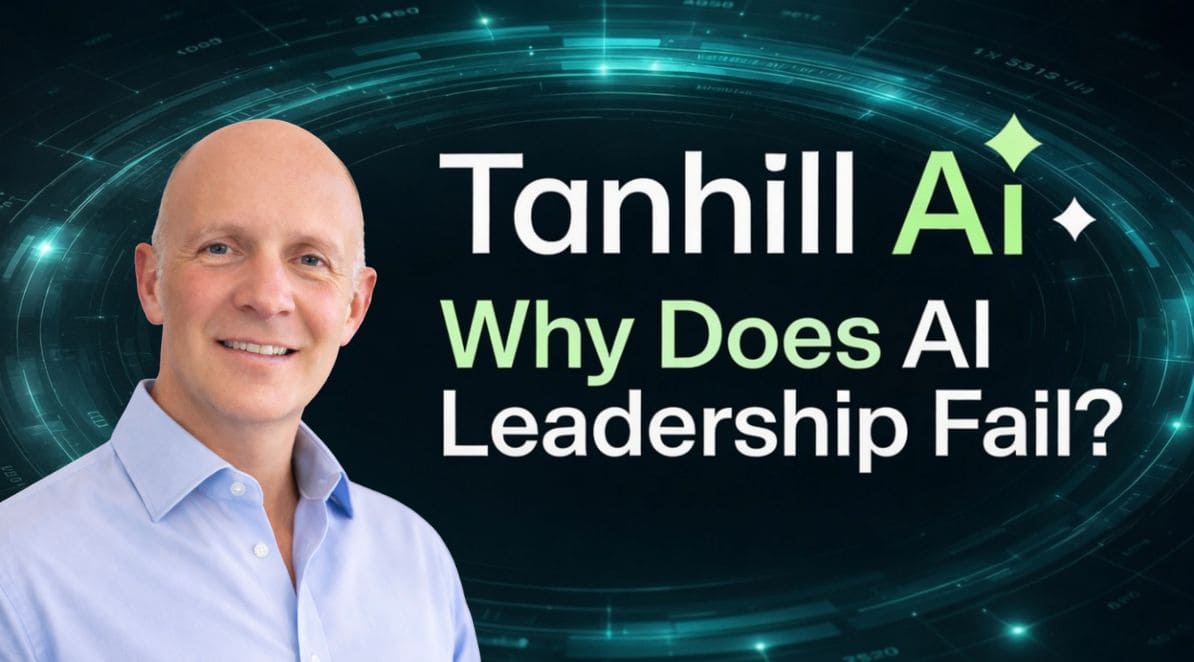
The firms moving fastest on AI adoption in financial services are not always the best equipped to lead it effectively. While enthusiasm and speed are valuable, sustainable success requires thoughtful leadership, governance, and organisational transformation.
David Royle has spent thirty years at the sharp end of financial services transformation: Big Four trained, former Big Six partner, global technology executive, and fintech founder. That experience underpins Tanhill.ai, the AI strategy and transformation consultancy he founded to help mid-market financial services firms and organisations beyond the sector, move from AI ambition to effective leadership and strategy.
He has seen too many institutions invest heavily in technology while the surrounding organisation stayed unchanged. He is watching the same pattern repeat with AI, only this time the stakes and speed are far higher.
What lies at the centre is not a technology gap or a budget problem. It is more fundamental: AI does not just threaten jobs. It threatens the expertise, seniority, and authority that senior leaders have spent entire careers building. As Royle puts it plainly:
“All of your business standing and justification of why people should listen to you is suddenly undermined.”
From AI Paralysis to AI Chaos: Have Mid-Market Firms Lost the Plot?
Twelve months ago, Royle’s conversations were dominated by fear. Firms banned AI tools outright. That phase is now over for the majority. What replaced it is harder to manage.
“We’ve moved from a period of reticence to engage to a period of chaotic engagement,” Royle says. “Most organisations now have so much AI activity going on, both sanctioned and unsanctioned, that it’s very hard to control.”
The structural reason is a leadership vacuum. Large institutions can appoint Chief AI Officers. Mid-market firms cannot. As a result, the AI agenda is scattered across IT, digital, risk, and operations with no single accountable leader.
“AI is a unique technology,” Royle says. “It touches every business, every process, every function, and every role. It therefore demands a genuine strategic approach, including disciplined portfolio management of the many use cases that will emerge.”
Financial Services Keep Making the Same Expensive Mistakes
Organisations have seen this before. Enterprise Resource Planning (ERP) implementations in the late 2000s and early 2010s consumed huge budgets but often delivered little real change because companies treated them as technology projects rather than business transformations.
“AI is following the same path. Treating it purely as a technology tool misses the point. Without role transformation, process re-engineering, cultural change, and organisational restructuring, companies will end up with a more expensive version of what they already had.”
Why Risk and Control Leaders Are the Answer – But They’re Not in the Room
There is a generation of risk and control professionals in financial services carrying something close to “post-traumatic stress” from previous technology projects. Their caution is understandable, but it creates a dangerous irony.
These are precisely the people best equipped to shape successful AI adoption. Yet few are helping them see how their expertise can become a superpower: asking the right questions of AI, crafting strong prompts, and building effective controls and guardrails.
Bringing them back to the centre of AI initiatives, as shapers rather than clean-up crew, is one of the biggest cultural challenges in the sector.
The AI Audit Nobody Wants to Run
Before any framework or strategy, most firms must first discover what is already happening inside their own walls.
Using AI at work was initially stigmatised as cheating. This perception has carried into professional life, causing many employees to hide their usage, often due to strict controls on what AI they are authorised to use versus the best tools on the market.
Many firms have now moved past this view, and actively want their teams to optimise with AI, but staff are not always aware of the shift. They need active encouragement to be transparent so the organisation can build its strategy on real needs and usage patterns.
Royle’s approach to the AI audit is therefore explicitly non-threatening. He argues firms should “embrace it…We want to know what you’re doing. We need to understand what you’re using. We want to give you corporate support to realise your AI ambitions.”
The Real Reason AI Leadership Keeps Struggling
The leadership vacuum, ungoverned AI activity, risk-averse control functions, and hidden usage all stem from one uncomfortable truth.
Domain expertise, long the foundation of seniority for accountants, lawyers, and compliance officers, is now accessible to anyone with a well-crafted prompt. This undermines the justification of many leadership roles. Resistance is not obstructionism. It is a rational response to a profound shift in the hierarchy and social order of business.
Turning AI into an Innovation Engine
Yet this disruption also creates a major opportunity. When properly led, AI becomes a powerful catalyst for innovation management. The right governance does not stifle creativity, it enables it. It gives people across the business the enthusiasm, safety, and authority to explore how AI can improve their specific areas of responsibility.
Success depends on effective portfolio management: identifying the many potential use cases, prioritising those with highest value, timeboxing experimentation, and applying commercial discipline. Proven solutions should then be productionised efficiently, while excessive cost and duplication are avoided.
AI Leadership in Financial Services Will Not Fix Itself
No framework alone will solve this. Success requires an honest conversation about what AI disrupts and what it enables.
The firms that thrive will treat AI not as a technology project but as a leadership and organisational transformation imperative. They will combine strong governance, space for innovation, and disciplined portfolio management to deliver real, commercially sound value.
Royle and the team at Tanhill.ai have been guiding mid-market firms through this transition for years. The question now is whether more organisations are ready to have the honest conversation and act on it before the cost of inaction becomes unsustainable.