
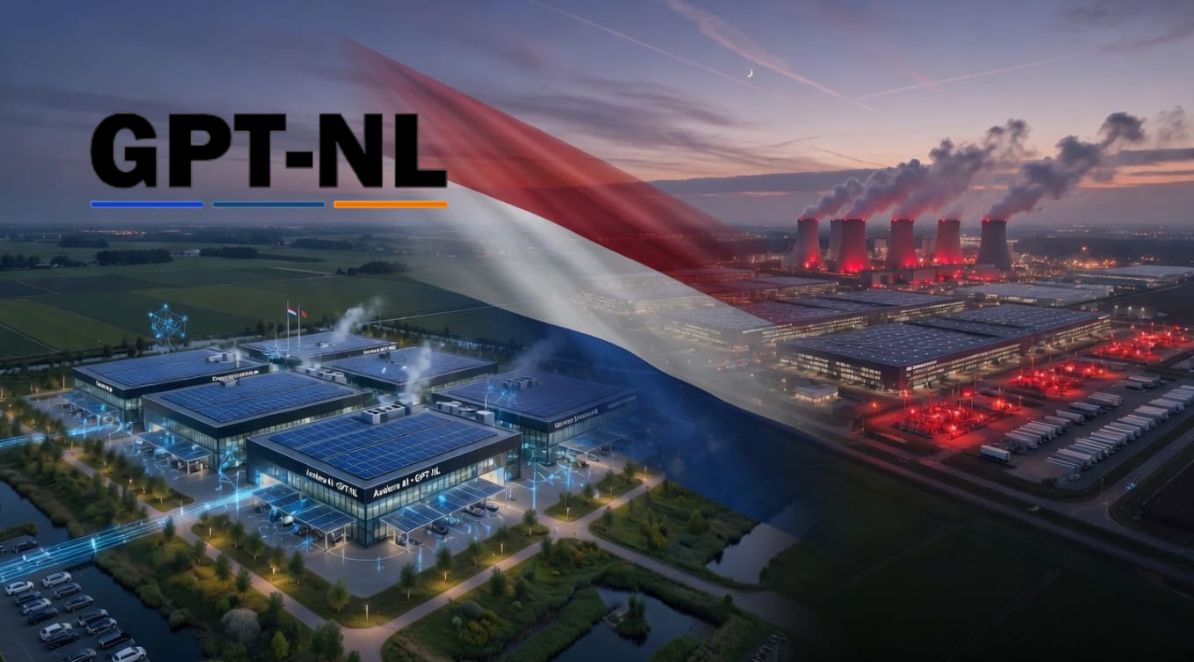
While OpenAI continues to face billions in copyright lawsuits, the Netherlands has addressed a challenge Silicon Valley has struggled with: it paid the publishers.
GPT-NL, the country’s €13.5 million flagship language model, has moved from lab to live deployment. Licensing deals are in place with major Dutch publishers through NDP Nieuwsmedia. Not scraped. Not stolen. Licensed. The first pilots are already underway.
This isn’t just about ethics. It represents the first real-world test of whether an AI system designed for European regulations can compete with American scale. Can a country of 17 million people chart its own AI path while France and Germany invest billions in large-scale initiatives that often mirror Silicon Valley approaches?
What is GPT-NL?
Launched on November 3, 2023, GPT-NL is a sovereign Dutch open language model built by TNO, the Netherlands Forensic Institute (NFI), and SURF, the IT cooperative of Dutch research and education institutions. The project received €13.5 million from the Ministry of Economic Affairs and Climate Policy. It was trained from scratch on the national supercomputer Snellius using exclusively lawfully sourced data.
How is GPT-NL Different From ChatGPT?
This is not a ChatGPT rival. GPT-NL is built for specific institutional tasks: summarising, simplifying, and extracting information from Dutch-language text. Government agencies and research institutions, including TNO and ICTU, began feasibility pilots in late February 2026, with a broader commercial rollout planned for the second half of the year.
What distinguishes it is how the training data was assembled. Rather than scraping the web, the consortium struck licensing agreements with publishers. NDP Nieuwsmedia, representing DPG Media, Mediahuis, Erdee Mediagroep, and others, contributed a large archive of Dutch-language news content, totalling over 20 billion tokens. SURF states that GPT-NL is “the first initiative worldwide” to reach agreements with “all publishers” on the use of their content with fair remuneration built in. That is a carefully scoped claim, not a global copyright solution. But it is one no other national AI project has formally completed.
The practical stakes extend beyond ethics. A clean, documented training data chain avoids the legal exposure that has followed OpenAI into courtrooms globally. The New York Times sued OpenAI for $1+ billion over unauthorised content use. Authors, artists, and news organizations lined up lawsuits across multiple jurisdictions.
GPT-NL sidesteps all of this. The full training dataset, including metadata on copyrighted content used, is set for publication on Hugging Face. GPT-NL also won the 2026 Dutch Privacy Award for its GDPR and EU AI Act compliance.
Why the Dutch Are Not Chasing the Biggest Model
The Netherlands is not trying to build a 500-billion-parameter monster. TNO explicitly tunes GPT-NL’s size and training for low energy and water use.
This “energy-efficient AI” ethos extends to national strategy. In 2025, a €200 million project was committed to building an AI Factory in Groningen. The goal is not to out-Google Google, but to provide mid-scale compute in Europe for tasks in agriculture, healthcare, and defence. The expertise centre is expected to open in 2026, with the supercomputer at full capacity by early 2027.
This contrasts with France and Germany. France’s champion, Mistral AI, raised billions to build massive infrastructure. Germany is pushing to double domestic data centre capacity and quadruple AI compute by 2030. By contrast, the Dutch argument is that smarter models can win where raw scale can’t: smaller models tuned to Dutch can deliver top-tier performance, according to preliminary benchmarks. And by keeping infrastructure lean, the Netherlands avoids the astronomical costs and environmental impact of “brute-force” training.
In this view, if Europe’s AI future demands sustainable resource use, then focusing on efficiency is a strategic choice.
The Dutch AI Ecosystem Is Broader Than One Model
GPT-NL is only one node in a wider Dutch AI ecosystem. Eindhoven’s Axelera AI is a high-profile example: it recently raised $250 million to produce custom “inference” chips for AI, with BlackRock joining as a new investor, bringing total funding to over $450 million. These chips run trained models at factories or edge sites with far less power draw than conventional GPUs.
CEO Fabrizio Del Maffeo boasts of not only an energy-efficient design, but also “making AI deployment economically viable at scale for real-world applications.” Such specialised hardware is the opposite of a one-size-fits-all GPU farm, it reflects the Dutch thesis that efficiency and tailoring to use cases matter.
In fintech, Amsterdam’s Adyen has long used machine learning to spot payment fraud. Its risk platform analyzes “trillions of dollars” in transactions and “reduces false positives”, boosting revenue. In healthcare, Rotterdam’s Aidence offers Veye Lung Nodules, an AI tool for lung cancer screening. UK officials note it helps radiologists report scans 40% faster by automatically flagging and measuring nodules. The NHS has now rolled Aidence’s software into dozens of clinics.
Each of these examples shows a Dutch strength in applied AI: using algorithms to solve specific industrial or social problems, rather than chasing general intelligence.
Other Dutch startups (like vector database vendor Weaviate, or firm EclecticIQ in cybersecurity) also illustrate this ecosystem. Taken together, they suggest the Netherlands is building a mosaic of AI capabilities, data platforms, chips, algorithms, and domain expertise, rather than competing with monolithic models. This complements GPT-NL’s “ethical foundation” with practical tools that companies and governments can adopt now.
A Different Playbook From France and Germany
Two high-capital strategies dominate Europe’s sovereign AI debate. France pledged €109 billion ($126+ billion) in AI infrastructure at the February 2025 AI Action Summit and has backed Mistral AI through a €1.7 billion Series C investment. Germany is channelling AI into industrial deeptech via SAP and Siemens, with a Franco-German framework agreement for public-sector deployment. Both countries are competing at scale.
France’s approach centres on scale and frontier ambition. Mistral AI has a French military contract, a growing enterprise licensing business, and a compute footprint now measured in tens of megawatts. Paris is betting that if Europe is going to have a competitive general-purpose AI model, it will come from a French lab. Germany is betting on AI embedded in industrial infrastructure (the SAP, Siemens, and deeptech layer of the economy) with AI as an enterprise and governance tool more than a consumer product.
The Netherlands is not positioned to compete at that scale and is not trying to. Its argument is narrower: lawful data infrastructure, energy-efficient hardware, sovereign compute, and applied AI in regulated sectors. Critics worry the Netherlands risks irrelevance if it can’t keep pace with petaflops of compute. Advocates counter that Europe’s real challenge is not beating ChatGPT at OpenAI’s game, but delivering AI systems that comply with GDPR and the AI Act while fitting European markets.
The Dutch insist on a “realistic” path: moderate budgets, legal licenses, and clear use cases.
If EU AI Act compliance provisions around training data provenance create structural costs for poorly documented models – and the Act’s transparency requirements suggest they will – the Dutch approach carries an advantage not yet fully priced in.
What’s the Most Realistic European Playbook?
GPT-NL is still in early pilots. Commercial rollout is planned for H2 2026. The Groningen AI Factory won’t reach full capacity until 2027. Axelera’s Europa chip ships before mid-2026. The pieces are moving, but outcomes are unproven.
The Netherlands isn’t Europe’s only hope for sovereign AI. France has more capital. Germany has more industrial scale.
But the Netherlands is testing whether the only AI that survives EU regulation is one built for compliance from day one. If the EU AI Act makes training data transparency mandatory (and it will), first-mover advantage goes to whoever has clean documentation now.
In a landscape where many sovereignty strategies mean running American models on American hardware with a European flag, the Dutch route is the most realistic European playbook actually being built.
Commercial rollout starts in six months. Then we know if Europe’s best shot was regulatory compliance, not raw compute.

See Also:
Europe vs US AI Infrastructure: Who’s Winning?
European Tech Sovereignty: ASML’s Crown Jewel in the AI Race 2026