
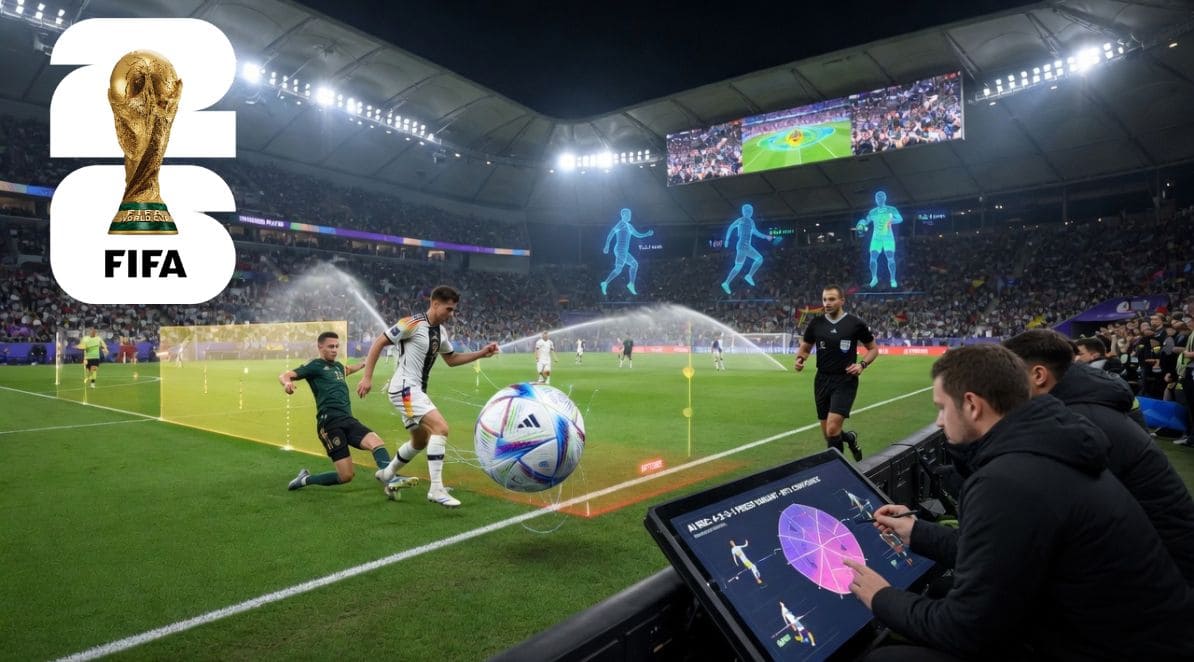
The 2026 FIFA World Cup kicks off on 11 June across the United States, Canada and Mexico, and it is the most AI-heavy tournament football has ever seen.
A football that talks to the referee. Robot-assisted offside. Referees wearing body cameras. A generative AI tactical brain handed to every team. FIFA and its technology partner Lenovo have rolled out a wide suite of AI tools, including the generative assistant known as Football AI Pro.
And, for once, the cleverest parts are not purely American or Chinese, they are European. The official match ball (Trionda) is made by Adidas (Germany) and uses sensor technology developed with Kinexon (Munich, Germany). And plenty of the players modelled as 3D avatars are Europe’s own. Europe, in other words, built much of the brains of the operation.
But here is the catch. If this full system were run inside the EU, several key components (particularly large-scale biometric processing, real-time remote biometric identification, and high-risk automated decision-making) would face significant restrictions or require heavy compliance under the EU AI Act.
So, the continent that engineered football’s smartest tournament is the one place on Earth that could not legally stage it. Ironic? Yes. Surprising? Not really.
How AI is Being Used at the FIFA World Cup 2026
AI runs five key layers across the 2026 World Cup: the connected match ball, semi-automated offside built on 3D player avatars, a generative tactical assistant handed to all 48 teams, AI-stabilised referee body-cam footage, and biometric crowd control at the stadiums.
Here is the stack at a glance:
Why the World Cup’s AI is a European Story
The headline writes itself as “American World Cup, American tech,” but the engineering tells a different story.
The connected-ball system is a German success story. A large share of the players being scanned into 3D biometric avatars come from the 16 UEFA-qualified European teams – stars like Mbappé, Bellingham, Kane, Yamal and Musiala.
Europe is supplying much of the intellectual property and the richest player data, while the deployment, governance and glory happen 4,000 miles away in North America.
If that pattern sounds familiar, it should. It is exactly the kind of value-and-rights mismatch Brussels has spent three years trying to fix through regulation.
Where the 2026 World Cup Collides with the EU AI Act
Run this stack inside the EU and several components would land squarely in the EU AI Act’s regulated or high-risk zones. The security elements around it brush up against practices the Act heavily restricts or prohibits.
The Act’s risk-based regime hit a fresh milestone on 7 May 2026 when negotiators reached agreement on the “AI omnibus” simplification package. Its core prohibitions (in force since February 2025) already ban the untargeted scraping of CCTV or web images to build facial-recognition databases and impose strict limits on real-time remote biometric identification in public spaces.
Wiring a tournament’s worth of stadiums for large-scale facial recognition would walk straight into that regulatory minefield.
Three aspects in particular would cause serious concern for European regulators:
- Scanning the players – 3D-modelling every footballer to drive automated decisions is a clear example of high-stakes biometric processing. The AI Act wraps this in significant oversight, documentation, and human-control requirements. Then you have the separate GDPR questions around who owns a player’s biometric twin and how long it can be stored.
- Faces at the turnstile – Frictionless biometric entry might be convenient in Texas, but in the EU it is one of the most legally sensitive things an event organiser can attempt.
- The word “semi” doing a lot of lifting – “Semi-automated offside” sounds reassuring. But the more the avatar-and-sensor pipeline drives the actual decision, the stronger the AI Act’s demands become for meaningful human oversight and explainability.
None of this makes the 2026 tournament illegal. It is being staged outside EU jurisdiction, so the Act does not apply. That is precisely the point. North America has become a lightly-regulated test track for an advanced AI system that its European inventors cannot fully deploy at home.
What It Means for European Football
The real question is not North America. It is the return leg.
Euro 2028 lands in the UK and Ireland. UEFA’s competitions live inside EU and EU-adjacent legal space. Domestic leagues across Europe are watching the officiating tech like hawks. Whatever survives 104 matches this summer becomes the thing fans, broadcasters and federations expect at home within a cycle or two.
And that is where it gets awkward. A technology proven abroad, demanded back home, and standing face-to-face with a rulebook built specifically to slow this exact flavour of biometric, high-stakes automation. The World Cup is about to show European football everything the tools can do. The EU AI Act gets to decide how much of it ever clears customs.
Europe built the smartest World Cup in history. Now it has to work out whether it is allowed to enjoy it.

See Also:
Will the EU’s AI Act Cripple Europe’s Innovation Edge?
Will the EU’s Digital Omnibus save Europe from ‘Doomerism’?
What is the European Innovation Act? How the EU is Bridging Europe’s Research-to-Market Gap
Frequently Asked Questions
AI powers five layers: the Adidas Trionda connected ball (a 500Hz sensor tracking every touch), semi-automated offside built on 3D player avatars, the Football AI Pro tactical assistant for all 48 teams, AI-stabilised referee body-cam broadcast, and biometric stadium access and security.
A side-mounted 500Hz inertial measurement unit records the ball’s movement hundreds of times per second and sends it to the VAR system in real time. It was developed by Adidas with the German firm Kinexon and combines with AI player-tracking to speed up offside and handball decisions.
Yes. Biometric and facial-recognition systems handle stadium access and crowd monitoring across several host venues, extending the pattern set at Qatar 2022 which linked more than 22,000 connected cameras.
The tournament is outside EU jurisdiction so the question is hypothetical. But several components, biometric player scanning, large-scale facial recognition and automated officiating, would fall into the AI Act’s regulated or restricted tiers if deployed inside the EU. That would trigger oversight, transparency and human-control requirements.
Largely yes. The connected-ball system is built by Adidas (Herzogenaurach, Germany) with Kinexon (Munich) and a large share of the players turned into biometric avatars are European. Even though the deployment and FIFA’s lead technology partner sit in North America.