
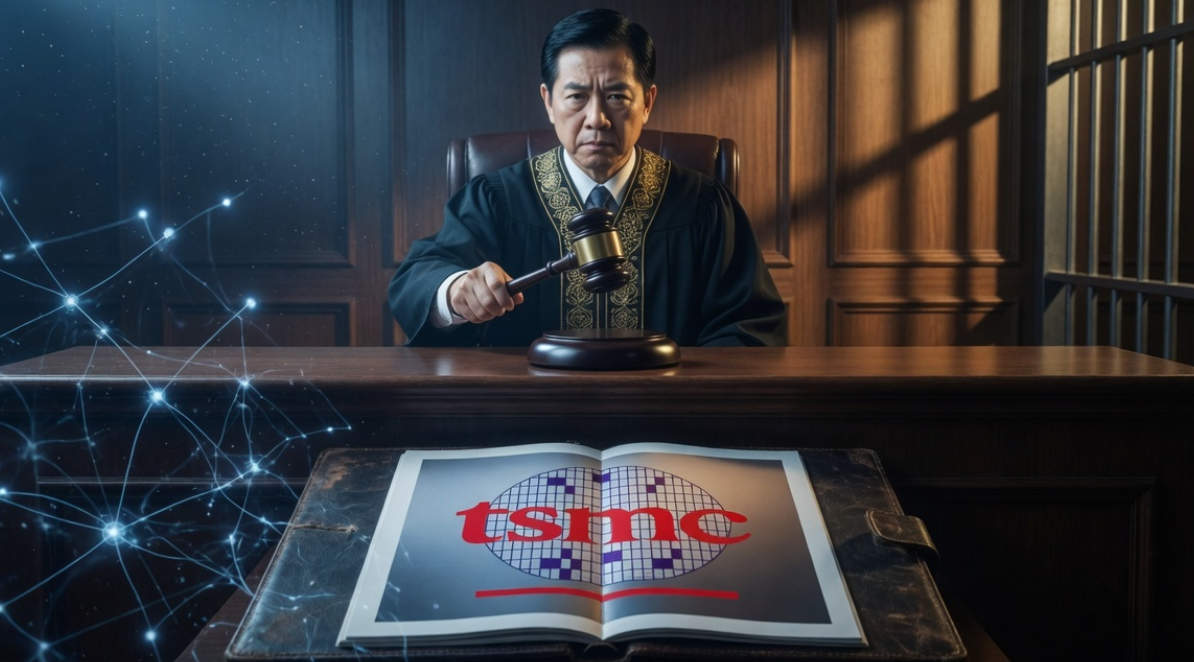
On April 27, 2026, Judge Chang Ming-huang of Taiwan’s Intellectual Property and Commercial Court sentenced Chen Li-ming to ten years in prison. Chen, a former TSMC engineer who moved to Tokyo Electron’s Taiwan unit, had persuaded former colleagues to photograph confidential documents on the chipmaker’s 2-nanometer etching processes. Three of those colleagues went to prison with him, for terms of two to six years. Tokyo Electron Taiwan was fined NT$150 million, roughly $4.8 million, the first corporate conviction under Taiwan’s amended National Security Act.
Three months earlier, on January 14, Taiwan promulgated its first-ever artificial intelligence law. Break it, and nothing happens. There is no fine, no sanction, no enforcement mechanism of any kind. The distance between those two facts is the most honest statement available about what Taipei considers worth protecting.
Ten Years for 2nm Secrets, Prosecuted as a National Security Crime
The Chen case was never treated as ordinary corporate theft. Prosecutors charged it under the National Security Act because the stolen material concerned what Taiwanese law designates “national core key technologies”: semiconductor processes below the 14-nanometer threshold. The court found that investigators discovered TSMC trade secrets stored in Tokyo Electron’s cloud, and Judge Chang said Chen had jeopardized Taiwan’s economic security, not merely one company’s competitive position.
The sentencing fits a pattern. In November 2025, prosecutors raided the residence of a former TSMC executive suspected of leaking secrets to Intel. In May 2026, Taiwanese authorities made their first known detentions of alleged AI chip smugglers. When the target is silicon, Taiwan’s legal system moves fast and hits hard.
The AI Basic Act: 20 Articles, Seven Principles, Zero Penalties
Taiwan’s Legislative Yuan passed the AI Basic Act on December 23, 2025, and President William Lai promulgated it on January 14, 2026. The 20-article statute codifies seven principles: sustainability, human autonomy, privacy and data governance, cybersecurity, transparency, fairness, and accountability, and designates the National Science and Technology Council as the central competent authority. The Ministry of Digital Affairs must build a risk classification framework aligned with international standards, and the government must bring existing regulations into conformity within 24 months.
What the act does not do is bind anyone. Baker McKenzie’s analysis notes that the act imposes no immediate operational obligations on the private sector. A Taiwanese AI developer who ignores every one of the seven principles faces exactly the same legal exposure as one who follows them all. The Taiwan AI Basic Act is, by design, a statement of direction rather than a set of rules.
The Real AI Rules Are Being Written in Export Control Talks
While the AI Basic Act sits inert, the decisions that actually determine who gets access to AI compute are happening in trade negotiations with Washington. In June 2026, Bloomberg reported via the Taipei Times that Taipei is weighing restrictions on AI chip sales to all customers in China, not just blacklisted entities like Huawei and SMIC. The change matters because unauthorized AI chip exports to China are currently not a crime under Taiwanese law; last month’s smuggling detentions had to be charged as document falsification. The proposed Taiwan chip export controls would let prosecutors treat AI chip smuggling the way they already treat the theft of TSMC trade secrets: as a criminal offense.
The pressure runs through the same channel MRKT3.0 examined in its breakdown of the MATCH Act, the bipartisan bill that would impose an ASML duv ban on China and force allied governments to align within 150 days. That pressure got personal in June, when US Commerce Secretary Howard Lutnick told ASML executives he believed one of the company’s EUV machines may have reached China, a claim ASML flatly denies. Taiwan is watching Washington squeeze its most important equipment supplier and drawing the obvious conclusion about which direction its own rules need to move.
The Strongest Case for Taipei’s Approach
It would be easy to read the penalty-free AI Basic Act as a regulatory failure. The better reading is that it is a deliberate bet, and a defensible one. Stanford’s Charles Mok and Harvard’s Wesley Chu argue that the act could become a model for Asia precisely because its soft-law design preserves flexibility while global AI governance remains unsettled, aligning Taiwan with the United States and Japan rather than with stricter regimes.
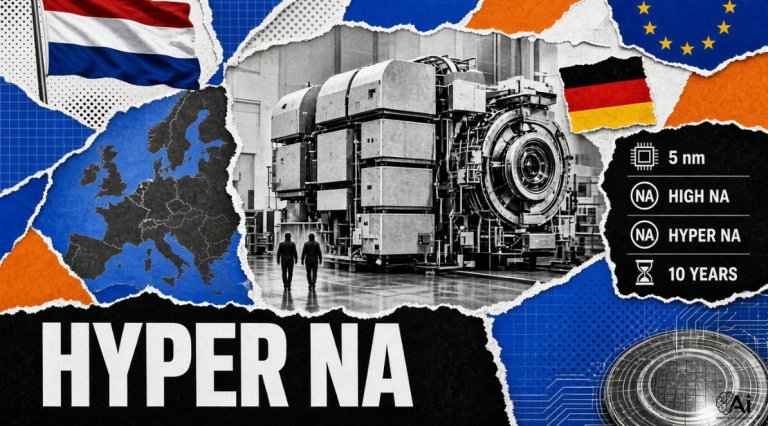
Taiwan’s leverage in the AI economy is hardware, and it protects that leverage ferociously, sometimes even against its own suppliers. In April, TSMC said it would skip ASML’s newest high-NA EUV machines, which cost upwards of $410 million each, until at least 2029, despite a capital budget approaching $56 billion. A country whose national champion can dictate terms to the world’s only EUV maker does not need an AI statute with teeth to shape the AI industry. It already shapes it at the foundry gate.
Where Brussels Wrote the Penalties First
For European readers, the contrast with the EU AI Act is instructive. Brussels built enforcement in from day one: violations of prohibited-practice rules carry fines of up to €35 million or 7% of global annual turnover. Then came the retreat. The Digital Omnibus package, which MRKT3.0 covered when asking whether it could save Europe from doomerism, proposes delaying high-risk obligations after industry warned the rules were arriving faster than the standards needed to comply with them. Europe legislated penalties first and is now softening; Taiwan legislated principles first and is hardening, but only on chips. The question MRKT3.0 raised about whether the AI Act would cripple Europe’s innovation edge is one Taipei answered preemptively by refusing to take the risk.
What the Gap Between the Two Laws Actually Shows
The AI Basic Act is not a weak regulation. It is a map of Taiwan’s threat model. Every jurisdiction regulates hardest at the layer where its power lives. Europe’s leverage is market access, so it regulates conduct and imposes a 7% turnover charge for defiance.
Taiwan’s leverage is silicon, so it sends chip spies to prison for a decade, criminalizes smuggling, and leaves AI software to seven aspirational principles. The AI Basic Act’s real audience was never Taiwanese developers. It was Washington and Brussels, a signal that Taiwan speaks the language of trusted-partner governance, while the criminal code and the export control regime do the actual work. Judge Chang’s courtroom, not the Legislative Yuan, is where Taiwan’s AI policy gets enforced.
Author: Ayanfe Fakunle
See Also:
Asia’s AI Rulebook: How Asia Regulates AI in 2026
Why Is TSMC Refusing to Buy the World’s Most Expensive Chipmaking Machine?