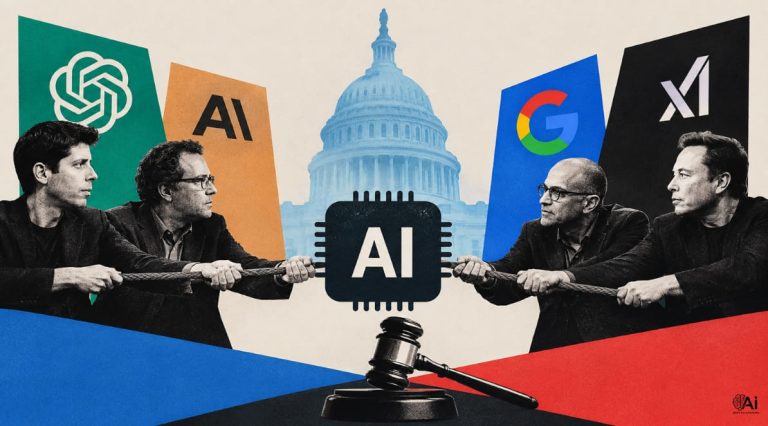

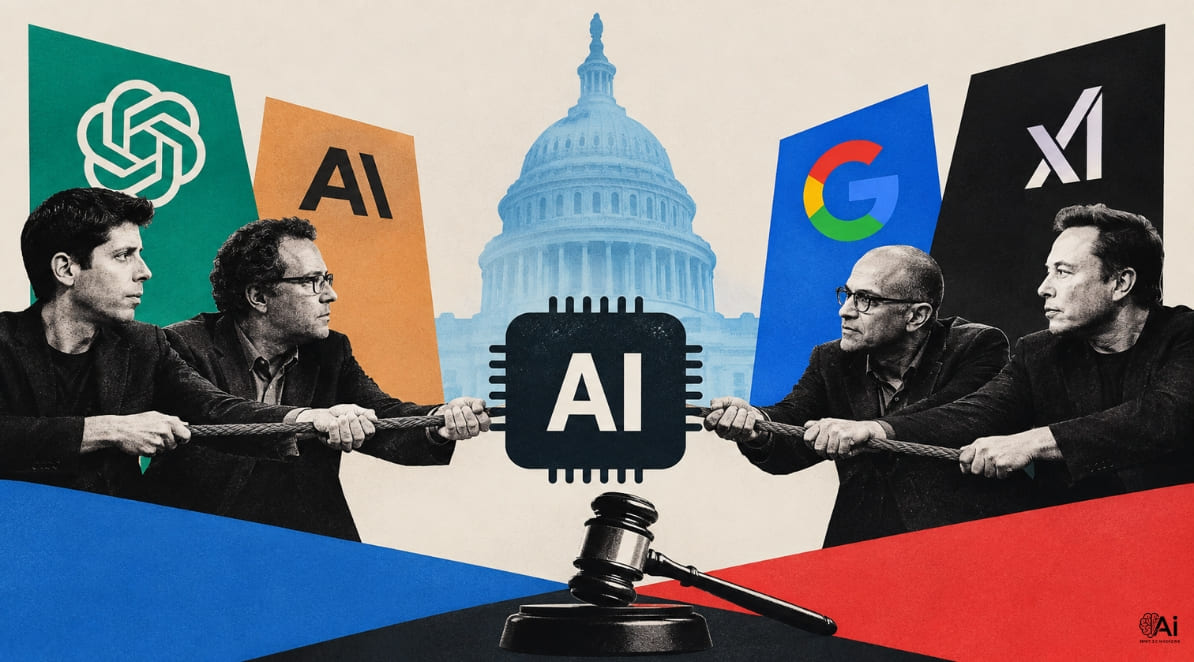
The push to slow artificial intelligence development in the name of safety is colliding with antitrust law and a growing international fight over who gets to dominate the industry. A proposed class action filed Friday in the U.S. District Court for the Northern District of California alleges that Anthropic, OpenAI, Google and SpaceXAI, the venture formerly known as xAI, illegally coordinated efforts to restrain AI development. The four named plaintiffs pay for subscriptions to ChatGPT, Claude, Grok and Gemini, and they are suing on behalf of every other paying subscriber in the country.
The lawsuit arose as a response to an essay published by Anthropic’s CEO Dario Amodei on September 12. In the essay, “We Must Pace the Frontier”, Amodei proposes an industry-wide slowdown of frontier AI development, citing recursive self-improvement (RSI) of AI models as a top safety concern. He asks the industry to give up roughly one to two years of capability gains so that safety work can catch up.
The Same-Day Chorus
OpenAI’s Sam Altman, SpaceXAI’s Elon Musk and Google DeepMind’s Demis Hassabis all showed their support on X, though Altman added that OpenAI would not wait for an antitrust exemption before acting on safety. The Trump administration and other major players in the industry, such as Meta’s Mark Zuckerberg and NVIDIA’s CEO Jensen Huang, have signaled their opposition to Amodei’s proposal. Zuckerberg distanced Meta from the whole idea, arguing that every lab already has the incentive and the ability to pace itself.
Additionally, European challengers in the AI space, including France’s Mistral, have warned that slowdown proposals could protect America’s existing AI leaders from competitors still trying to catch up. Mistral said in a statement that incumbents are “using this moment to consolidate their market position.”
In his essay, Amodei calls for the U.S. government to issue a narrow antitrust waiver for safety conversations, seeming to acknowledge the legal peril of such an arrangement, but also raising a much bigger question for regulators:
Can the companies controlling the world’s most powerful AI systems cooperate to reduce existential risks without effectively forming a cartel?
Amodei’s Words Weren’t New
On July 23, Musk sat down for an interview with the Economist. Amidst a series of topics covered, Musk said that someone in government without deep technical knowledge cannot judge whether a frontier model should be released, but that rival labs, given a week or two of early access, could review a new model and flag its problems. Competitors, he argued, have an incentive to keep each other honest.
That was five days before the July statement the lawsuit now points to. On July 28, more than 1,100 employees of OpenAI, Anthropic, Google DeepMind and Meta signed “Pacing the Frontier”, a one-sentence request that the U.S. government support an international effort to build the tools needed to pace automated AI development. The statement acknowledged the “intense competitive pressure not to unilaterally slow” that pace. Signatures have since passed 1,300, and both OpenAI and Anthropic endorsed it as companies within a day.
In July, Demis Hassabis proposed his own safety protocols. OpenAI outlined its ideas for mandatory national safety requirements on September 9, four days before Amodei’s essay, and promised to work with rival labs on shared standards “with or without government support.”
What triggered the recent lawsuit seems to be the fact that competitors publicly agreed, in principle, to a collective throttling of their respective AI labs in the name of safety. The question is how extensive, never mind sincere, any of this is.
Open Source and Europe
In Amodei’s essay, he makes the point that an American slowdown of AI development can’t allow Chinese open-source AI to surpass American capabilities. Chinese models have already closed much of that gap. In the same Economist interview, Musk noted that Kimi K3, released the week before, was almost as good as Anthropic’s Claude Fable, while maintaining that Fable was still the smartest model available. It’s not clear how long a slowdown of frontier American models could last, or what it would materially mean.
Criticism from European AI leaders seems to focus on the potential for regulatory capture by American frontier AI labs. Amodei’s essay explicitly talks about slowing aspects of American frontier models, and doesn’t address European AI, the tech of which is still lagging behind. Kristian Kersting, an AI professor at Germany’s Technical University of Darmstadt, told Reuters that the proposals amount to “regulatory capture.”
But the fear shared among European firms is that American AI would collude on new release strategy, while regulations imposed by U.S. regulators would be overly burdensome to European competitors who operate with far fewer resources than their American rivals. Moreover, in such a scenario, Europe’s pivot towards open-source models also could be in the crosshairs of American regulators.
For several months, lobbyists from Anthropic and OpenAI have been trying to convince Washington to impose more regulations on open-source AI. Clearly the immediate worry is Chinese AI, but Europe could also feel the sting of regulations if the American government was to act.
Ulterior Motives and Changing Tunes
In response to Amodei’s call for safety, Musk wrote “Dario is right” on X. However, seven weeks earlier, in response to Jensen Huang’s ardent defense of open-source AI, Musk also wrote “Jensen is right.”
While Huang’s argument for open source in July and Amodei’s argument for slowing down AI development in September are not completely incompatible, they do clash. Amodei is not explicitly calling for a ban on open-source AI, but he is implicitly arguing that closed systems offer more safety.
And yet, Musk endorsed both points of view, even though the threat of Chinese open-source AI makes it highly unlikely American frontier labs will slow development in any meaningful way.
The Prospectus Says Nothing About Pacing
Amodei suffers from his own contradictions as well. Accompanying his calls for safety, Anthropic is moving toward an IPO that investors value near $2 trillion, with a raise of up to $100 billion, a valuation built on Anthropic’s potential market share. The timing has already slipped once, and could slide past the November midterms. Slowing down development of its frontier models isn’t part of that pitch.
Instead, six days after the essay, Reuters broke the news, reported elsewhere since, that Anthropic is considering rushing out a new model to compete with OpenAI’s GPT-6 Astra, which was released on September 3 and has been eating into Anthropic’s enterprise business. This is quite a reversal from Amodei’s September 12 essay calling for restraint, or the doomsday scenario he laid out, in which a swarm of misaligned AI agents seizes much of the internet within six to twelve months.
Jensen Huang’s Own Book
Then, there’s Huang.
Unimpressed with the various doomsday scenarios proffered by Amodei or by former Anthropic researchers such as Jacob Coxon, who resigned on September 8 warning that the labs are gambling with everyone’s lives, Huang told CBS Sunday Morning that the warnings are irresponsible and not grounded in science. The people making them, he said, “must be doing it for ulterior reasons.”
But Huang himself has his own ulterior motives. His entire business is reliant on customers buying NVIDIA chips. It doesn’t serve him or his investors if business slows. NVIDIA is also in talks to buy up to $10 billion of Anthropic’s IPO as an anchor investor, according to Reuters.
Therein lies the problem in trying to fully understand developments within the AI space. Between the rampant circular financing, future IPOs, and shifting politics, trillions of dollars are at stake in an industry where the same handful of people are industry cheerleaders one day and doomsday prophets the next.
In the words of Nick Rowley, the lead attorney for the plaintiffs suing the AI labs, AI safety cannot be left to “private self-serving agreements” between the world’s most powerful for-profit technology companies.
The Man on Both Sides of the Trade
The labs are not the only parties here with a balance sheet. The slowdown movement has one too, and it is published.
Jaan Tallinn, the Skype founding engineer, co-founded the Future of Life Institute (FLI) in 2014 and has sat on its board ever since. FLI is the outfit behind the 2023 letter calling for a six-month pause on giant AI experiments. Its own finances page names Ethereum co-founder Vitalik Buterin as its largest donor by far, on the strength of a 2021 cryptocurrency gift the institute valued at $665.8 million, and names Tallinn as the single exception to its rule that donors do not influence its positions. Musk seeded FLI’s first AI-safety grant program with $10 million in 2015.
Tallinn also funds the Survival and Flourishing Fund, which by its own accounting has moved roughly $152 million to safety and existential-risk organizations since 2019. And he is the sole publicly named backer of ControlAI, the London nonprofit that wrote the UK’s Artificial Superintelligence Security Bill and consulted on the Ban Artificial Superintelligence Act that Senator Bernie Sanders and Representative Greg Casar announced on September 3. ControlAI says it has briefed nearly 400 lawmakers across four countries and sponsored nine creator videos that, together with nine unpaid ones, have drawn more than 6.3 million views. The Washington Post counted hundreds of its meetings on Capitol Hill.
The Series A Nobody Mentions
Then comes the part that collapses the whole builders-versus-doomers frame. Tallinn led Anthropic’s $124 million Series A in 2021, and he sits on Anthropic’s board as an observer.
The money behind the most aggressive anti-superintelligence lobbying in Washington and London is also the money that helped launch one of the labs building it.
FLI is spending on its own account as well. In February it launched Protect What’s Human, a national campaign that could run to $8 million across Iowa, Kentucky, Maine, Michigan and North Carolina, and it has run grant programs of up to $5 million for public organizing and up to $4 million for work on AI power concentration, alongside a media accelerator that pays creators to make AI-risk content.
None of this is hidden. The organizations post it themselves. That is what makes it worth reading: a documented influence network on one side of a fight whose other side is a $2 trillion listing and the most valuable chipmaker on earth.
An AI Slowdown Isn’t in the Cards, So Far as Trump Is Concerned
President Donald Trump is hosting Xi Jinping in Washington this week, with White House talks set for Thursday after Xi’s arrival Wednesday evening. Trade and tariffs are the center of the visit; a coordinated AI slowdown is not. Trump has already rejected that premise. Writing on Truth Social, Trump said the only guardrail AI needs is a “STRONG AND SMART (High IQ!) PRESIDENT,” claimed a conspiracy is being waged against AI and data centers, and signed off with a warning to conspiracy theorists, traitors and leakers.
Former White House AI adviser David Sacks put it more coldly, telling the labs to stop pretending they need anyone’s permission to slow down, and to stop pretending the motive is purely altruistic when the real exposure is product liability.
In theory, the biggest leverage the U.S. would have in forcing an AI slowdown would be Trump’s trade negotiations and fondness for tariffs. Without his support, the American frontier labs can’t do much without risking violating antitrust laws, or being leapfrogged by competitors.
Senator Josh Hawley has closed the other door. At a September 15 Senate hearing, Hawley rejected the waiver Amodei asked for, saying there is “absolutely no world” in which he would hand the most powerful companies in history an exemption to collude.
A Mirage of Restraint
Maybe the resistance was expected all along. Maybe Amodei’s essay and the subsequent nods of approval from his competitors were nothing more than performative, a mirage of restraint from companies with no intention of slowing anything down.
Consider the timeline. Amodei published on September 12. Altman, Musk and Hassabis agreed the same day. By September 18, Reuters had Anthropic weighing a faster model release, and four subscribers had filed suit in California. By September 20, Huang was on television calling the warnings a fear campaign driven by ulterior motives, while his company negotiated to anchor Anthropic’s public offering. Eight days, start to finish.
What the labs cannot get from each other, and cannot get from this White House, a courtroom will now supply: a public accounting of what was agreed, when, and by whom. Discovery is the one mechanism in this story that doesn’t require anybody’s permission.
The slowdown may never happen. The deposition schedule will.
Author: Tim Tolka, Senior Reporter
The editorial team at #Mrkt30 has taken all precautions to ensure that no persons or organizations have been adversely affected or offered any sort of financial advice in this article. This article is most definitely not financial advice.
See Also:
France Puts the Hugging Face Hack Before the UN Security Council
France Called the UN Security Council Meeting on AI and Sam Altman Is Briefing It
“We Must Pace the Frontier”: Who Is For It, and Who Is Against It?