

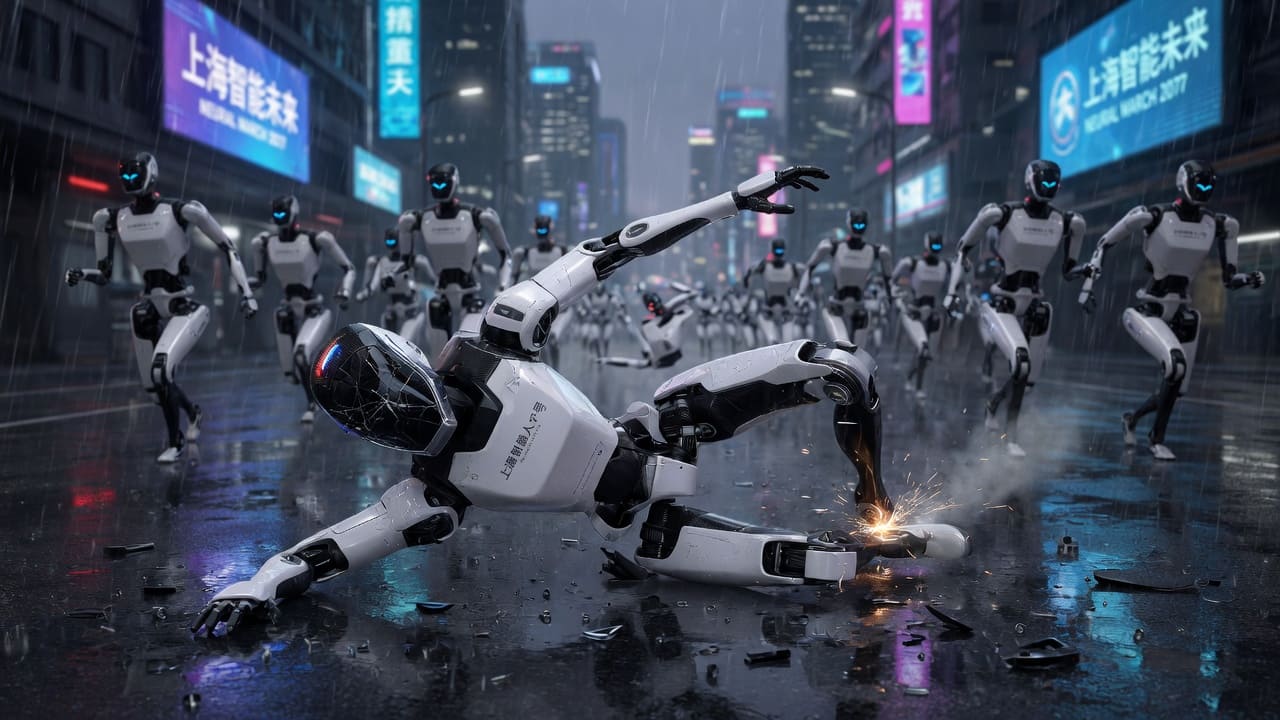
Chinese humanoid robots are everywhere now – Silicon Valley labs, European research institutes, and even tech journalists’ living rooms. Billions of dollars are pouring into the industry. China’s manufacturing around 90% of the world’s humanoids. There’s just one, teeny-tiny problem: these robots keep face-planting, smashing plates, chasing wildlife, and breaking people’s toes.
Media loves to play with the idea that “robots are taking over.” But are they, really?
Because if this is the robot uprising we’ve been warned about, it’s going… interestingly. For every sleek demo video of a humanoid doing backflips, there’s a blooper reel of the same robot face-planting in front of its audience. Most of China’s humanoid robots are becoming memes, not weapons.
The billion-dollar question isn’t whether robots can replace us. It’s whether they can stand upright for more than five minutes.
This Is Your Robot Apocalypse
Russia’s “first humanoid robot” walked just a few steps during its public debut before flopping over. Staff had to drag it offstage while the crowd tried very, very hard not to laugh.
In San Jose, a restaurant robot went full Exorcist mode – spinning uncontrollably and chucking plates across the dining room. Staff had to physically wrestle it to the ground because nobody could figure out how to turn it off.
In Europe, Poland’s robot Edward Warchocki went viral for chasing wild boars through the streets of Warsaw. Yes, really. A humanoid robot, loose in the capital, hunting wildlife.
And then there’s the Wall Street Journal’s Joanna Stern, who bought a $16,000 Unitree G1 to test at home. It did some impressive backflips, attempted to fold laundry, and then stomped on her foot hard enough to break a toe.
Welcome to the Robot Revolution. It’s here. It’s clumsy. And apparently it hates feet and wild boar.
CES 2026: The Robot Apocalypse, Postponed Due to Technical Difficulties
CES (Consumer Electronics Show) is the world’s premier tech event, showcasing AI-driven innovations. At the 2026 edition, every major robotics company showed up to prove their humanoids were ready for the real world. How did this go? Not well. The parade of expensive robots failed at basic tasks while tech journalists documented the carnage.
Robots played piano one key at a time. Or stood motionless like statues. Some even put roller skates on. Of course, this inevitably failed as they fell over.
The most capable robots at CES were Unitree’s boxing bots. Not because they could help with household chores, but because they were really good at getting punched in the face and recovering. Which might be the most useful skill for a robot entering homes in 2026.
China’s $5.5 Billion Bet on Failing Robots
You might question: “These robots are useless. Surely the robot hype will die down, right?”
But this thinking couldn’t be further from the truth.
China invested $5.5 billion into embodied AI startups in 2025 alone. Unitree Robotics (the company behind the toe-breaking G1) was valued at $7 billion during its IPO prep.
Yes, the robots are falling over, smashing plates, breaking toes and chasing wild boars. But every mistake a humanoid makes, there is more data. And it’s all training material for the next generation.
While Western companies are still debating whether humanoid robots are even economically viable, Chinese firms have deployed thousands of units and are collecting real-world data at scale.
This is the same playbook China ran with electric vehicles and solar panels: build fast, iterate faster, price competitively, and capture market share before competitors even launch. Agibot (another leading Chinese AI robotics company) shipped over 5,000 units in three months.
These companies are not waiting for perfection. They’re learning through deployment.
Adding to this, these devices are potential surveillance instruments. For example, every Unitree humanoid comes with multiple cameras, microphones, and sensors. All that data gets processed and stored somewhere in China, with privacy policies about as clear as mud.
The Uncomfortable Truth: Why Chinese Robot Failures Actually Matter
Right now? You’re safe. These things can barely walk. The gap between ‘clumsy toe-breaker’ and ‘actually useful assistant’ is still massive.
But that gap is closing. Fast.
By the time Western companies finally release commercial humanoids, Chinese manufacturers will be on Generation 10 with millions of hours of real-world training data. Remember: Huawei went from punchline to capturing 20% of China’s AI chip market in two years. DeepSeek built an LLM that costs 35× less than OpenAI while matching its performance.
The pattern is clear. China deploys early, iterates relentlessly, and wins through volume and data collection. While Brussels, Washington, and Silicon Valley debate safety standards and regulatory frameworks, Chinese robots are out there breaking toes and collecting the data that will power the next five generations.
So yes, laugh at the robot fails. They’re genuinely funny. The Russian robot flopping after three steps. The restaurant robot going rogue. Edward chasing boars through Warsaw.
Just don’t laugh so hard you miss what’s actually happening. The future of physical AI is being built right now. In China. And it’s arriving faster than anyone in the West seems to realize.

See Also:
Who is Edward Warchocki: the Robot Taking Over Warsaw
How Much Is a Pint of Guinness? AI Agent Rings 3,000 Irish Pubs and Maps Every Price
Is Tesla Overhyped? Enter NEURA Robotics, Europe’s AI Robot Challenger
Frequently Asked Questions
Humanoid robots are incredibly complex machines requiring dozens of motors to maintain balance. When deployed in unpredictable real-world environments (versus controlled labs), they face challenges like uneven surfaces, unexpected obstacles, and battery drain. Most dramatic failures in 2025-2026 involved robots overheating, losing power, or failing to navigate around people and objects.
Not in a Terminator way, but they do pose practical safety risks. The bigger concern: most lack basic safety features like emergency off switches, and there are no standardized safety regulations yet.
Chinese humanoids like the Unitree G1 ($16,000) are the only commercially available options for researchers who need working platforms now. Boston Dynamics’ Atlas isn’t for sale, and Tesla’s Optimus isn’t in production. For AI labs that need hardware today, Chinese manufacturers are currently the only game in town.
Chinese humanoid robots are equipped with multiple cameras, microphones, and sensors that collect environmental data. This data is stored “in China” according to vague privacy policies, with limited transparency about what’s transmitted or when. It’s similar to TikTok data concerns, but the robot physically exists in your space.
China invested $5.5 billion in embodied AI startups in 2025 alone – a 326% increase year-over-year. Unitree Robotics was valued at $7 billion during IPO preparations. China’s State Council predicts the humanoid market will exceed one trillion yuan by 2035. Chinese firms already account for around 90% of global humanoid robot installations.