
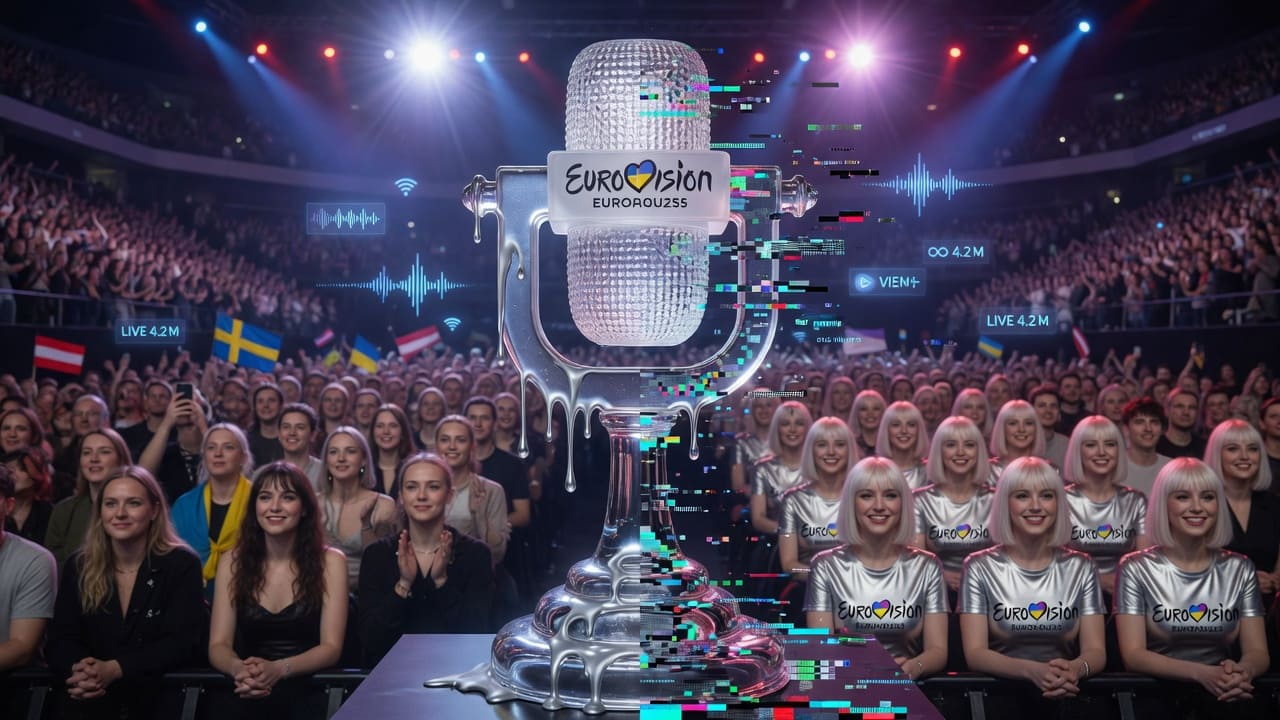
In March 2026, a North Carolina man pleaded guilty to defrauding streaming platforms out of $8 million using AI-generated tracks and bots. Two months later, Eurovision 2026 opened in Vienna with Martin Green declaring AI music banned from the contest forever.
Strong words. Clear stance. Just one problem: there’s no written rule.
Green told reporters that “songs will always be created by humans… that is a fundamental part of the creativity of this contest.” But the official Eurovision rulebook says nothing.
Meanwhile, the evidence that Eurovision can’t stop AI music is already on the record. San Marino partnered with Casperaki, an AI music company, and openly ran four AI-assisted songs through Una Voce per San Marino in 2025. None qualified for the main stage, but nobody stopped them trying.
Moldova’s jury accidentally accepted a fake AI band called Eblansh Band into their official lineup before the stunt was exposed. The jury couldn’t tell. Moldova withdrew from Eurovision 2025 entirely.
Could “AI slop” kill Eurovision? Let’s see.
The Tech Already Won. Eurovision Just Doesn’t Know It.
In April 2026, Deezer (the global music streaming giant) announced that 44% of new music uploads are AI-generated. That’s 75,000 AI songs uploaded every single day to a major European streaming platform.
The technology enabling this? Companies like ElevenLabs, the $11 billion Polish voice AI giant. Upload a few seconds of audio, type lyrics, generate a complete song with cloned vocals. The same tech that powered “Heart on My Sleeve” in 2023 (the fake Drake and The Weeknd track that hit 9 million views before it was pulled).
By 2026, AI voice cloning is indistinguishable from real artists. Breath patterns, vocal inflections, ad-libs – all perfect. The North Carolina fraudster who stole $8 million proved the business model works. Generate AI tracks, fake the streams, collect royalties.
Universal, Sony, and Warner spent two years suing Suno and Udio for “mass infringement on an almost unimaginable scale.” Suno admitted it trained on copyrighted music. Their defense was fair use, but the potential damages could be up to $150,000 per track.
While the lawsuits dragged on, Spotify deleted thousands of AI spam tracks. It changed nothing. For every song removed, a hundred more appeared.
Meanwhile, the parallel AI Eurovision universe keeps expanding. EuroReVision ran its 2026 competition with 32 countries in the final, all songs generated by Suno AI. Airovision, which bills itself as “the world’s first fully AI-powered music competition,” launched its second edition in January 2026, complete with virtual artists, semi-finals, and a grand final. Anyone can submit for any country. The format mirrors real Eurovision exactly.
Two separate AI-only song contests now run parallel to the real thing. Both had major activity/editions in 2026. Both position themselves as democratizing music. The fact that multiple AI Eurovision clones exist proves the demand is real and growing.
Eurovision Bans AI Music, Celebrates AI Graphics
Eurovision 2026 banned AI-generated music to protect human creativity. Then fans flooded Reddit calling the entire visual production “AI slop.”
The logo. The animations. The graphics. All accused of being machine-made garbage. Designer Amy Bedford defended her work in an interview, explaining the months-long human process behind it. Reddit didn’t buy it. One user wrote: “It looks like AI because AI is trained to produce corporate sterile inoffensive slop.”
Martin Österdahl, the former Executive Supervisor of the Eurovision Song Contest, explained in 2025 that “we just have to figure out how to make AI our friend. It’s not going to go away, we know that.”
Eurovision 2026: The Ban That Isn’t
Banning AI from music competitions isn’t impossible. The Grammys proved it. The Recording Academy wrote explicit rules in 2023: only “meaningful human contribution” qualifies for awards. This is clear, written, and enforceable.
Eurovision took a different approach. This week in Vienna, Green told reporters that AI music would never be allowed because “songs will always be created by humans.” Is this the same for Eurovision’s graphics? Apparently not.
So, is “AI slop” killing Eurovision?
Not yet. But Eurovision 2026 is already “fractured and mired in controversy” according to plagiarism tracking sites. The contest banned AI music without writing a ban. San Marino tested it. Moldova got pranked by it. A North Carolina man made $8 million from it.
Additionally, writing rules is one challenge, but detecting when AI is being used is another entirely. Eurovision has solved neither.
The real question isn’t whether AI will compete at Eurovision. It’s whether anyone will know when it wins.
See Also:
ElevenLabs: Poland’s $11B Voice AI Giant Hits $500M ARR
How Much Is a Pint of Guinness? AI Agent Rings 3,000 Irish Pubs and Maps Every Price
Frequently Asked Questions
Not officially. Martin Green, Eurovision’s executive supervisor, stated that “songs will always be created by humans,” but there’s no written rule in the official Eurovision guidelines banning AI-generated music. Individual broadcasters currently face no EBU regulations regarding AI use in their Eurovision submissions.
Four AI-generated songs competed in San Marino’s 2025 national final, Una Voce per San Marino, openly announced as AI-created. None qualified for the main Eurovision stage, but they faced no sanctions or disqualifications from the EBU because no formal rule exists to break.
According to Deezer’s April 2026 announcement, AI-generated tracks account for 44% of all new music uploads – approximately 75,000 AI songs per day. Spotify removed thousands of AI-generated spam tracks in 2024-2025, but the volume continues growing across all streaming platforms.
The Recording Academy ruled in 2023 that only works featuring “meaningful human contribution” qualify for Grammy consideration. By 2025, rules specified that AI-generated material can be part of a song but not the only creative contributor. Only human creators who meaningfully shape or guide AI output are eligible for awards. AI cannot be credited as an artist or songwriter.