
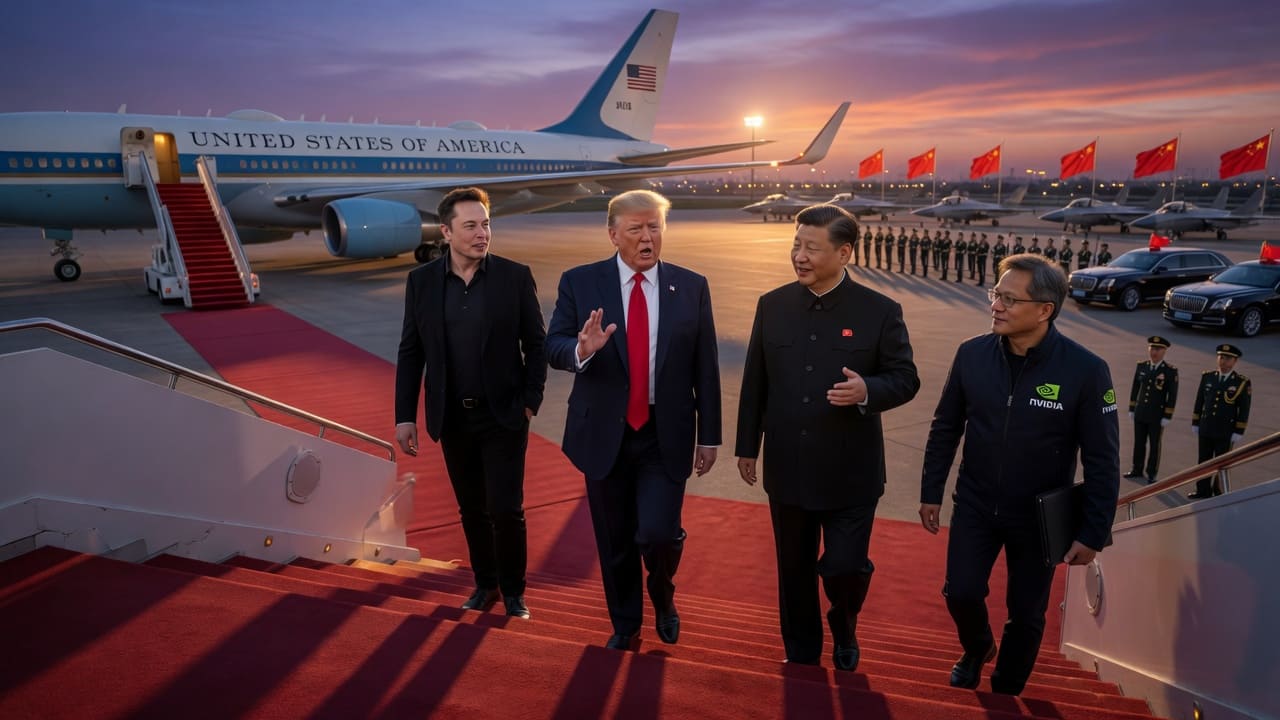
US President Donald Trump flew to Beijing on May 13, 2026, with Elon Musk, Tim Cook, and Jensen Huang on Air Force One to negotiate US-China tech relations. The visit included discussions on AI chip sales, trade barriers, and technology cooperation. Europe was nowhere to be seen at the negotiating table.
Trump’s visit to China isn’t just another summit. “This is a meeting designed to frame the new global order,” noted one major US analysis.
Among the outcomes, the US cleared about 10 Chinese firms to buy NVIDIA’s H200 AI chips worth billions. But this isn’t just about easing years of tech tensions. It’s about forging a partnership that will help decide who controls the technology powering the next decade: AI development, semiconductor access, cloud computing, and digital infrastructure.
Where was Europe? Nowhere to be seen.
Air Force One Had Musk and Huang. Europe Had Nobody.
Trump’s delegation included representatives from Qualcomm and Micron alongside the CEOs of the world’s most valuable tech companies. NVIDIA’s Jensen Huang wasn’t even on the original roster. Trump personally picked him up in Alaska during the flight to meet Chinese President Xi Jinping.
America brought its tech titans to negotiate access, trade terms, and cooperation. China brought its government ministers and corporate champions. Together, they’re deciding how AI development, cloud infrastructure, and digital trade will work going forward.
Europe brought nothing. Because Europe has nothing.
The Data Is Damning: Europe Can’t Compete
Some will argue: “but Europe is still a leading superpower!” Cute, but the data tells a different story.
Let’s talk AI models. The foundation of everything from chatbots to autonomous vehicles. According to the Stanford AI Index 2025, the US produced 40 notable AI models. China built 15. Combined, Europe made three.
Now look at the money. In 2024, U.S. private AI investment hit $109.1 billion. Europe scraped together around $8 billion. That’s roughly 13 times less than America. China poured massive resources into AI, with its top tech firms like Alibaba and Tencent each committing billions annually in research, development and capital expenditure .
What Trump and Xi Are Really Negotiating
The chip deal makes headlines, but it’s only a small part of a bigger conversation:
- AI Development Rights: Which companies get access to advanced processors that determine who can build competitive AI systems.
- Cloud Infrastructure: How American cloud providers operate in China, and whether Chinese platforms can expand globally.
- Digital Trade: Standards for cross-border data flows, e-commerce, and technology exports.
- Research Cooperation: Potential collaboration on AI safety and development.
Each approved Chinese company can purchase up to 75,000 H200 chips. Chips must route through US territory first, and the US government receives a 25% share of the proceeds. This isn’t just commerce. It’s America and China shaping rules for global tech.
Why Europe Wasn’t Invited
What would Europe have brought to the table? America has NVIDIA (which powers roughly 90% of the high-end AI chips that matter), OpenAI, Anthropic, Google, Meta, Microsoft, Amazon, and Google Cloud. China has Alibaba, Tencent, ByteDance, billions of users, deep pockets, and 47+ AI unicorns. China also has the political will to subsidize its semiconductor industry aggressively.
Europe has ASML (which still supplies certain tools to China under restrictions), Mistral AI (impressive, but reliant on American chips and data centers), and strong regulation.
The last decade was spent passing GDPR, fining American companies, debating digital sovereignty, and rolling out the EU AI Act. All while America and China built actual AI.
What China Gets That Europe Doesn’t
China is often hesitant to buy all the H200 chips it’s now allowed, pushing its companies to invest in domestic alternatives like Huawei Ascend chips and SMIC’s advancing processes. Europe doesn’t even have that choice.
Chinese chipmakers went from inferior designs to producing competitive 7nm processors in record time despite sanctions. Europe’s response was more committees studying digital sovereignty.
The European Chips Act and Plans: Ambitious but Late?
To be fair, Europe has strategies. The European Chips Act mobilizes $50 billion to boost semiconductor production by 2030. France announced a major $126.5 billion AI investment push. But compare that scale: single fabs from Intel or TSMC cost $20–40 billion each, and China’s semiconductor subsidies dwarf these efforts. By 2030, the world may have moved on to the next generation.
What Hurts Most
The worst part isn’t that Trump didn’t invite European leaders. It’s that Europe currently lacks the cards to play at this table. America controls the chips, models, and cloud. China controls the market, manufacturing scale, and urgency. Europe excels at regulation and standards. Valuable, but not enough to claim a seat when the future is being carved up.
The Americans and Chinese are building the future. Europe is… risk managing the past.
When historians write about how the 21st century’s tech landscape was shaped, Europe won’t be irrelevant. But it may be remembered as the regulator watching from the sidelines. Time to change the game

See Also:
Europe vs US AI Infrastructure: Who’s Winning?
Can Huawei Replace NVIDIA in China’s AI Sovereignty Race?
China’s Semiconductor Industry No Longer Needs NVIDIA
Frequently Asked Questions
Europe wasn’t included because it lacks bargaining power in semiconductor and AI negotiations. America controls chip manufacturing through companies like NVIDIA, and China controls market access. Europe has no major chip manufacturers or AI companies competitive at the global scale needed for such high-stakes negotiations.
Trump’s delegation included Elon Musk (Tesla, xAI), Tim Cook (Apple), Jensen Huang (NVIDIA), and representatives from Qualcomm and Micron. These companies represent America’s dominance in chips, consumer electronics, and AI infrastructure.
No. Europe has no companies comparable to NVIDIA, AMD, or even China’s emerging chipmakers. ASML makes chip manufacturing equipment but doesn’t produce processors. European AI companies like Mistral rely entirely on American chips from NVIDIA and cloud infrastructure from US providers.
Beijing is pressuring Chinese companies to invest in domestic semiconductor alternatives rather than buying American chips. This reflects China’s strategy of building technological independence, something Europe has failed to achieve despite.
Under the approved sales terms, the US government receives 25% of proceeds from H200 chip sales to China. Also, the chips must be routed through US territory before delivery. This arrangement generates revenue for America while maintaining control over the technology supply chain.