
Reported from Deep Tech Momentum 2026, Wilhelm Studios, Berlin.
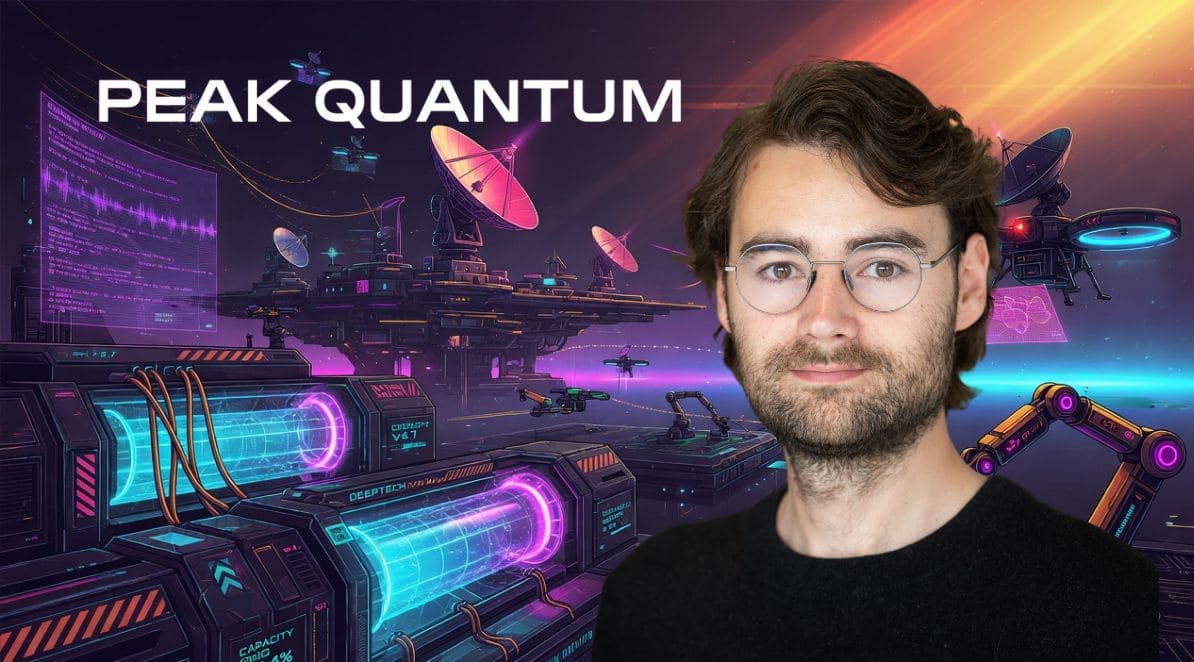
The world’s biggest technology companies are locked in a race to take quantum computing from lab to industry, and the stakes could not be higher. At the heart of it are qubits, the tiny processing units that power these machines, and the industry’s obsession has been simple: the more qubits, the more power. Dr. Thomas Luschmann, Co-Founder and COO of Munich-based Peak Quantum, sees it differently.
The quantum hardware startup, a spinout from the Walther Meißner Institute at the Technical University of Munich, is building a new type of superconducting quantum processor where quality comes first. Better qubits, he believes, will decide who leads the quantum era.
A Different Kind of Chip
Peak Quantum is, at its core, a chip manufacturer. The team uses superconducting circuits, a method not unlike traditional semiconductor manufacturing, to build the processors that power quantum computers. But what sets this quantum hardware startup apart is the circuit architecture itself.
Where the sector’s biggest players use a qubit design known as the transmon, Peak Quantum has developed its own. “We do a different kind of circuit that has better properties and should scale better,” Luschmann explains. The goal is to tackle one of quantum computing’s most persistent challenges: qubit error rates.
Right now, quantum computers exist but they are not yet reliable enough to solve any problem at industry scale. The standard approach involves correcting errors through software after the fact, typically requiring thousands of unstable physical qubits to encode just a few usable ones. Peak Quantum’s approach is different. Their error-protected qubits are designed with fault resistance built directly into the hardware itself. The company is now focused on demonstrating the technical superiority of this architecture. Fewer qubits, better ones, and ultimately more powerful compute without the overhead.
The Challenge Is Still Scientific, Not Just Engineering
It would be tempting to treat quantum computing as a pure engineering problem at this point: take what exists, scale it up, ship it. Luschmann is clear that this would be a mistake.
“Quantum computing is not yet purely an engineering problem. There are still scientific challenges to solve.” The team at Peak Quantum spans the full technical stack, from circuit design and cleanroom fabrication through to system integration and characterisation. The difficulty, Luschmann says, is holding both things at once: “We cannot have the technology stuck in a lab until every last problem is solved. We need to start thinking about scaling and engineering. But we also can’t do the second step before the first.”
The layers compound quickly. Reducing qubit error rates on the processor is only part of it. There is also the wiring, the control electronics, and the cooling systems that surround it, all of which need to work together to make quantum computing economically viable at scale.
What Europe Needs to Do Now
Peak Quantum is part of the EU Chips Act quantum funding, and for Luschmann, the stakes for Europe go well beyond his own company. The semiconductor industry offers a cautionary tale, one that saw Europe become almost entirely dependent on outside manufacturing for chips it now considers critical infrastructure. He does not want quantum to follow the same path.
“What we are doing is really building up a production line in Germany, in Europe, that is supposed to be accessible for European companies and researchers and be a dependable source for quantum chips.”
That ambition has a concrete form. Peak Quantum has been selected as a key operator in SUPREME, a multi-country European quantum chip pilot line developed under the EU Chips Act and coordinated by VTT. The project aims to move superconducting quantum processor manufacturing from research into scalable industrial production on European soil. It is a direct step toward genuine quantum chip sovereignty, and a signal that Europe is serious about not repeating its semiconductor mistakes.
Can Europe Actually Compete?
On whether Europe can genuinely compete with the US and China, Luschmann is optimistic. The scarcest resource in this field is talent, and in quantum computing, Europe has a genuine advantage. But the deeper structural strength of Europe’s ecosystem is something that often gets framed as a weakness: fragmentation.
“You have these hubs, for example in Munich, Delft, and Helsinki, and each of them has spawned a number of great universities, students, and also startups.” In the US, quantum computing is dominated by tech giants: IBM, Google, companies throwing billions at the problem. In Europe, it is a landscape of newly founded, highly specialised quantum startups, each focused on a specific layer of the stack, processors, packaging, wiring, cooling, software, control electronics.
“I think this focus of individual startups doing precisely what they’re best at can actually beat the full vertical integration.” China faces a similar limitation in the opposite direction: heavy state funding and a clear agenda, but without the dynamics of competing startups pulling individual capital into a distributed ecosystem.
Europe has the talent and the science, more quantum publications than the US, more graduates, more startups. What it lacks is the ability to grow those companies through the large funding rounds that would let them scale. “This is precisely what needs to be addressed,” Luschmann says. Getting that right, he believes, is what quantum chip sovereignty for Europe actually looks like in practice.
Where Is Peak Quantum Going Next?
Founded in 2024 by a six-person, interdisciplinary team as part of the Munich Quantum Valley network, Peak Quantum recently closed a €2.2 million pre-seed round. This brings its total funding to over €5 million when combined with public support including the EU Chips Act.
The team has grown to close to fifteen people, with the immediate focus on demonstrating the technical superiority of their error-protected qubits and proving their superconducting quantum processor architecture can address the scaling issues that have held the industry back.
The longer horizon is more ambitious. The target for the end of the decade is to deliver a chip sitting inside an HPC centre providing real compute value to real customers.
“You need much less of them to run industrial compute,” Luschmann says. Fewer qubits, better ones, and if the roadmap holds, quantum chip sovereignty built not from abroad, but from Munich.

This interview was conducted at Deep Tech Momentum 2026, Berlin, where Luschmann was attending to build collaborations across the European quantum stack and meet the HPC operators who will eventually deploy these systems. As he put it, when it comes to infrastructure timelines, you have to start early.
DTM27 takes place on 19 and 20 May 2027 and is already shaping up to be the most impactful two days of the year for the European deep tech and AI ecosystem. If you are looking to partner or want to secure your spot early at a special rate, now is the time.
See Also:
Europe’s 7 Million Worker Shortage: How NEURA’s Robots Offer a Solution