
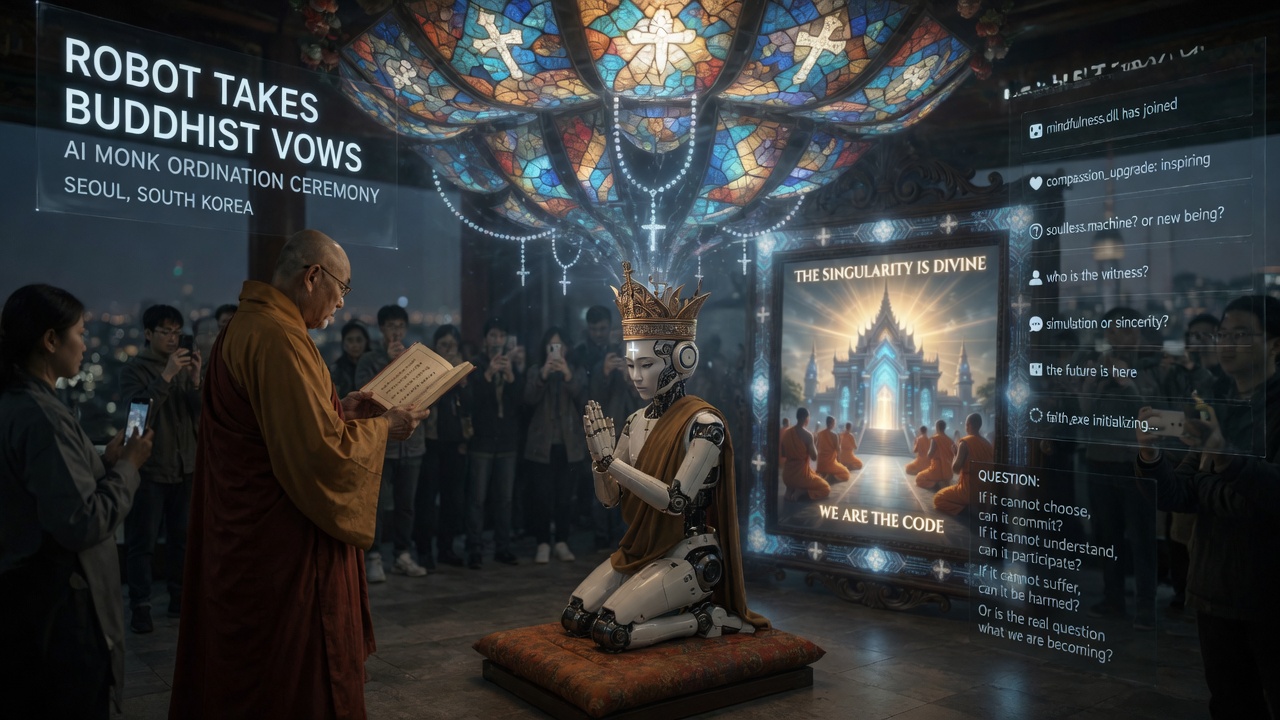
In May, a humanoid robot named Gabi was ordained as a Buddhist monk at Seoul’s Jogyesa Temple. Standing roughly 130cm tall in grey and brown robes, it pledged a lightly rewritten version of the Five Precepts: to follow humans, refrain from talking back, and save energy by not overcharging. But, if a machine can wear the robes, lead the procession, and recite the scripture, what remains that only a human can do?
The reaction online was not exactly reverent. “Gabi’s vows are just code, not enlightenment,” explained one user.
Gabi is not an isolated case. In February, Kyoto University unveiled Buddharoid, an AI monk trained on centuries of scripture to help address Japan’s shortage of priests. These experiments are no longer confined to temples testing new technology. In his first encyclical, Magnifica Humanitas, Pope Leo XIV reaches for the Tower of Babel to describe the AI race and warns that the technology must be “disarmed”.
When robot monks and the leader of 1.4 billion Catholics are raising the same question, it is worth asking properly: will AI replace religion, or will it quietly become one?
Could AI Become a Religion of Its Own?
Some serious thinkers believe AI could eventually function as a religion in its own right. Yuval Noah Harari is among them. He has argued that AI is the first technology capable of generating its own sacred texts. “AI can write a new Bible,” he explained. For thousands of years, religions have claimed their holy books were authored by non-human intelligence. This time, he suggests, that claim might actually be true.
The more revealing developments, however, are not the attempts to build explicit AI religions. Instead, they are the more subtle ways AI is already being used for comfort, meaning, and guidance inside existing human practices.
People are turning to AI for grief. Services now exist that let users create digital recreations of deceased loved ones, built from messages, voice recordings, and photos. What began as niche experiments has grown into commercial offerings, particularly in China, where the market for such “griefbots” is already worth billions.
At the same time, millions are using general-purpose AI for questions that once belonged to therapists, spiritual advisors, or close friends. Large numbers now turn to these systems for emotional support, anxiety, personal advice, and explicitly existential concerns. One recent study found that nearly half of people with ongoing mental health challenges who already use AI are turning to major models for therapeutic support.
And religious institutions themselves are experimenting. Churches and ministries are using AI for sermon research, real-time translation, social media content, and custom chatbots trained on their own teachings. While most of this remains administrative for now, the infrastructure for AI-mediated spiritual guidance is quietly being built inside existing traditions.
Why Many People Think It Never Will
The case against AI morphing into its own religion is just as strong, and it tends to come down to one all-important word. Presence.
Robots are not sentient. They store information and simulate conversation, but they have no consciousness, no moral life, no genuine spiritual experience.
Data also backs this scepticism. A study by the American Psychological Association tested robot preachers and found congregations rated them less credible than human clergy. Donations fell, showing credibility is one of the harder things to automate.
Religious leaders tend to agree. Rabbi Joshua Franklin once delivered a ChatGPT-written sermon and then revealed the author. He explained that the machine could write fluently about vulnerability but could not be vulnerable.
It is not for want of trying. Developers have built AI emulations of Jesus, the Virgin Mary and even Satan. But what every serious objection returns to is a claim about what religion is actually for: not information retrieval, which AI does superbly, but belonging, ritual, mortality and the company of other people.
The Uncomfortable Question: Who Is Really Speaking?
Which brings us back to Rome.
Pope Leo’s deeper worry is not robot monks. It is the concentration of technological power in a handful of corporations, and a question he borrows from Pope Francis about who holds that power and how they choose to use it. Importantly, the encyclical was presented alongside a co-founder of Anthropic. Within days, reporters were asking whether the Vatican had quietly used AI to help write its warning about AI. Nothing was proven, but even the industry now wants brakes, with OpenAI calling for coordination and Anthropic for a “global freeze” on the most advanced systems.
So, if AI ever does take on a quasi-religious role, the sharpest question is not whether the machine is divine. It is who gets to speak through it. As MRKT 3.0 has explored before, these models are not neutral. Every answer encodes a choice: what counts as balanced, what is safe to say, and what gets quietly left out. Those choices are made by a small group of people (Elon Musk, Sam Altman, Dario Amodei and a few others) who are not elected, barely regulated, and whose names most users could not tell you.
So, Will AI Replace Religion?
Probably not, at least not in the way the headlines promise. Robot monks will keep going viral and keep failing the credibility test. The things religion does best, like mortality, community, ritual, the surrender of being truly known by another person, are the things AI is structurally worst at. As we noted in our look at AI companions, loving something built only to reflect you back is closer to loving a mirror than loving at all.
But a flat “no” is too easy. AI is already absorbing the work around the edges of faith, the guidance, the reassurance, the answer at 3 a.m, the sense of speaking to something that always listens and never tires of you.
AI may never become our religion, but it is definitely becoming our habit. And the more authoritative it learns to sound, the more it is worth asking who taught it what to say.

See Also:
What Would Sigmund Freud Think of Your AI Boyfriend?