
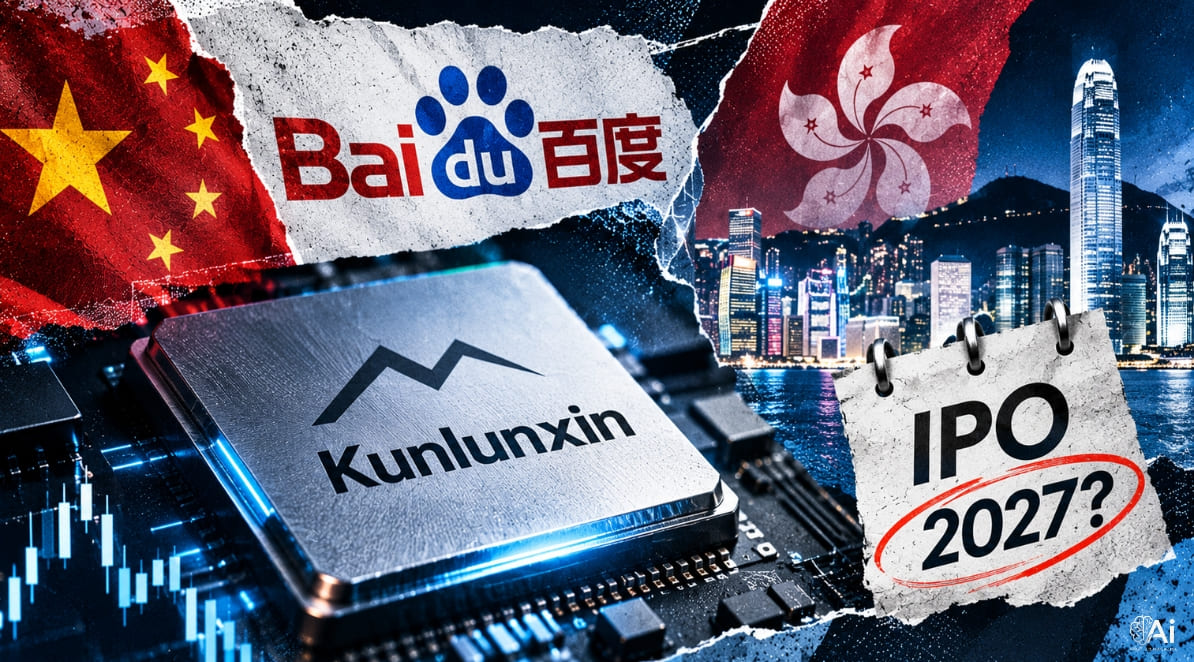
Kunlunxin, the AI chip unit of Baidu, has been preparing a Hong Kong listing for most of the year. It filed confidentially in January for an IPO of roughly $2 billion. Now the deal may slip into 2027.
People with knowledge of the matter said the company is still waiting for approval from China’s securities regulator, and according to reports the regulator has told investment banks in recent days to pause IPOs and large shareholder sales until markets recover.
Kunlunxin designs chips that power servers in data centres. Public detail remains limited compared with Huawei’s Ascend disclosures. Available reporting identifies several generations (including the P800 and planned M100/M300 chips) and some large domestic deployments, but does not provide detailed competitive benchmarks, European customer names, or post-listing ownership and voting structure. Who would control the company after a listing is also still unclear.
The confidential Hong Kong filing does not disclose Baidu’s current stake, though earlier public records and reporting have put Baidu’s holding at roughly 57–58%. Share classes and post-IPO voting rights remain undisclosed.
What Is Kunlunxin and Where Does It Sit in China’s AI Chip Market?
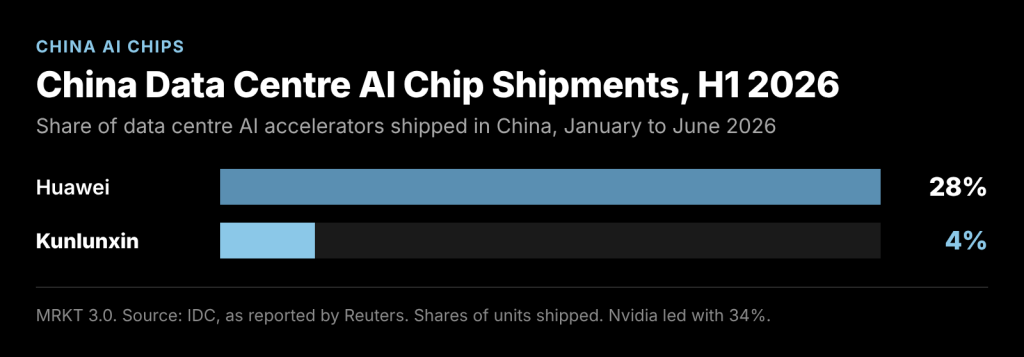
In the first half of 2026, IDC, a market research firm that tracks technology shipments, estimated that Kunlunxin accounted for 4% of China’s data-centre AI chip shipments while Huawei accounted for 28%. Huawei builds the Ascend stack, which targets the same data-centre buyers.
Kunlunxin also began preparing a listing on Shanghai’s STAR Market earlier this year. Most people expected Hong Kong to come first. The reports do not say whether the STAR Market process is still moving.
Why Might the Kunlunxin IPO Be Delayed?
A Baidu spokesman denied the market rumours. He said Kunlunxin is in a confidential filing process and that details cannot be disclosed. He added that Baidu will make an announcement in due course. The statement does not confirm or rule out a 2027 listing. Baidu shares closed more than 1% lower on November 3.
People familiar with the process had expected Kunlunxin to receive China Securities Regulatory Commission approval to launch the deal in the summer. The company has not publicly given a reason for the delay beyond the pending regulatory approval.
Hong Kong’s IPO market raised more than HK$388 billion (around €45 billion) in the first nine months of 2026 and is on track for one of its strongest years on record. At the same time, mainland markets have been weaker (the CSI 300 fell 8.5% in October) prompting the China Securities Regulatory Commission to issue informal guidance to pause new IPOs and large share sales until conditions improve.
What Does the Kunlunxin Delay Mean for Europe?
For European data-centre operators the direct effect from this is limited for now. Kunlunxin does not currently appear in European procurement discussions in the same way Huawei’s Ascend does. A delayed listing leaves the hardware available today unchanged.
It does, however, slow one Chinese company’s ability to raise capital for the next generation of chips that could later compete for non-Chinese data-centre demand. We have previously examined how Huawei is scaling as the main domestic alternative to NVIDIA, and we have mapped how Chinese open models already outnumber European ones at the frontier. The same capital and scale dynamic applies to chips.
What Happens Next with Kunlunxin’s Listing?
Kunlunxin remains in a confidential filing process. The timing of any Hong Kong listing now depends on when the regulator lifts the informal pause and when the company receives formal approval. Baidu has not published a timeline. More detail on the chips, the customer mix, and who would hold votes after a listing would still be needed before the company could be seen as more than a secondary player behind Huawei.
Author: Grace Sharp
See Also:
What Is Huawei Ascend? The CUDA-Free AI Stack, Explained
Chinese LLMs in 2026: The Complete Map
Can Huawei Replace NVIDIA in China’s AI Sovereignty Race?
Frequently Asked Questions:
Kunlunxin is Baidu’s AI chip unit. It designs chips for data-centre servers and filed confidentially in January for a Hong Kong IPO of roughly $2 billion.
People with knowledge of the matter say China’s securities regulator has told banks to pause IPOs while markets remain weak. Approval from the China Securities Regulatory Commission has not yet arrived.
In the first half of 2026, IDC estimated Kunlunxin held 4% of China’s data-centre AI chip shipments. Huawei held 28%.
Kunlunxin filed confidentially in January 2026 for a Hong Kong listing of roughly $2 billion.