


The UK wants far more data centres to support its AI ambitions. The government has set a target of roughly 6 GW of AI capacity by 2030 and has introduced a Data Centre Covenant that offers faster grid connections to projects meeting tests on local benefits, water use and efficiency.
At the same time, organised opposition is growing. Local residents are objecting to individual schemes while national groups are coordinating campaigns and, in some cases, taking the government to court.
A £120,000 grant specifically aimed at limiting AI data centre expansion, combined with crowdfunded legal work, has already forced the government to accept that environmental protections on one major project must be legally binding. That outcome raises a question for anyone building or financing data centres in the UK: how much further can organised opposition go, and what will it cost.
Who Is Organising the Opposition
Local resident groups continue to lead individual planning fights, as MRKT 3.0 mapped in its October overview of UK opposition.
Global Action Plan and Foxglove Legal are the national organisations that appear most consistently across policy advocacy and litigation. Global Action Plan coordinates the “Stop Dirty Data Centres” campaign, supports local groups, and is part of a European network that has organised action days involving more than 82 groups across ten countries. Foxglove is the litigation vehicle. Other groups appear in specific places, including Action to Protect Rural Scotland in several Scottish cases and the Environmental Law Foundation in at least one English challenge, but the national pattern is the same pair.
The Funding That Can Be Tied to Data Centres
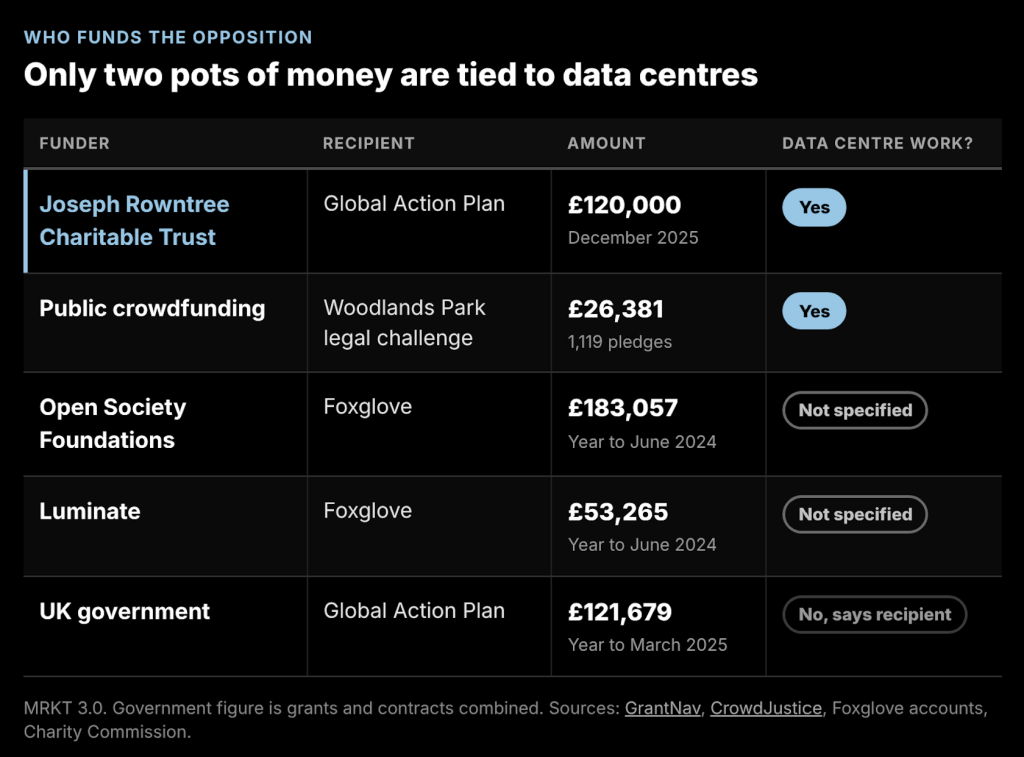
The clearest campaign specific disclosure remains the Joseph Rowntree Charitable Trust award to Global Action Plan. GrantNav records £120,000, award date December 6, 2025, duration 24 months, purpose “Limiting AI UK data centre expansion”, under the Power and Accountability programme. Detailed conditions and actual expenditure are not shown in the public grant data.
Foxglove’s 2024 accounts list support from Luminate (£53,265), Open Society Foundations (£183,057) and both Joseph Rowntree trusts, among other funders. These are organisation level figures from a prior year. The accounts do not assign them to later data centre litigation. The two Rowntree trusts are separate bodies.
Most local opposition continues to run on modest resources. The Woodlands Park CrowdJustice appeal raised £26,381 from 1,119 pledges. After the government and developer accepted costs liability, campaigners sought permission to retain unused funds for further work. This is one route by which a successful challenge can preserve resources.
Global Action Plan’s Charity Commission return for the year ending March 2025 shows total income of £2,005,564, of which £53,090 came from two government grants and £68,589 from five government contracts. That establishes public income at organisational level. It does not identify the funding source for data centre staff time, research or litigation. The organisation has stated that no funding from the Government or the National Lottery has gone to its data centre work. Even if that is accurate, public funding for other programmes can free organisational resources for campaign work. Grant level verification would be required to go further. Separate Lottery funding for Global Action Plan’s Good Life Schools education programme should not be treated as a data centre campaign budget.
What This Capacity Has Already Changed
The Woodlands Park challenge is the clearest outcome so far. Buckinghamshire Council refused the 90 MW project. The Secretary of State called it in and granted permission in July 2025. Foxglove and Global Action Plan challenged the decision. In January 2026 the government conceded that it had made a serious logical error in concluding that low carbon power measures could be secured. The developer has since accepted that environmental mitigation must be made binding through a contract with the council, according to the campaigners’ April update. Whether that concession is treated as a template in other decisions remains open.
Elsewhere the picture is mixed. Some local refusals have been overturned on appeal. A Scottish parliamentary vote paused decisions on hyperscale data centres pending guidance. Petitions and potential judicial reviews have appeared at other sites. Coordinated action days on November 6 and 7 indicate that national and European networks are attempting to sustain pressure. Not every challenge succeeds.
What This Means Under the Covenant
The UK currently has roughly 2 GW of operational data centre capacity. Reaching the government’s 6 GW AI target by 2030 therefore requires a substantial pipeline of new projects. On October 28, 2026 the government launched a Data Centre Covenant. Strategic sites that meet tests on local investment, jobs, water protection and efficiency are offered help with grid connections and planning.
Industry groups have argued that most new facilities use closed loop cooling and that data centre water use is small relative to other sectors, while permanent local job numbers after construction are typically modest. Tech companies have themselves told ministers they see roughly a 12 month window to secure local consent before UK opposition risks following patterns seen in the US.
Opposition capacity does not reverse the 6 GW policy, but it raises the cost and uncertainty of meeting the Covenant tests. A relatively small, specialised legal effort has already produced a government concession on enforceable mitigation at one site. For developers, the risks are longer planning timelines, tighter conditions on power and water, and the possibility that similar challenges will be funded and repeated. For investors, the relevant question is whether those risks are priced into project timelines and cost of capital under the new Covenant framework.
What to Look for Next
The immediate tests are practical and project-level. The next few months will show whether:
- the November mobilisation produces further planning objections or legal challenges at specific UK sites
- the Woodlands concession is treated as a template in other decisions
- any new campaign-specific grants are disclosed
Tracking outcomes such as revised conditions, delays or successful consents will show whether the funding traced here translates into material impact on the 6 GW build-out. Parallel patterns in Ireland have already been examined by MRKT 3.0.
Author: Connor Fitzgerald
See Also:
Who Is Fighting Data Centres in the UK? The 2026 Opposition Map
Who Funds Ireland’s Data Centre Opposition?
“We Want That Data Here”: UK Chancellor’s New Deal for UK Data Centres
Frequently Asked Questions
The clearest campaign-specific funding is a £120,000 award from the Joseph Rowntree Charitable Trust to Global Action Plan in December 2025 for “Limiting AI UK data centre expansion”. Foxglove has also received foundation support, while the Woodlands Park legal challenge was partly crowdfunded.
Global Action Plan received £53,090 in government grants and £68,589 in government contracts in the year to March 2025. The organisation has stated that neither government nor Lottery money funded its data centre work. Public records do not show that government grants directly financed the campaigning.
The government approved the 90 MW project in July 2025 after Buckinghamshire Council refused it. Following a legal challenge by Foxglove and Global Action Plan, the government conceded in January 2026 that its decision should be quashed. The developer later accepted that environmental mitigation must be made binding.
Opposition capacity does not reverse the government’s 6 GW target or the Data Centre Covenant, but it raises planning risk and the chance of tighter conditions on power and water. Developers and investors now face the prospect of longer timelines and repeated challenges as projects seek to meet the Covenant tests.