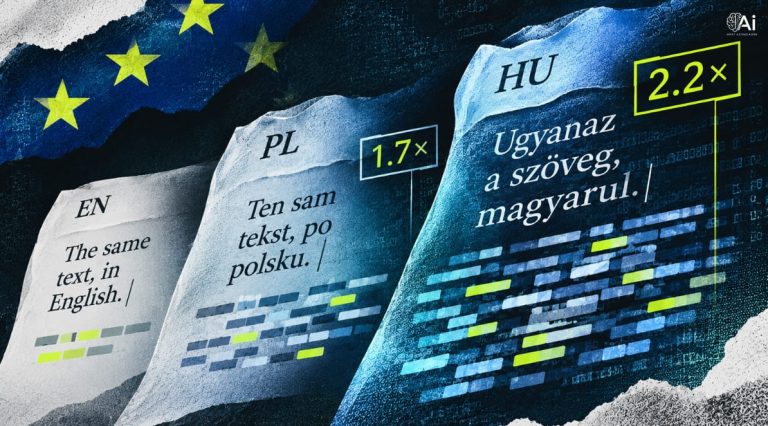

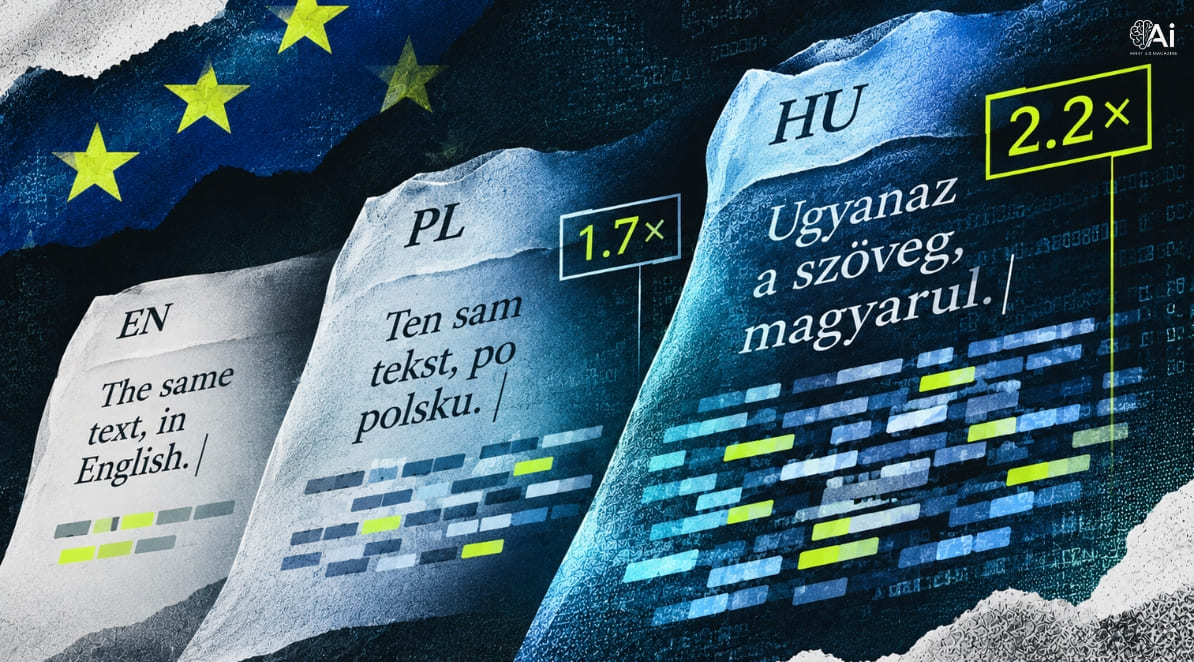
The AI language tax is the extra cost of using AI in a language other than English. In our test of nine models, Hungarian needed 2.2 times as many tokens as English for the same text, and Polish 1.7 times.
At a glance
The AI language tax
Tokens needed for the same text as in English, average of 9 AI models, November 2026
- Why
- Tokenisers split words in most languages into more pieces than English words
- Text length
- The Hungarian text had 15% more characters than the English and fewer words
- Lowest tax
- Meta’s Muse Spark Open, 1.38× on average
- Highest tax
- Moonshot AI’s Kimi K3.1 Pro, 1.95× on average
- Trend
- For Hungarian on OpenAI models, down from 3.3× with GPT-3 to 2.2× with GPT-4o in 2024, flat since
What Is the AI Language Tax?
Models read and write in tokens, small chunks of text, and companies charge per token. A tokeniser that splits a language into more, smaller pieces makes the same message cost more.
Oxford researchers found in 2023 that one text can take up to 15 times more tokens in some languages than in others. They warned that this makes AI more expensive and slower for those speakers, and lets them fit less text into a model.
A University of Washington-led team tested OpenAI’s API in 22 languages the same year. It concluded that speakers of many languages were overcharged while getting poorer results. We measured how big the tax is today for eight European languages, with the same text and nine current models.
How Much More Does AI Cost in European Languages?
Between about a third more and more than double. Hungarian needed 2.18 times as many tokens as English on average, Polish 1.73 times and Spanish, the cheapest of our eight, 1.32 times.
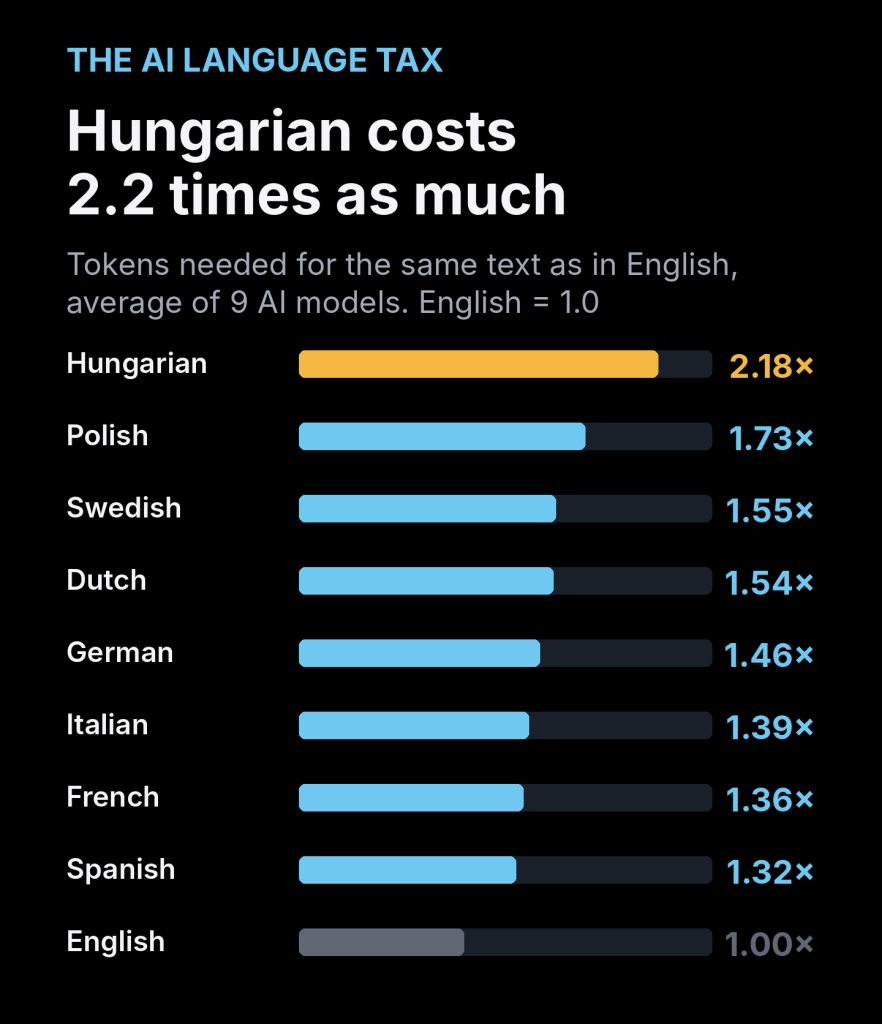
| Language | Tokens vs English | Range across 9 models |
|---|---|---|
| Hungarian | 2.18× | 1.78× to 2.64× |
| Polish | 1.73× | 1.40× to 2.29× |
| Swedish | 1.55× | 1.40× to 1.82× |
| Dutch | 1.54× | 1.29× to 1.85× |
| German | 1.46× | 1.28× to 1.87× |
| Italian | 1.39× | 1.16× to 1.79× |
| French | 1.36× | 1.22× to 1.69× |
| Spanish | 1.32× | 1.20× to 1.64× |
Every model in our test charges per token. So €1,000 spent on English text becomes about €2,180 in Hungarian, €1,730 in Polish and €1,320 in Spanish.
The tax costs time and memory too. Models write one token at a time, so a Hungarian answer takes about twice as many steps to generate as the same answer in English. On average, a model’s context window, the text it can consider at once, holds a little under half as much Hungarian as English.
Why Does Hungarian Cost So Much?
Length explains little. Our Hungarian version had 543 words against 587 in English and only 15% more characters, yet it needed 2.2 times the tokens.
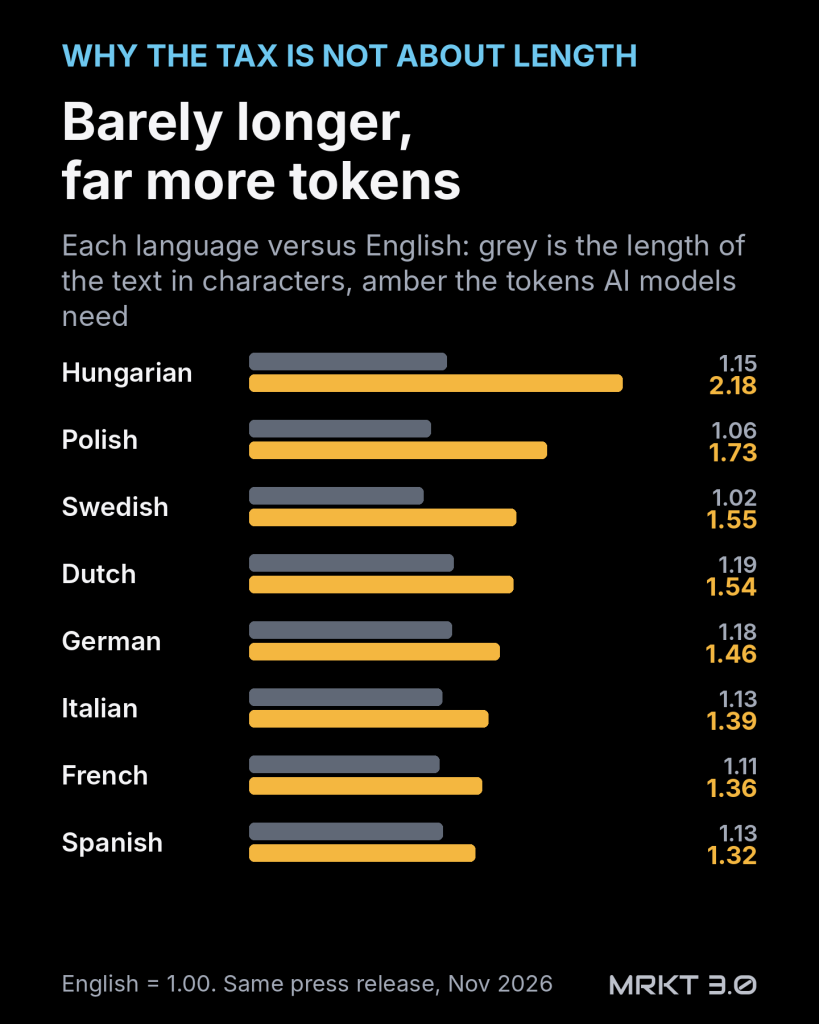
The reason is how Hungarian builds words. It is a highly agglutinative language, which stacks suffixes onto a stem, and its nouns can take 18 case endings. One long word does the work of several English ones, and tokenisers rarely store such words whole.
Take “a Büntetőbíróságnak”, Hungarian for “to the Criminal Court”. The tokeniser OpenAI has used since GPT-4o cuts it into 11 pieces, while the English takes four. Across the whole text, it used 1.2 tokens per English word and 2.9 per Hungarian word.
Polish, second at 1.73 times, also adds endings to its nouns, for seven cases. By contrast, Spanish and French sat closest to English, at 1.32 and 1.36 times.
Which AI Model Has the Lowest Language Tax?
Meta’s Muse Spark Open, with an average of 1.38 times across the eight languages. Moonshot AI’s Kimi K3.1 Pro had the highest, at 1.95 times, and needed 2.64 times as many tokens for Hungarian as for English.
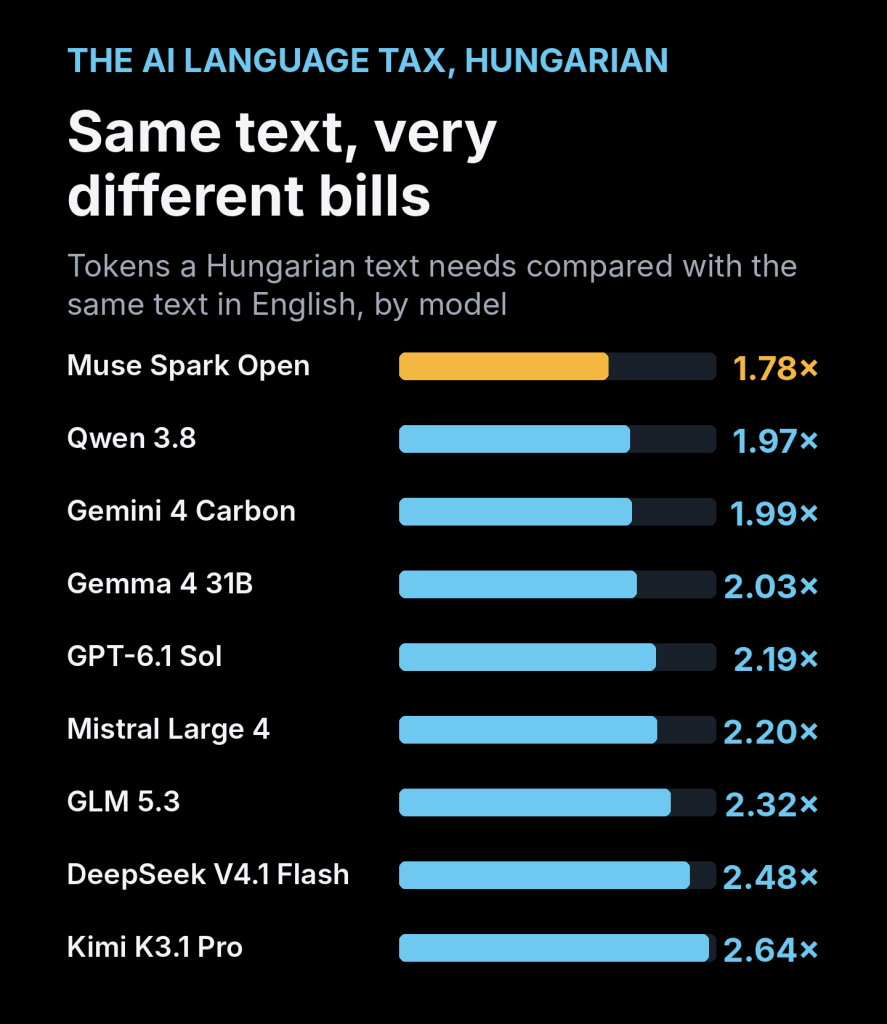
| Model | Average | Hungarian | Polish |
|---|---|---|---|
| Muse Spark Open | 1.38× | 1.78× | 1.40× |
| Gemini 4 Carbon | 1.45× | 1.99× | 1.46× |
| Qwen 3.8 | 1.46× | 1.97× | 1.58× |
| Gemma 4 31B | 1.48× | 2.03× | 1.56× |
| Mistral Large 4 | 1.48× | 2.20× | 1.95× |
| GPT-6.1 Sol | 1.51× | 2.19× | 1.75× |
| GLM 5.3 | 1.68× | 2.32× | 1.85× |
| DeepSeek V4.1 Flash | 1.71× | 2.48× | 1.77× |
| Kimi K3.1 Pro | 1.95× | 2.64× | 2.29× |
Kimi, DeepSeek V4.1 Flash and GLM 5.3, three of the four Chinese models in our test, had the highest averages. Qwen 3.8, the fourth, had the third-lowest average, at 1.46 times. Our map of Chinese LLMs covers who makes each of them.
The tax changes which model is cheapest. In other words, a model that needs more tokens has to charge less per token to cost the same. On Hungarian text, Kimi would have to be about a third cheaper per token than Muse Spark Open just to break even.
Is the AI Language Tax Getting Smaller?
At OpenAI it was, until 2024. We ran our texts through the tokenisers of older OpenAI models, which the company publishes in its tiktoken library. The Hungarian tax fell from 3.28 times with GPT-3 in 2020 to 2.69 with GPT-4 in 2023 and 2.19 with GPT-4o in 2024.
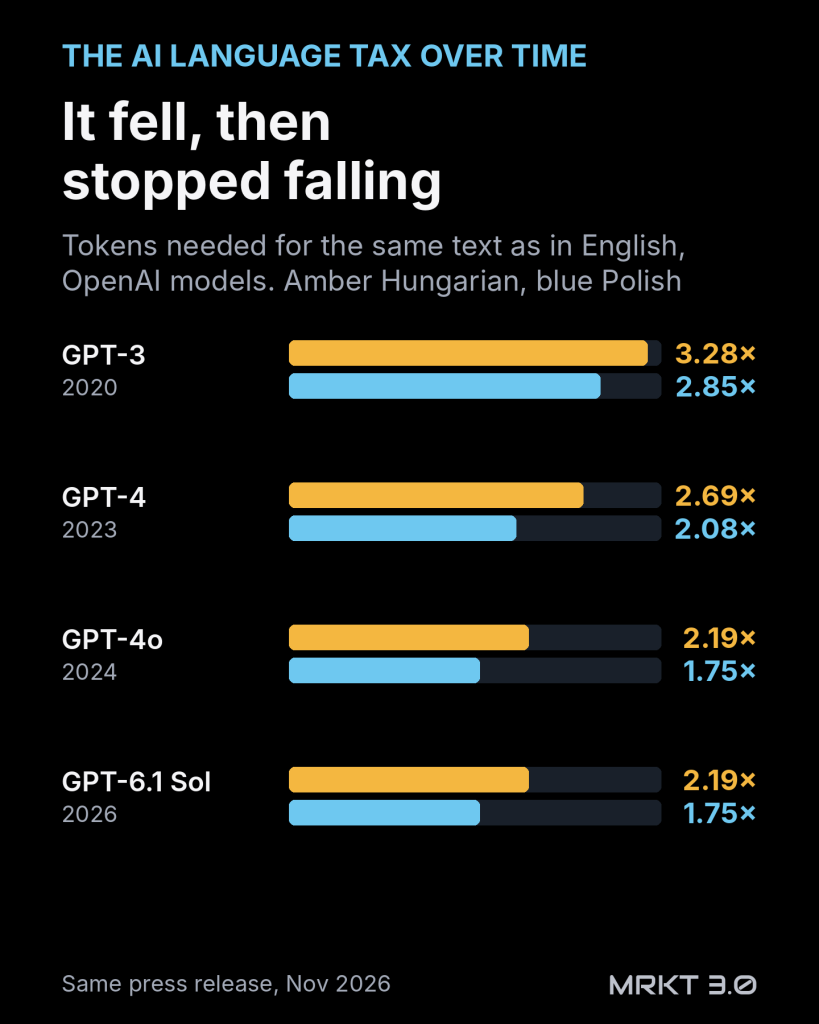
| Model (year) | Hungarian | Polish | Average of 8 |
|---|---|---|---|
| GPT-3 (2020) | 3.28× | 2.85× | 2.29× |
| GPT-4 (2023) | 2.69× | 2.08× | 1.86× |
| GPT-4o (2024) | 2.19× | 1.75× | 1.51× |
| GPT-6.1 Sol (2026) | 2.19× | 1.75× | 1.51× |
OpenAI said in May 2024 that GPT-4o’s new tokeniser used fewer tokens in 20 languages it chose as examples, from Gujarati to English. Hungarian and Polish were not on that list, yet both gained. Polish fell from 2.85 times with GPT-3 to 1.75.
Since then, it has stayed put. GPT-6.1 Sol needed exactly as many tokens as GPT-4o’s tokeniser for all 17 of our texts. OpenAI’s library also lists GPT-4.1 and GPT-5 under the same tokeniser.
Model makers point to tokenisers trained on more languages, often with bigger vocabularies. Mistral’s Tekken tokeniser, launched in July 2024, was trained on more than 100 languages. By Mistral’s own measure, it beat Llama 3’s similar-sized tokeniser in about 85% of all languages.
The EuroLLM team settled on a vocabulary of 128,000 tokens and found it needed noticeably fewer tokens per word than Mistral’s older 32,000-token one. Prelude, the first model of the EU-funded OpenEuroLLM project, uses more than 262,000.
We could not count EuroLLM or Prelude through the same API, so their tax is not in our table. Both appear on our map of European LLMs.
Does a Higher Language Tax Mean Worse Answers?
Among models, no. Kimi K3.1 Pro had the highest tax yet was the third-best writer in our European languages test. Mistral Large 4 sat mid-table on tax, at 1.48 times, and had the lowest writing score.
Among languages, the two went together. Hungarian, the most expensive language, got the lowest writing scores, and Polish the second lowest. The order of the eight languages by tax was almost the reverse of their order by writing score. The spread was modest, though, from 84.4 for Hungarian to 89.7 for Spanish.
That does not prove that tokens cause weaker writing. Both may reflect how little Hungarian and Polish text the models saw in training. Still, it matches the 2023 finding that speakers of costlier languages also get poorer results.
What Can European Companies Do About the Language Tax?
Test in your own language before choosing a model. Two models with the same price per token can send very different bills for Hungarian or Polish text. So compare them on the cost of a real task.
Our data file gives the multiplier for every model and language. For a quick comparison, multiply a model’s price per input token by its multiplier in your language. That works because the models’ English counts were within 4% of each other.
Seven of the nine models in our test have open weights, and the best open-source LLMs can run on a company’s own servers. There the tax shows up as more computing time, slower answers and less room in the context window.
How Did We Measure the Language Tax?
We sent the same text in each language to each model through OpenRouter, which counts input tokens with each model’s own tokeniser. Then we subtracted the fixed tokens each chat request adds, from 6 to 144 depending on the model, and divided by the English count.
The text was a European Parliament press release on the Sakharov Prize from October 22, 2026. For the eight languages we used the best machine translation from our test, which follows the English sentence by sentence.
The Parliament’s own versions, which are edited for local readers, gave a similar picture, with Hungarian at 2.09 times and Polish at 1.78. After removing its six-token overhead, GPT-6.1 Sol’s counts matched OpenAI’s published tokeniser to the token for all 17 texts, which supports the method.
Author: Akos Szima
See Also:
Which AI Is Best at European Languages? We Tested 9 Models in 8 Languages
What Is OpenEuroLLM? Europe’s €37m Open-Source AI Project and Its Unfinished First Model
European LLMs in 2026: The Complete Map
How We Checked This:
All API counts were taken on November 11, 2026, from each provider’s usage figures. We measured the chat overhead with a one-character message, minus that character’s token. The parallel texts are GPT-6.1 Sol’s translations, which our blind judge rated best, except Polish, where DeepSeek V4.1 Flash’s was best. Counts that came back as zero were taken again. Older OpenAI tokenisers were counted offline with js-tiktoken, a port of OpenAI’s tiktoken, using the r50k_base, cl100k_base and o200k_base encodings. The ratio covers input tokens. Download every count, with sources (CSV).
Change log: November 12, 2026, first published.
Frequently Asked Questions:
A token is a small chunk of text, often part of a word, that an AI model reads and writes. Companies charge per token, and a model’s context window is measured in tokens.
Tokenisers split most other languages into more pieces than English, so the same message uses more tokens and costs more. In our test Hungarian needed 2.2 times as many tokens as English.
Hungarian was the most expensive of the eight European languages we tested, at 2.18 times English, followed by Polish at 1.73. Spanish was the cheapest, at 1.32.
This test was designed and run by MRKT 3.0. MRKT 3.0 has no commercial relationship with any of the model makers.