
Reported from Deep Tech Momentum 2026, Wilhelm Studios, Berlin.
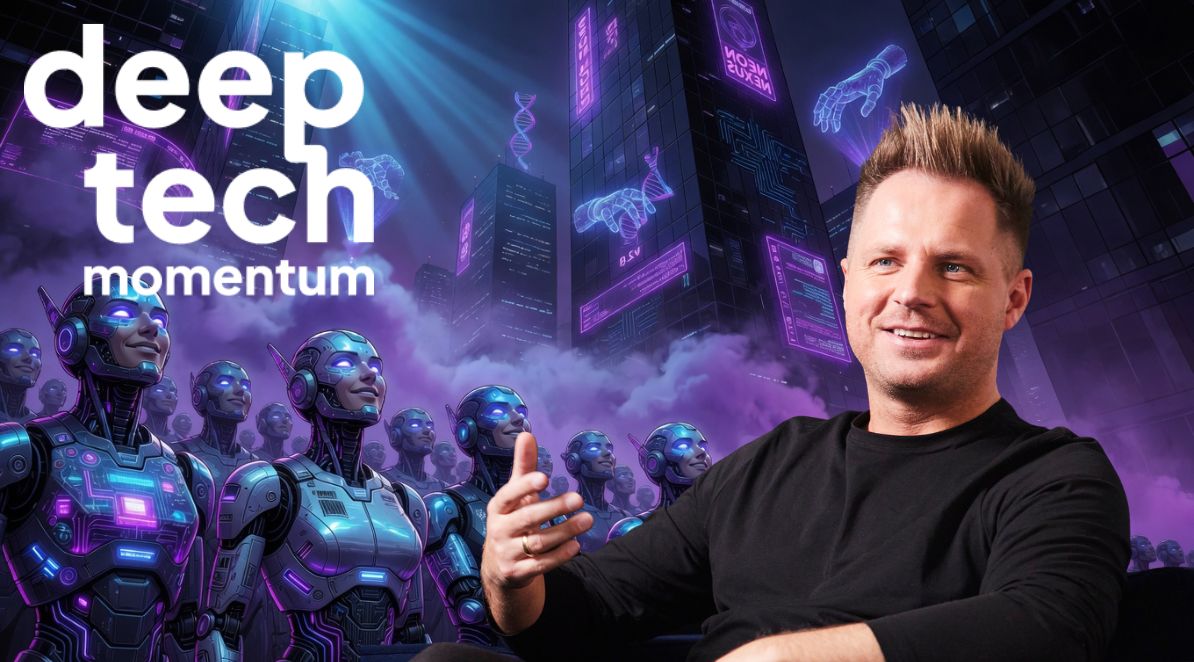
By midday on Day 2 of Deep Tech Momentum 2026 (DTM), the main stage was packed for the “Titans of Europe” session. Day 1 had opened with the DTM CEO Martin Schilling’s opening address and Germany’s Federal Minister Karsten Wildberger’s fireside chat on digitalization.
Day 2 shifted the focus to hardware and execution. David Reger, founder and CEO of NEURA Robotics, took the floor.NEURA is Germany’s largest humanoid robotics company. The firm raised €120 million in Series B funding and recently announced a strategic partnership with Amazon Web Services as its primary cloud provider for the Neuraverse platform.
Among the topics Reger covered was Europe’s looming workforce gap. By 2030, the continent will have a shortage of 7 million workers. He explained his solution, and why Europe can’t just watch others solve it.
You Don’t Learn By Watching
In the session, Reger challenged the audience:
“Do you think you can watch videos for one year of swimmers … and then be a swimmer afterwards? If you say yes, then you’re probably not a swimmer.”
He continued: “You can’t learn swimming by somebody telling you how to swim.”
Reger explained that swimming requires real-world repetition. It demands building muscle memory, training the nervous system and reflexes, feeling water resistance, and coordinating breathing. You have to get in the water, try, fail, adjust, and repeat.
This idea links to NEURA’s core thesis. Most robotics companies focus on visual language action models trained on millions of videos. Reger is clear:
“The big differentiator from NEURA to the most players worldwide, is simply that we do not believe in visual language action models. We do not think that the visual language action models are actually a physical AI, it’s just a small piece of a physical AI brain.”
True physical tasks need proprioception, force feedback, and tactile sensing. That’s why NEURA builds robots that can adjust based on what they feel, not just what they see.
NEURA’s Infrastructure Bet
In March 2026, NEURA and the Technical University of Munich announced the TUM RoboGym. This is a €17 million, 2,300-square-meter facility at Munich Airport. Opening mid-2026, it will host hundreds of humanoid robots training under real-world conditions.
Companies can remote-control robots, demonstrate tasks, and train AI models. Reger claims even complicated tasks could take only “three to four hours.”
The data from these training sessions flows into NEURA’s Neuraverse platform. Companies can choose to keep their training data proprietary (and pay for that privacy) or share it with the broader ecosystem for free access. Reger believes most will protect their core know-how while still benefiting from a stronger, shared foundation model.
Europe’s 7 Million Worker Gap
“In 2030 we will have about 7 million less human labor just here in Europe,” Reger said. China will lose more than 80 million workers. Japan around another 7 million.
He explained “this is a problem we can only solve not just by using AI, but actually somehow making AI physical.”
These demographic warnings sit within a much larger global picture. According to Korn Ferry’s widely referenced global talent study, the world could face a shortage of over 85 million skilled workers by 2030 – equivalent to the entire population of Germany. Many analysts believe these numbers could even be on the lower side.
Even the most basic tasks take companies a significant amount of time to onboard a human worker. Tasks with quality or know-how dependencies can take weeks or months. Robots that can learn physical skills in just hours dramatically flip the economics.
Europe’s Test
Reger’s message was loud and clear. Europe can’t learn Physical AI by watching others. At some point, you have to jump in.
“Physical AI is actually the most important step in humanity,” Reger said.
Germany is betting its industrial strengths (precision, safety, and real production environments) will win. The AWS partnership and growing momentum suggest the bet is gaining traction. The next two years will show if superior engineering beats cost and hype.
This session fits the DTM26 conversation on turning Europe’s deep tech strengths into real commercial outcomes. As we’ve covered in pieces on AI sovereignty and execution gaps, the technology is here, but now it’s about speed.
Follow MRKT 3.0’s coverage of DTM26 throughout the two days.

See Also:
Europe’s Deep Tech Reality Check Starts in Berlin
Is Tesla Overhyped? Enter NEURA Robotics, Europe’s AI Robot Challenger
China Controls 90% of the Robot Market. Their Robots Can’t Walk.