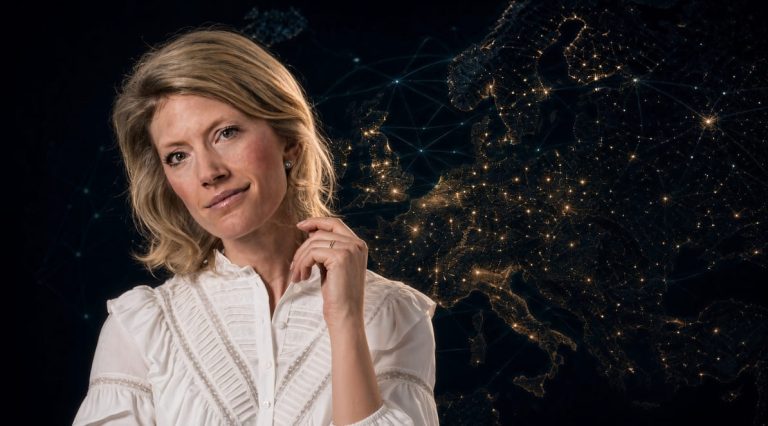

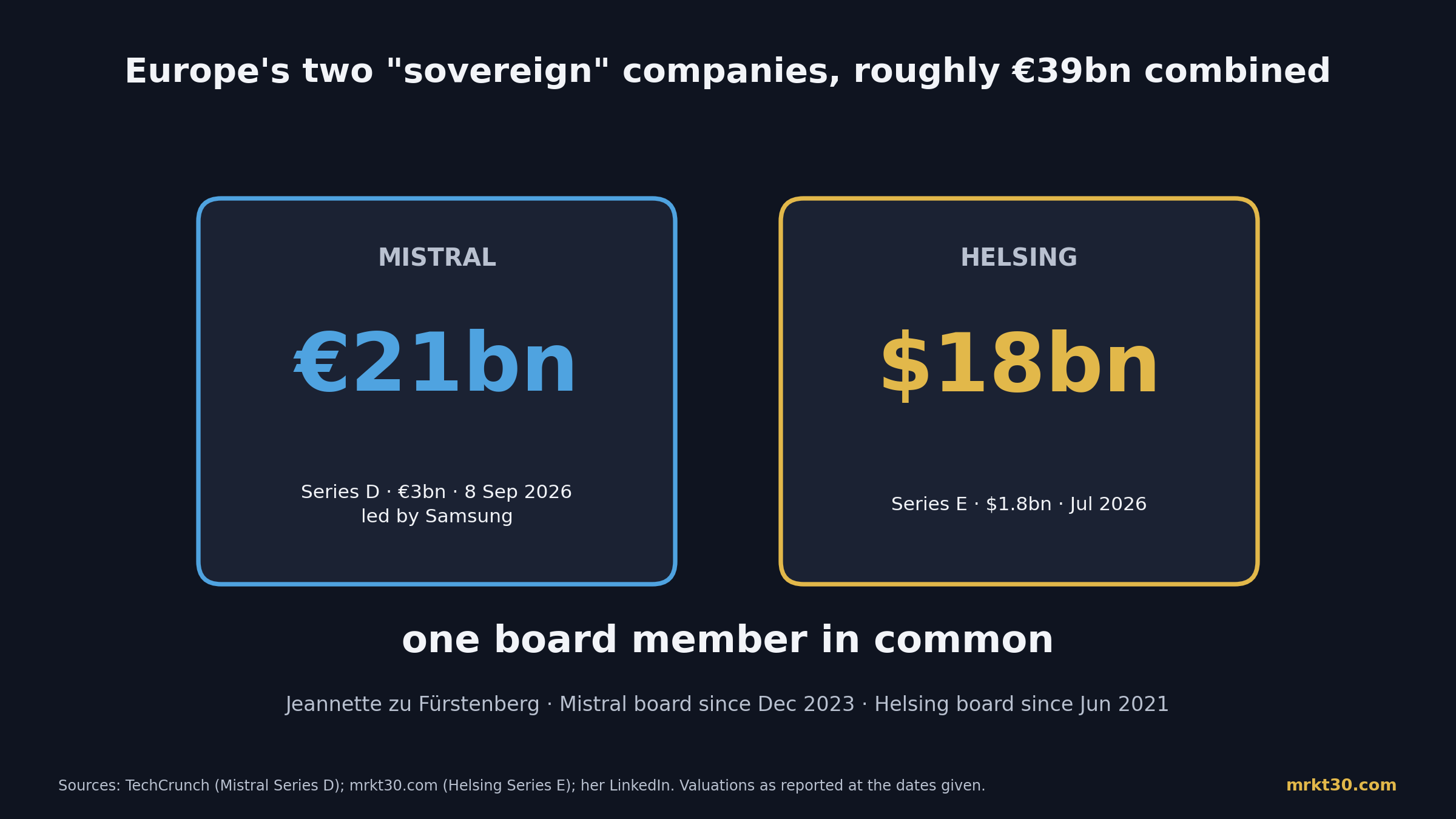
On September 8 Mistral closed a €3 billion Series D at a €21 billion post-money valuation, led by Samsung. In July, Helsing raised $1.8 billion (roughly €1.55 billion). When Europe says the word “sovereignty” it normally points at those two companies. On the boards that have been made public, they have one director in common: Jeannette zu Fürstenberg.
This is the third profile in our series on the investors behind Europe’s AI and defence wave. We began with Shaun Maguire, and continued with Luciana Lixandru. Fürstenberg is now adding to that list. What makes her profile even more interesting is that she also puts her name on the policy papers that argue for the budgets and rules those companies need as customers.
Jeannette zu Fürstenberg’s Summer of 2026
Fürstenberg’s summer 2026 had four acts.
In July, Helsing’s round, which she marked with a post: “we met in 2021, when defense was still a word most VCs avoided in a pitch meeting.”
In early July France made her a Chevalier de l’Ordre national du Mérite. “I sometimes say: my passport is German, but my heart is French.”
In August, General Catalyst and Andreessen Horowitz co-led a $10.75 million seed round into EON, a California startup building an optical backbone in orbit. “Those choices get made now, or they get made for us,” she wrote.
And then, in September, Mistral. On the day the round closed she posted: “AI is becoming strategic infrastructure and an increasingly important source of geopolitical power.”
By then she was already operating under a new title. Bloomberg reported in February that General Catalyst had made her President in January with Hemant Taneja remaining as chief executive. The Mistral post was the first time the new job and the old thesis landed on the same day: AI as infrastructure, and her name on both sides of the table.
How Did a Renaissance Scholar End Up Running Europe for General Catalyst?
Fürstenberg was born in 1982 into a German industrial family, studied at LMU Munich and ESCP in Paris, and wrote a doctorate at the Free University of Berlin on the relationship between entrepreneurship and art in the Renaissance. Her first employers were Ernst & Young and AXA.
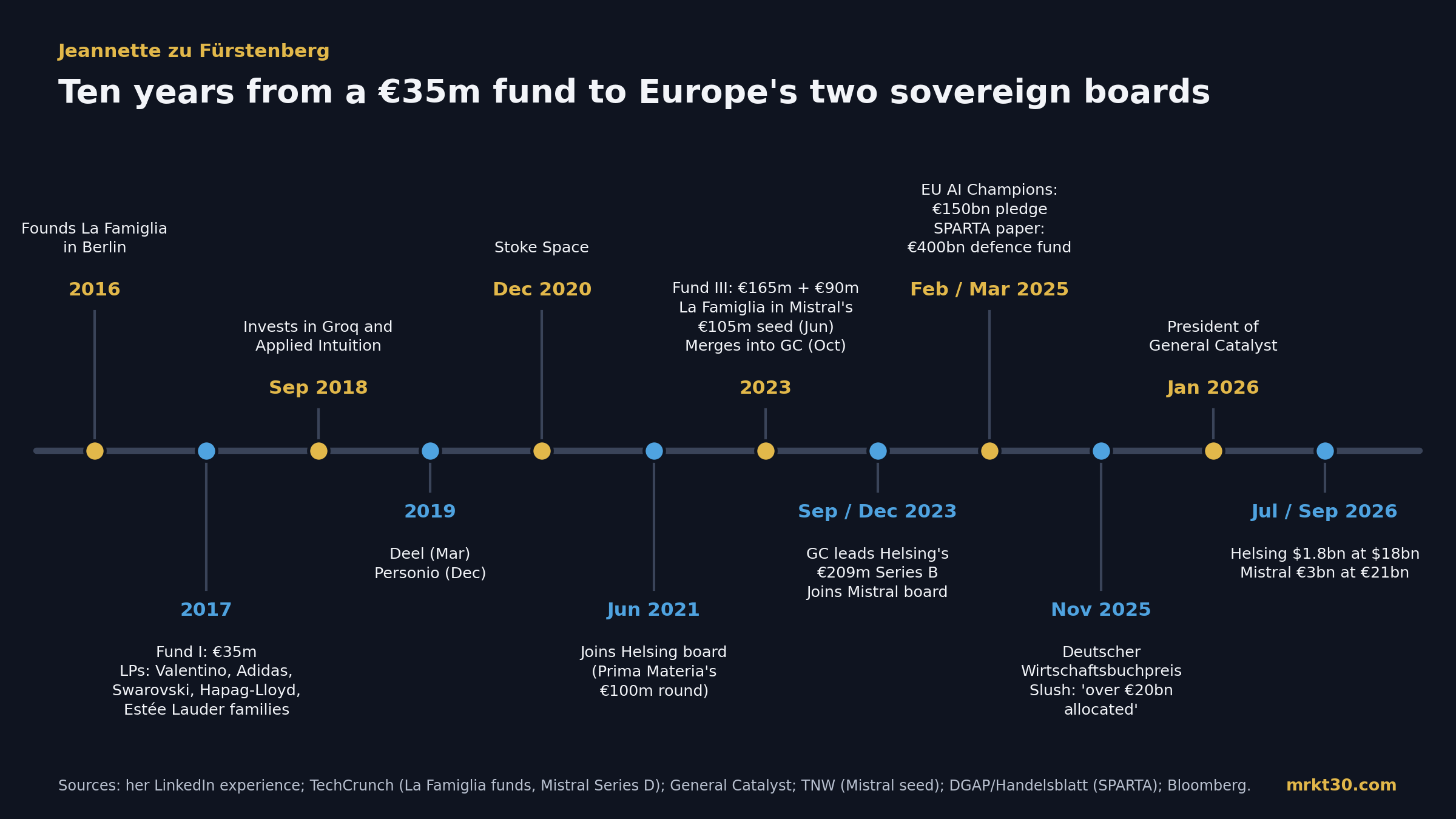
The doctorate is the key to everything that followed. The Renaissance she studied was a patronage economy: families with money financing builders with ambition. In 2016 she founded La Famiglia in Berlin on the same model (some German bios date the firm to 2014; the first fund closed in 2017). Its first fund, closed in 2017, was €35 million, and the limited partners were the family offices behind Valentino, Adidas, Swarovski and Hapag-Lloyd.
In 2025 she published the argument as a book with the journalist Inge Kloepfer. The German edition is called “Wie gut wir sind, zeigt sich in Krisenzeiten“, with the English edition being named “Europe’s New Renaissance“. It won the Deutscher Wirtschaftsbuchpreis, Germany’s business book of the year.
La Famiglia merged into General Catalyst in October 2023, months after closing a €165 million third fund, because, in her account, the larger firm could “activate true leverage points required to change the trajectory of the continent.”
What Did La Famiglia Actually Back?
Her LinkedIn experience rewards reading in date order. September 2018: Groq and Applied Intuition, both American. March 2019: Deel. December 2019: Personio. December 2020: Stoke Space. June 2021: the Helsing board. June 2023: Mistral’s seed round, where La Famiglia is named alongside Lightspeed, Xavier Niel and Eric Schmidt.
Read that way, the pattern is not “European B2B software,” which is how the firm described itself. It is infrastructure with a physical or geopolitical edge, chosen years before the market agreed.
How Did General Catalyst Get Into Helsing and Mistral So Early?
Helsing’s first large cheque, about €100 million in 2021, came from Spotify founder Daniel Ek’s Prima Materia. Her board seat dates from June of that year. General Catalyst led the €209 million Series B in September 2023 and cited her “deep connectivity to the European defense and industrial ecosystem” as a strategic asset. She sits on that board with Ek, former Airbus chief executive Tom Enders and former NATO commander Denis Mercier.
Mistral came through the same door. “Looking at this photo takes me back to a conversation I had with Arthur Mensch more than three years ago, before we backed Mistral at Seed,” she wrote on 8 September. She has sat on its board since December 2023.
General Catalyst says it has deployed more than $1.8 billion in Europe in its current fund cycle. Her list since the merger includes Black Forest Labs, Hypersonica, ICEYE and Legora.
How Does Jeannette zu Fürstenberg Choose Founders?
In a post, Fürstenberg explained that “spending time with exceptional founders is among the greatest privileges in this business.” She continued that what sets these founders apart from others is “their ability to unveil hidden truths and see possibilities where others see only constraints. The most remarkable founders don’t just understand the current reality; they envision a fundamentally different one.”
For a founder walking into her office, the screen is not the market slide. It is whether the person has already decided what the world should look like, and whether they will still be standing after the first version fails. “Every founder I admire begins with an act of imagination.”
Is She a Venture Capitalist or a Policymaker?
This is the section that separates her from every other investor in this series. In February 2025, at the AI Action Summit in Paris, General Catalyst launched the EU AI Champions Initiative at the Élysée. More than 20 capital allocators said they stood ready to deploy €150 billion into European AI over five years. A separate group of more than 60 companies (including Deutsche Bank, Helsing, Mistral and Spotify) signed the alliance.
Three weeks later, on 4 March 2025, she put her name to a defence position paper called SPARTA alongside Tom Enders, René Obermann and Moritz Schularick, president of the Kiel Institute. It called for a large, multi-year defence effort steered toward new technology rather than legacy platforms. Two weeks later, on 18 March 2025, the Bundestag voted to exempt defence spending above 1 percent of GDP from the debt brake and to create a €500 billion infrastructure fund. The SPARTA paper sat inside that debate, but it did not write the bill.
On regulation she is blunter. The headline of her Neue Zürcher Zeitung interview reads, in translation: “it is absurd to confront young companies with almost 1,000 pages of regulation.”
What Does Europe’s New Renaissance Actually Mean?
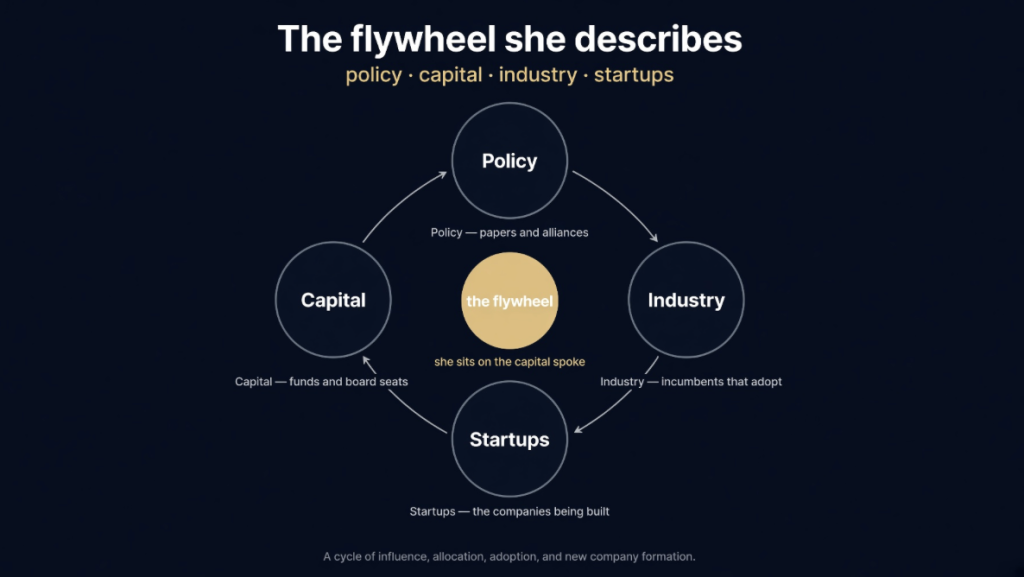
Strip the branding away and her thesis has three parts, all said out loud. First, that AI is a transformative rather than a disruptive technology, unlocking value through distribution and proprietary data, which Europe’s industrial leaders hold. Second, that the labour arithmetic favours Europe: “Think about all sorts of industries where essentially labor gets melted into compute.” Third, that none of it happens without what she calls a flywheel between “policy,” “capital providers,” “industry” and “startups.”
It is a coherent argument. It is also a business model. The flywheel she describes has General Catalyst at its hub.
Open Verdict
Searches for her name have been rising since the January promotion. The two companies she is most identified with have just raised the money to attempt what she wrote on 8 September that they must: “Europe cannot assume it will have a meaningful place in this technology stack simply because it has world-class research, industrial companies and talent. It has to build that place.”
The Renaissance she named her book after was financed by families who expected the cathedrals to be finished. Whether this one gets built, and whether the patron’s returns and the continent’s interest turn out to be the same thing, is the open question. Her own answer, from the Mistral post: “the bar is much higher today than it was three years ago.”
Author: Ákos Szima
See Also:
Who is Shaun Maguire? The Elon Musk Whisperer
Who Is Luciana Lixandru? Sequoia’s First Partner in Europe
Which VCs Are Actually Backing European AI in 2026?
How We Chose:
Other than the Forbes Midas List, which highlights individuals, several rankings assess the firms themselves: CB Insights’ Smart Money report, PitchBook’s ranking of venture firms by outcomes, and the Strebulaev-Jackson Venture Ranking. We use all of them, then weight towards investors who hold board seats at Europe’s defining AI and defence companies and have the least existing coverage relative to their influence.
This article draws on public interviews, the subject’s own LinkedIn posts, conference recordings and reported funding data; valuations are as reported at the dates given and change. Nothing here is investment advice.
Frequently Asked Questions
A German venture investor who founded La Famiglia in Berlin in 2016, merged it into General Catalyst in October 2023 and, according to Bloomberg, became the firm’s President in January 2026. She sits on the boards of Mistral and Helsing.
Her listed investments include Helsing, Mistral, Deel, Personio, Black Forest Labs, Legora, ICEYE, Hypersonica, Groq, Applied Intuition, Stoke Space, Ramp and EON.
A General Catalyst-led alliance launched in Paris in February 2025 with a €150 billion, five-year investment pledge from 20 backers, calling for lighter AI regulation and faster adoption of European AI by large European companies.
No. Hemant Taneja is General Catalyst’s chief executive. She is President and Managing Director and led the firm’s European business after the La Famiglia merger.