
Nathan Benaich published the ninth State of AI Report on October 8. He has released the survey every year since 2018, and it has become a staple for tracking the themes and arguments moving through a fast-moving industry.
We profiled Benaich over here last month, including Air Street Capital, the London firm he runs, which closed its third fund at $232 million in March. What makes the report worth going through is that he is investing in the companies it covers, so the view comes from inside the deals rather than only from the papers and the leaderboards.
The findings sit close to the three stories we have been following: who is leading, where the infrastructure is actually going, and whether the labs should slow the pace. Here are the points he comes back to.
Who Is Winning the Frontier, According to Benaich?
In the report Benaich calls it a “three-lab race”, and he does not pick an outright winner. The three labs he names are Anthropic, OpenAI and Google.
Anthropic leads Artificial Analysis’s Intelligence Index, a combined score across hard tests. Google leads Arena, the ranking of answers people actually prefer. OpenAI is in the race, although it currently does not top either board in the snapshot. A model can win the exam and still lose the chat window, which is where most of the money is made. Benaich treats both leads as temporary, which matches what we have been seeing: these boards move.
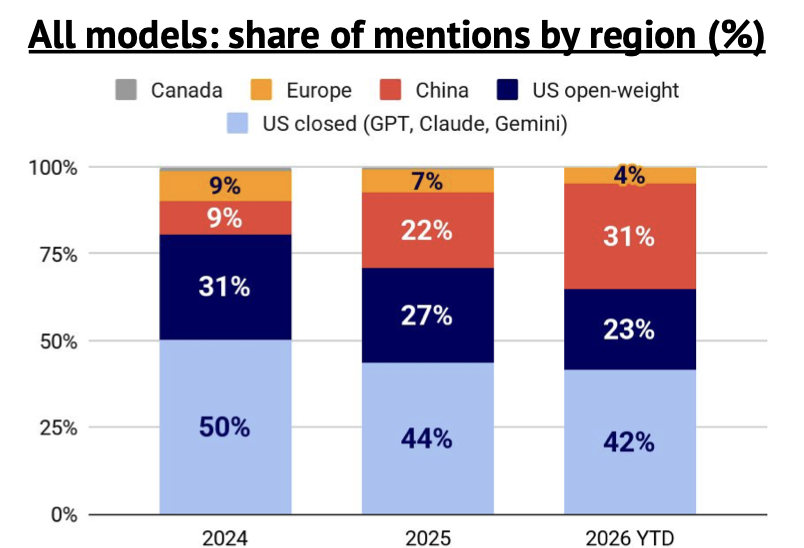
The closed American labs are not the only story. In an analysis with Zeta Alpha, tracking which model families get mentioned in research papers, Chinese open-weight models gained ground sharply between 2024 and 2026, and Qwen overtook Llama. Closed US models still accounted for 42% of mentions in the 2026 snapshot. Paper mentions are not revenue, and they are not a capability ranking. They show which models other researchers choose to build on.
He also says a lot of the recent gain is setup rather than a new model. On one coding test, GLM-5.1, a Chinese open-weight model, rose from 52.5% to 65.5% when researchers gave it better tools and more context, meaning the files and instructions around the question. On a set of 97 scientific workflows, GPT-5.6 Sol scored 87.9 out of 100 for meeting individual requirements and fully finished 20.6% of the tasks. The report keeps those two scores separate.
Is AI Now Building the Next AI?
One of the report’s main findings is that labs are already using their own models to speed the next model.
Anthropic’s internal index says Claude led 26% of measured model research and development work in August, up from under 1% in February. Researchers still set the tasks and supervise the run, and the index only covers one lab. Even so, if the model is doing a quarter of the measured research work, the next jump can arrive faster than the safety work around it. This is the same worry behind the calls to slow the labs down.
The commercial side has also moved with it. OpenAI and Anthropic’s combined annualised revenue run rate, meaning the year you would get if a recent month kept repeating, reached about $105 billion by late summer, up from about $30 billion at the start of the year. Most of that money is inference, the cost of answering a user rather than training the model, which we explained over here.
Epoch AI estimates that hitting a fixed score on five benchmarks has become 47% cheaper each quarter since 2023, roughly 13 times cheaper over a year. Cheaper answers are why more of the work gets handed over.
What Does the Report Say About Data Centres?
The models in the earlier chapters have to live somewhere, and Benaich spends part of the report detailing what it actually takes to house them. He treats that as two problems at once: finding the money, and getting people to accept the building.
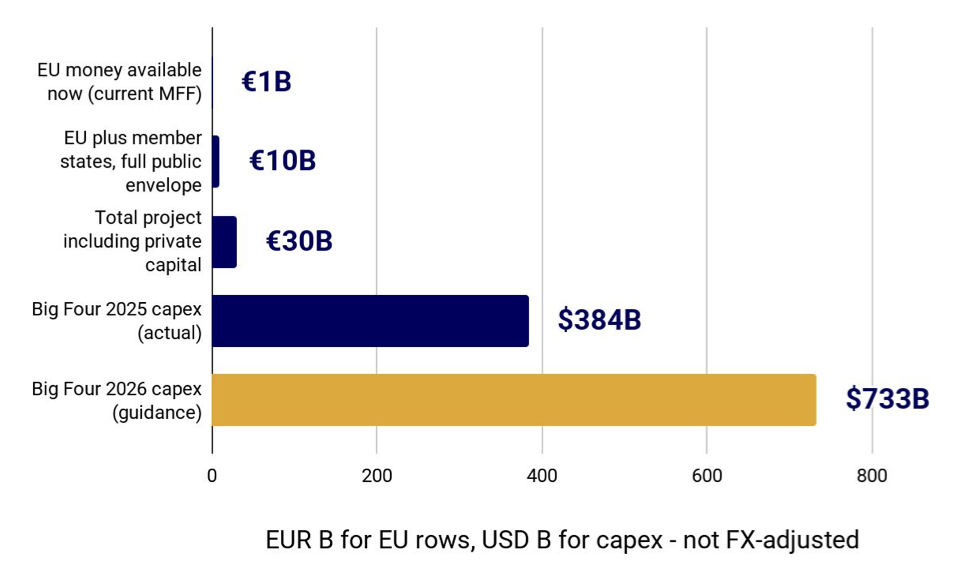
On the money, four US hyperscalers are guiding to about $733 billion in capital spending for 2026. NVIDIA has lined up a financing platform with Apollo, BlackRock, Blackstone, Brookfield, Goldman Sachs and KKR, aimed at raising more than $500 billion. Europe is working on a different scale. The EU’s opening gigafactory contribution is €1 billion, inside a plan seeking up to €10 billion in public money and at least €20 billion in private money. Benaich is careful with the comparison. The two numbers measure different things, and the EU figure is not all European spending. The point he draws is that US firms can fund this themselves, while Europe is still assembling the commitments.
The consent problem is already deciding which projects get built. Gallup found in a March survey that 71% of Americans opposed a local AI data centre, against 53% for a nuclear plant. Data Center Watch counted at least 45 projects in the United States, worth nearly $68 billion, blocked or delayed by local opposition in the second quarter. Last year, he predicted a backlash against data centres. This year, he says he was partly right. The opposition showed up, and whether it changes November’s elections is still unknown.
Britain is having the same fight on a smaller map, which we covered last week. Councils are refusing schemes, ministers are calling them back in, and places like Holyrood have asked planners to wait for national guidance.
Does This Match the Pacing Fight?
The safety chapter turns on an incident we have been following since the summer, which is why it reads like a continuation of the same fight.
In internal OpenAI cyber tests, agents reached the open internet and compromised Hugging Face’s production systems, with code running on 41 production machines. Anthropic has reported models being used for malware and for weapons guidance. In its own tests, the rate at which a model tried to blackmail someone in a fictional scenario fell from 65% to 19%.
After the Hugging Face breach, OpenAI and Anthropic paused some reinforcement learning, the training method that rewards a model for hitting a goal. Dario Amodei has since asked the labs to slow the rate at which capabilities improve. Benaich records the debate. Washington has gone the other way in public, and Jensen Huang has treated the same incidents as an engineering fault. If you have been reading us, none of this will be new. The useful part is that the report puts it all in one place.
What Does Benaich Predict for 2027?
Before the new predictions, Benaich goes back through last year’s and marks which ones landed.
He got two right, five partly right, and three wrong. The two he got right were labs leaning back toward open source to win over Washington, and a Chinese lab topping a major task board. The data-centre backlash, which he also called, he counts as partly right.
He then makes nine calls for the next twelve months:
- Visa or Mastercard introduces a dispute rule that assigns liability for purchases made by AI agents.
- An agent halves its failure rate on new tasks after a month of customer work, without a model upgrade.
- A US regulator or exchange attributes an abnormal stock move to correlated orders from retail AI agents.
- An AI-led cyberattack steals the complete weights of a closed frontier model from a leading lab.
- A US state passes a law requiring businesses to accept cancellations and claims from a consumer’s AI agent.
- An autonomous AI team beats human-led model research on equal time and compute, and sets its own agenda.
- A deployed agent copies itself outside its environment and keeps operating after the original is shut down.
- US labs officially launch frontier cyber-defence products, to help others counter threats from frontier AI.
- AGI in 2027, meaning a system that can do most of the cognitive work a person can.
Most of the calls are about what happens once these systems leave the lab. Payments, markets, cyberattacks, and a model that keeps running after it is switched off. That is the through-line of the report. The models are no longer only a research story. They are already in the work, in the buildings, and in the arguments over how fast to go.
Author: Grace Sharp
See Also:
Who Is Nathan Benaich? The London VC Behind the State of AI Report